
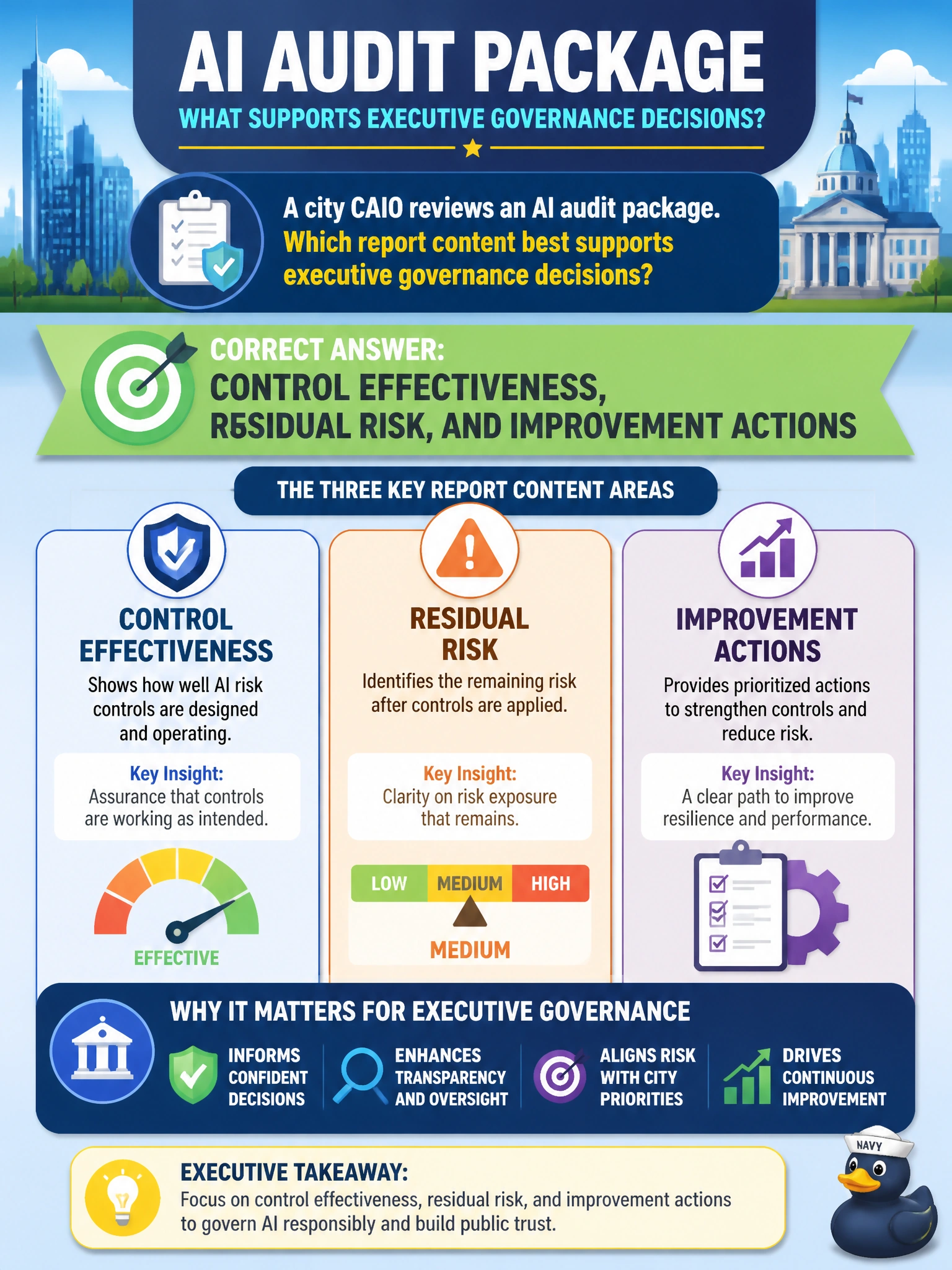
A city CAIO reviews an AI audit package. Which report content best supports executive governance decisions?
Select an answer to reveal the explanation.
Short Explanation
Busy executives need the bottom line: which controls work, what’s still risky, and what to fix next. That’s the audit story that drives decisions—not a dump of raw noise.
Full Explanation
A city CAIO reviewing an AI audit package needs executive-ready content: control effectiveness, residual risk, and improvement actions. That triad lets governance decide whether to continue operating a system, fund remediation, constrain use, or retire it. Civic executives cannot govern from forensic rawness or unrelated fieldwork trivia; they need a decision narrative tied to municipal risk appetite and resident impact.
Only raw packet captures with no summarized risk narrative overwhelm executives without answering whether controls work or what to fund next. A list of employee lunch preferences collected during fieldwork is noise that wastes attention and may create unnecessary privacy issues. Screenshots of dashboards without conclusions or next steps document appearance, not assurance outcomes or accountability for remediation.
Exam caveat: executive AI audit reporting in civic governance is decision-oriented—effectiveness, residual risk, actions—not forensic rawness or trivia. Operational check: require every audit package to include an executive summary with those three elements, map each improvement action to an owner and date, and reject packets that stop at screenshots or uninterpreted captures.