
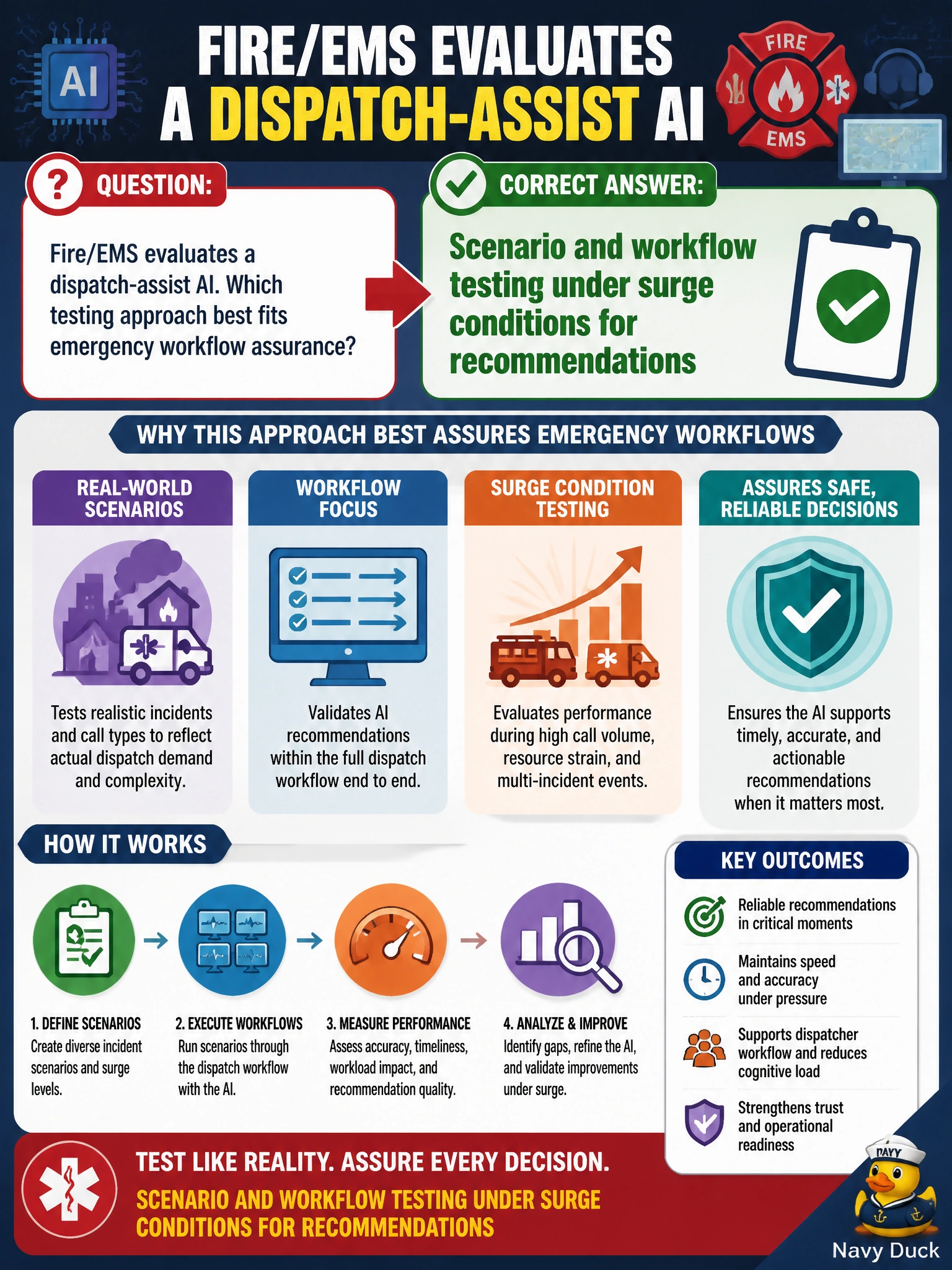
Fire/EMS evaluates a dispatch-assist AI. Which testing approach best fits emergency workflow assurance?
Select an answer to reveal the explanation.
Short Explanation
Dispatch help has to work when the board lights up. Run surge scenarios through the real workflow—not just a quiet lab login—so you know the assist still helps when it counts.
Full Explanation
Fire/EMS evaluating a dispatch-assist AI should use scenario and workflow testing under surge conditions for recommendations. Emergency assurance depends on whether the assist still helps when multiple calls, overlapping incidents, and stressed operators define the real workload—not on idle-hour convenience or login cosmetics in a quiet lab that never matches the board lighting up.
Testing only idle overnight hours with no surge or multi-call scenarios validates the wrong operating envelope and can miss latency, ranking, or cognitive-load failures that appear only under pressure. Relying solely on vendor accuracy claims without scenario exercises accepts marketing metrics in place of municipal workflow evidence. Checking only the login screen under quiet laboratory conditions proves authentication UI, not dispatch recommendation quality when seconds matter.
Exam caveat: emergency AI assurance is scenario- and workflow-centric under realistic load; lab calm and vendor slides are insufficient for life-safety adjacent tools. Operational check: script surge tabletop/tech exercises with multi-call feeds, measure recommendation usefulness and time-to-decision with dispatch staff, and require remediation of surge-only failures before production reliance.