
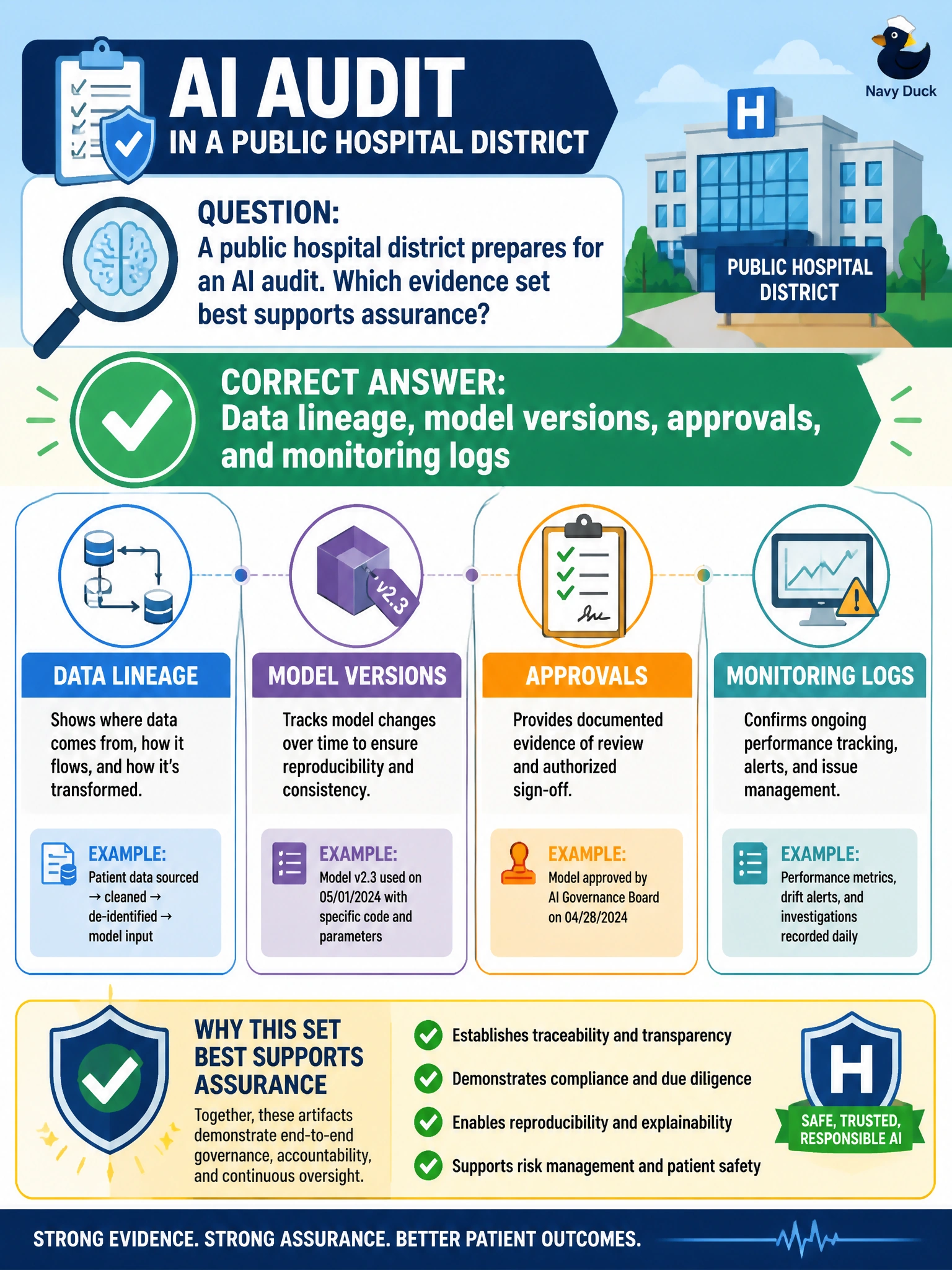
A public hospital district prepares for an AI audit. Which evidence set best supports assurance?
Select an answer to reveal the explanation.
Short Explanation
Auditors want a paper trail, not vibes. Keep lineage, model versions, approvals, and monitoring logs handy—like keeping pharmacy lot numbers when inspectors show up.
Full Explanation
A public hospital district preparing for an AI audit should present data lineage, model versions, approvals, and monitoring logs as the core evidence set. Those artifacts let auditors reconstruct what data trained or grounded the system, which model was live when, who authorized changes, and whether production health was watched—the foundation of civic AI assurance evidence in a healthcare-adjacent setting.
Only a screenshot of the chatbot welcome banner proves branding, not control effectiveness or clinical-adjacent governance. Verbal assurances from a vendor salesperson with no artifacts are hearsay and evaporate under audit scrutiny. Deleted logs to reduce storage costs before auditors arrive destroy evidence, create integrity red flags, and can violate retention obligations for healthcare-adjacent systems.
Exam caveat: AI audit readiness for civic healthcare entities rests on retained, linkable artifacts across data, models, approvals, and monitoring—not screenshots or sales talk. Operational check: inventory required evidence per system, verify retention periods cover the audit window, and perform a dry-run retrieval of lineage, version history, approval records, and recent monitoring logs before the auditors arrive.