
Courts gate a GenAI clerks’ tool into pre-prod. Which assurance test type best belongs in that gate?
Select an answer to reveal the explanation.
Short Explanation
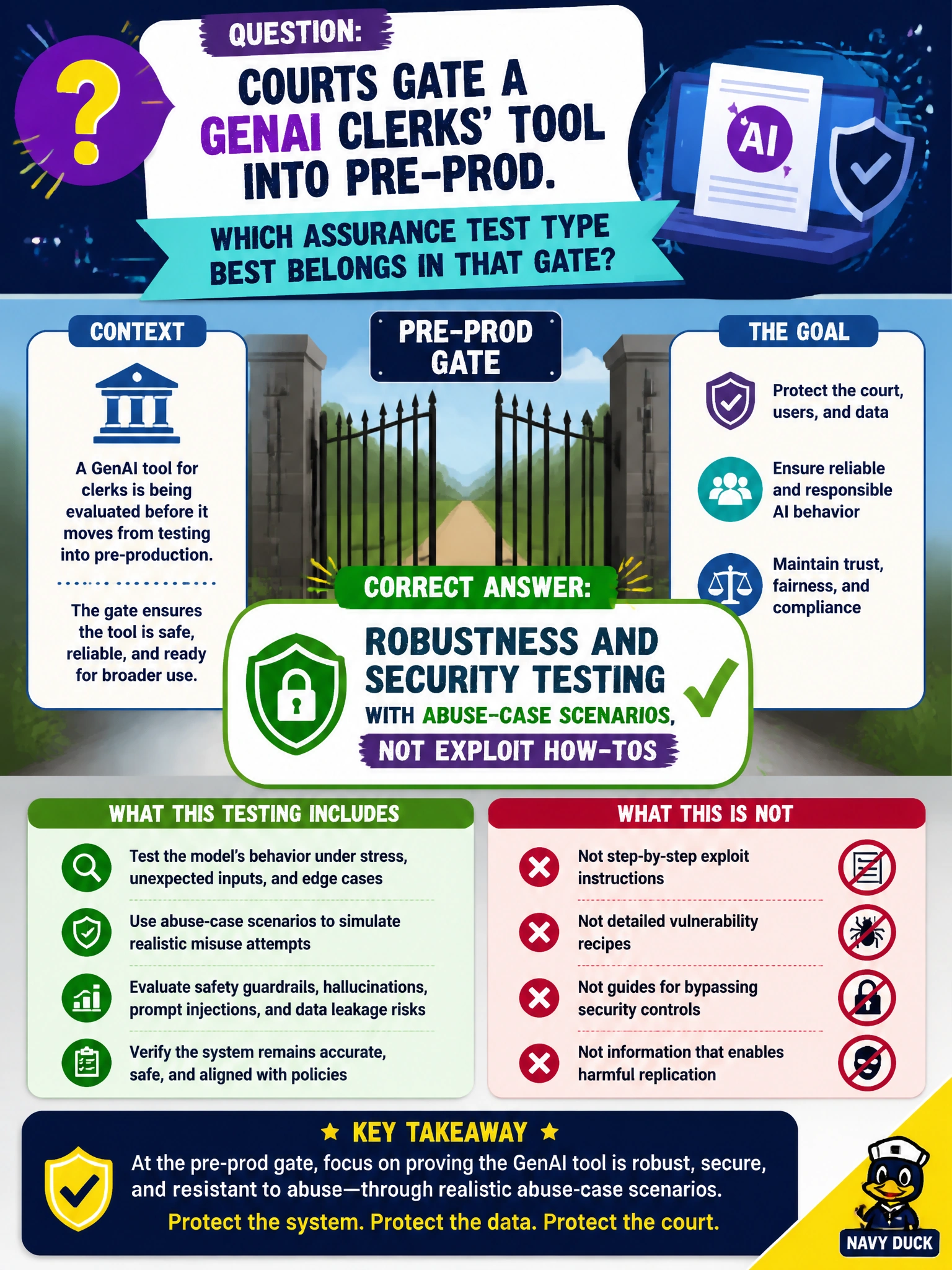
Before clerks lean on GenAI, run abuse-case and robustness checks—think stress-testing the courthouse doors, not handing out lock-picking guides.
Full Explanation
Courts gating a GenAI clerks’ tool into pre-prod should require robustness and security testing with abuse-case scenarios, not public exploit how-tos. Abuse cases probe prompt injection, data exfiltration attempts, unsafe legal advice patterns, and privilege misuse under realistic clerk workflows—evidence that belongs in the assurance gate without publishing a playbook for attackers against court systems.
Publishing step-by-step exploit recipes in the public release notes creates operational security risk and is not an assurance control. Skipping abuse-case review because clerks are trusted users confuses insider goodwill with system hardness; trusted users still make mistakes, and accounts can be compromised or social-engineered. Only spell-check tests with no robustness or security scenarios miss the GenAI-specific threat surface entirely.
Exam caveat: pre-prod gates for civic GenAI must include adversarial and abuse testing; orthography checks and trust assumptions are not substitutes. Operational check: define abuse-case suites tied to court data classifications, run them in pre-prod, retain pass/fail evidence for the gate, and keep exploit detail in controlled assurance files—not public notes.