
A water utility prepares a leak-prediction model for production. Which assurance practice best pairs validation with sustainment?
Select an answer to reveal the explanation.
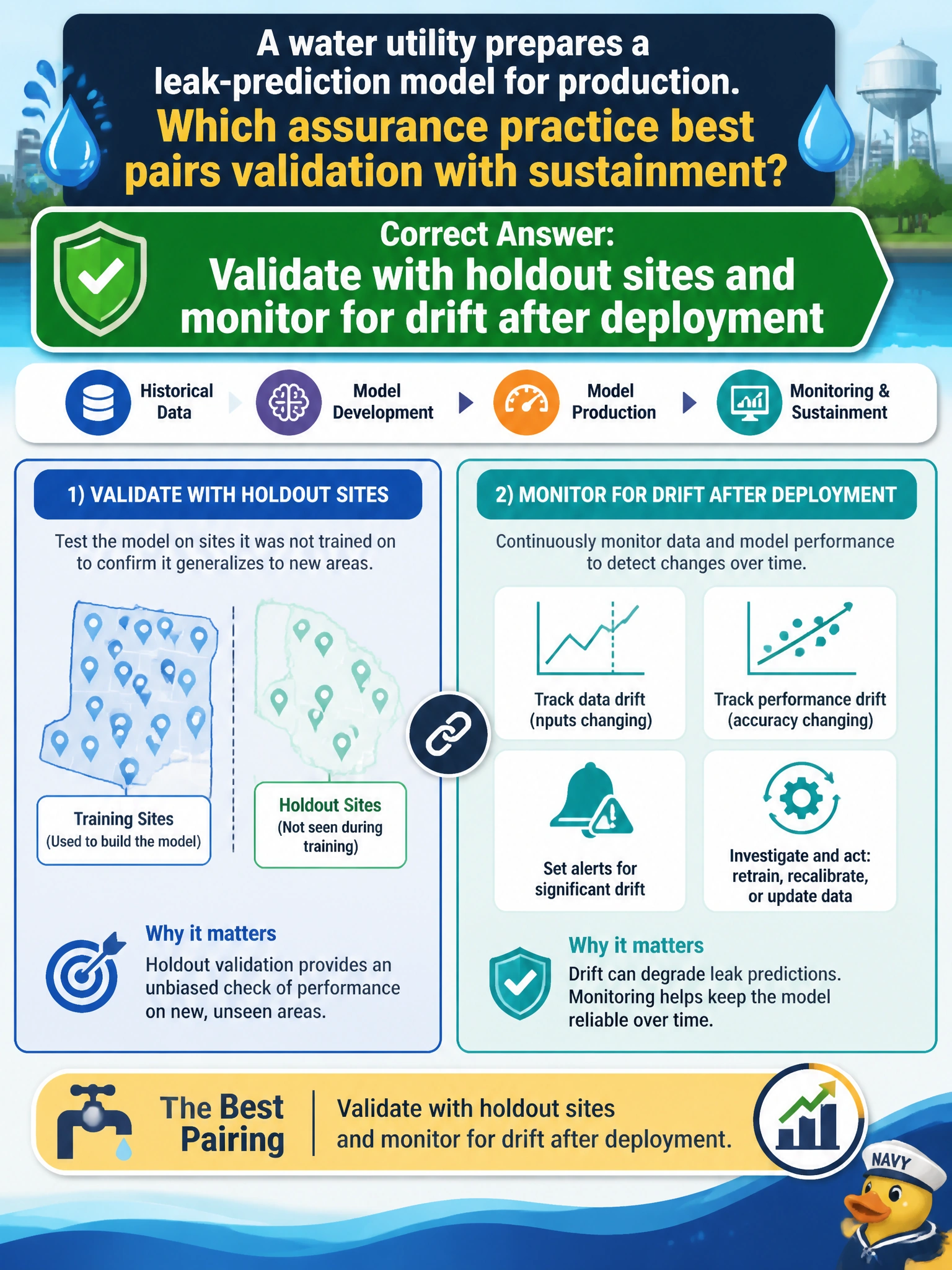
Short Explanation
Prove the leak model on sites it hasn’t memorized, then keep an eye out for drift once it’s live—like pressure-testing pipes, then watching the gauges after you bury them.
Full Explanation
A water utility preparing a leak-prediction model for production best pairs validation with sustainment by validating on holdout sites and monitoring for drift after deployment. Holdouts prove generalization beyond memorized training locations; post-deploy drift monitoring detects sensor changes, seasonal shifts, or data-pipeline breaks that invalidate earlier validation—together forming lifecycle assurance for infrastructure AI, not a one-shot demo.
Training on all sites with no holdout and skipping post-deploy checks overfits and leaves production blind to distribution shift. Declaring validation complete after a single executive demo substitutes theater for statistical evidence that operators and GRC can defend. Disabling drift alerts so operators are never interrupted removes the sustainment half of assurance and lets silent degradation become false leak priorities or missed breaks.
Exam caveat: AI validation without monitoring is incomplete; civic production AI needs both pre-deploy generalization evidence and ongoing drift detection with ownership. Operational check: reserve holdout sites, document acceptance metrics, enable drift alerts with owners and thresholds, and verify an alert path that triggers model review—not silent suppression—after go-live.