
Before an eligibility model go-live, what testing scope best fits housing-authority AI assurance?
Select an answer to reveal the explanation.
Short Explanation
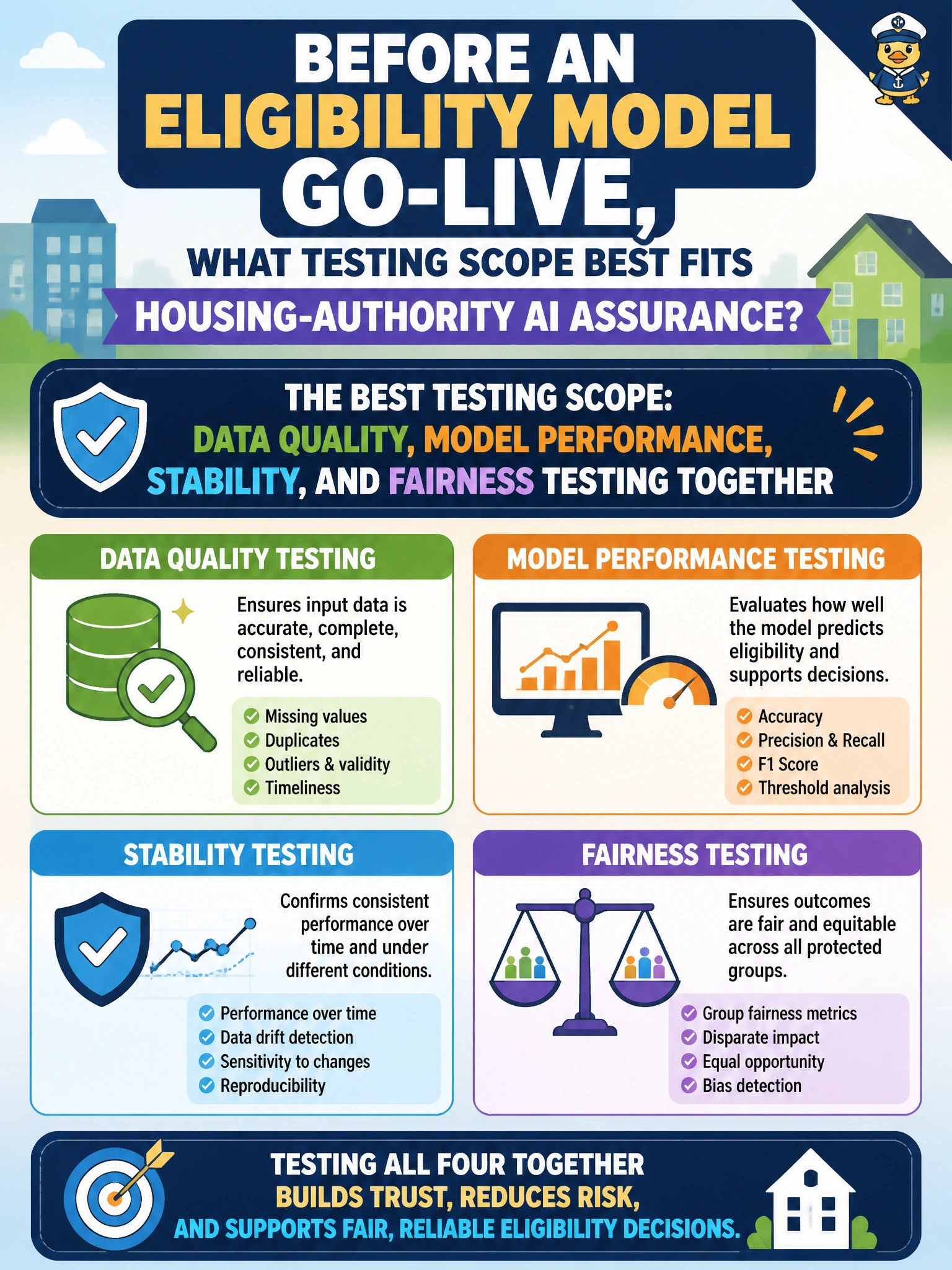
Eligibility models touch people’s housing. Don’t ship on a pretty screen alone—check the data, how the model scores, whether it stays steady, and whether it’s fair across groups.
Full Explanation
Before an eligibility model go-live, housing-authority AI assurance needs a combined testing scope: data quality, model performance, stability, and fairness together. Eligibility decisions affect housing access; weak training data, brittle scores, unstable outputs, or disparate impacts across protected or program-relevant groups are distinct failure modes that a single cosmetic or accuracy check will miss.
Only UI color checks with no data or fairness evaluation confuse interface polish with decision quality. Performance testing alone with no look at training data quality can certify a fast model that learned from biased or incomplete records. A single accuracy score with no stability or fairness review hides subgroup harm and temporal fragility that municipal fairness and due-process expectations require you to surface before go-live.
Exam caveat: high-stakes civic eligibility AI demands multi-dimensional pre-release testing; one metric or UI review is not assurance. Operational check: gate go-live on documented data-quality results, holdout performance, stability across time or sites, and fairness slices—with owners, thresholds, and remediation for any fail before production cutover.