
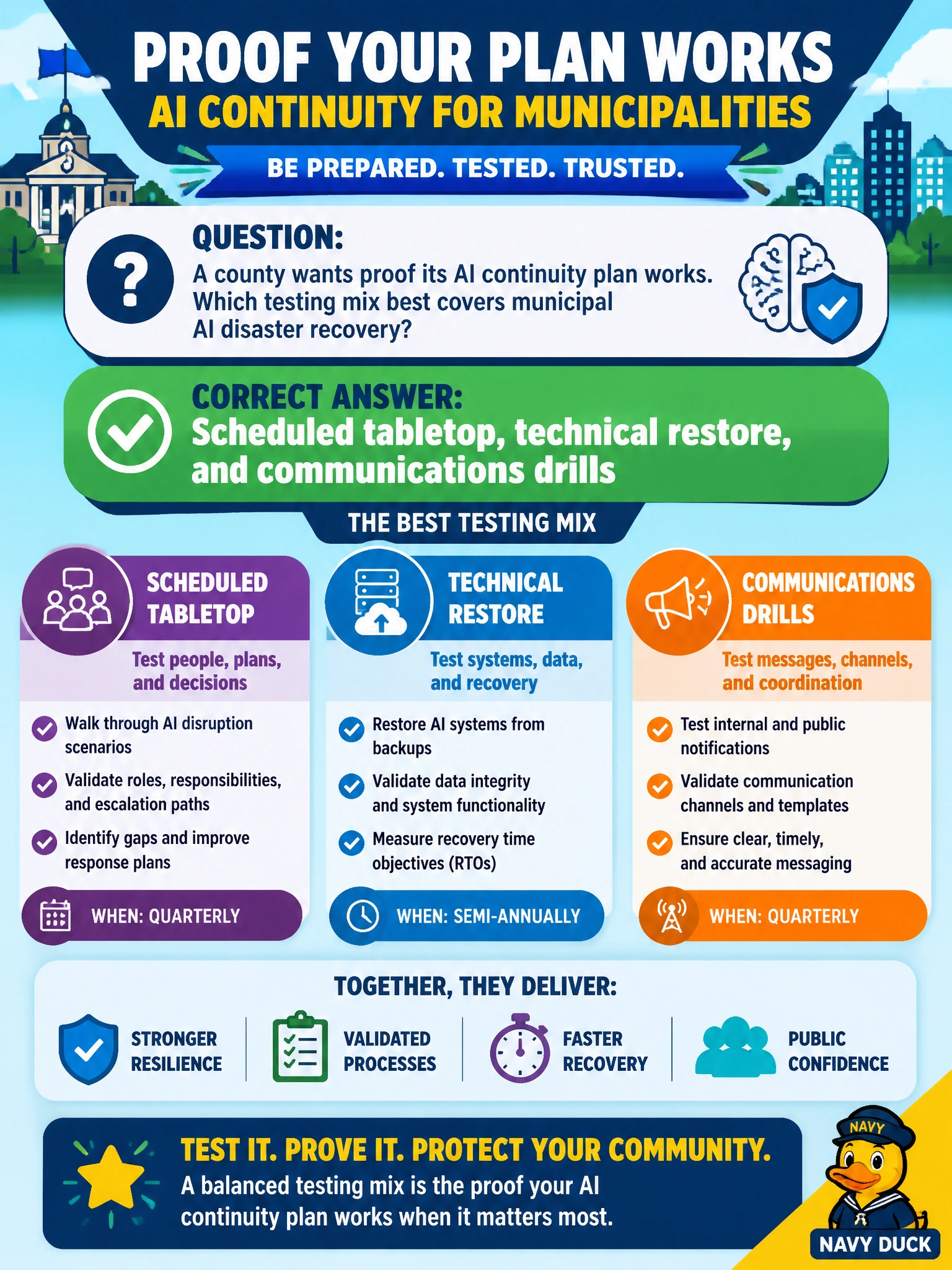
A county wants proof its AI continuity plan works. Which testing mix best covers municipal AI disaster recovery?
Select an answer to reveal the explanation.
Short Explanation
Saying you have a DR plan isn’t the same as proving it. Mix tabletops, real restores, and comms drills on a schedule—like testing both the spare generator and the call tree.
Full Explanation
Counties that need proof an AI continuity plan works must test it, not merely document it. The best municipal AI disaster-recovery testing mix schedules tabletop exercises (decision paths), technical restore tests (model artifacts, feature stores, configs), and communications drills (PIO and service desks). Together those exercises prove people, technology, and public messaging can recover AI-dependent civic services under time pressure.
A single unread PDF checklist with no drills or restores provides paperwork without evidence of capability. Only social-media posts announcing that backups exist are publicity, not recovery validation, and can create false public confidence. One informal hallway chat whenever someone remembers AI lacks scope, frequency, evidence, and coverage of technical restore or resident communications.
Exam caveat: continuity assurance for municipal AI is demonstrated by scheduled, multi-modal testing with recorded results and remediation, not by artifacts that sit unused. Operational check: put tabletops, restore tests, and comms drills on the annual calendar; after each event, log gaps (RTO miss, missing contacts, unrestorable artifacts) and track fixes to closure before the next cycle.