
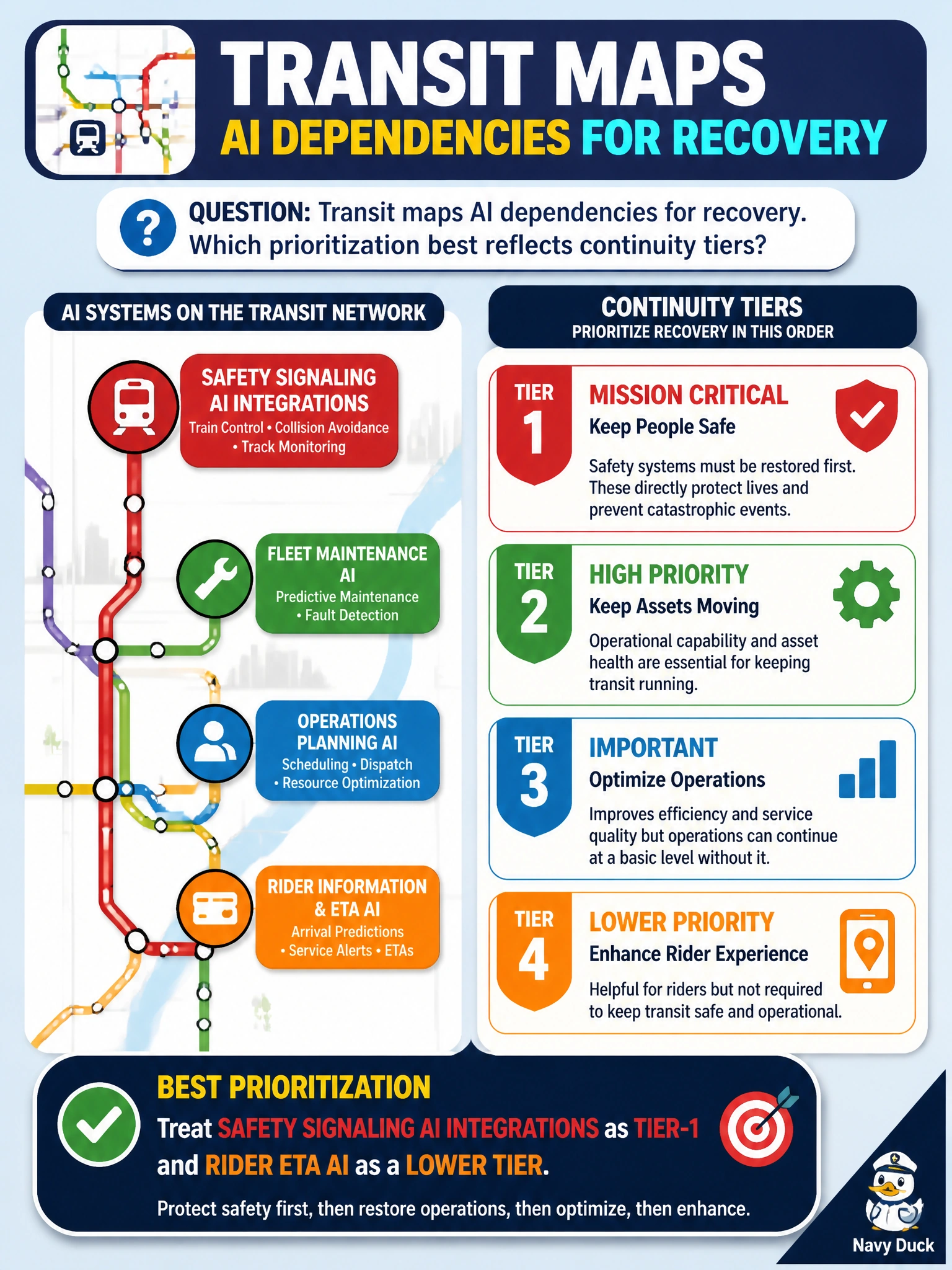
Transit maps AI dependencies for recovery. Which prioritization best reflects continuity tiers?
Select an answer to reveal the explanation.
Short Explanation
Not every AI widget is life-or-death. Safety signaling integrations jump the queue; rider ETA can wait a beat—same logic as fixing brake lights before the radio.
Full Explanation
Transit agencies mapping AI dependencies for recovery must tier continuity by resident safety impact, not by feature popularity. Treating safety signaling AI integrations as tier-1 while placing rider ETA AI in a lower tier reflects that signaling failures can endanger life and operations, whereas ETA convenience can degrade temporarily with less harm. Recovery order, staffing, and vendor SLAs should follow that risk ranking.
Treating rider ETA AI and safety signaling AI as equal tier-1 always dilutes scarce recovery resources and can delay restoration of safety-critical integrations. Deferring all AI recovery until every office printer is restored first elevates administrative peripherals above operational safety systems. Recovering entertainment kiosk AI before any safety-related integrations inverts civic priorities and fails continuity triage principles.
Exam caveat: AI recovery tiers in municipal transit follow safety and essential service criticality, not marketing visibility or convenience features. Operational check: review the dependency map with operations—confirm signaling integrations have the shortest RTO, ETA and kiosk AI have documented lower tiers, and failover procedures for signaling do not wait on non-safety AI restores.