
After an AI misinformation incident in outbreak messaging, what should public health do to improve continuous readiness?
Select an answer to reveal the explanation.
Short Explanation
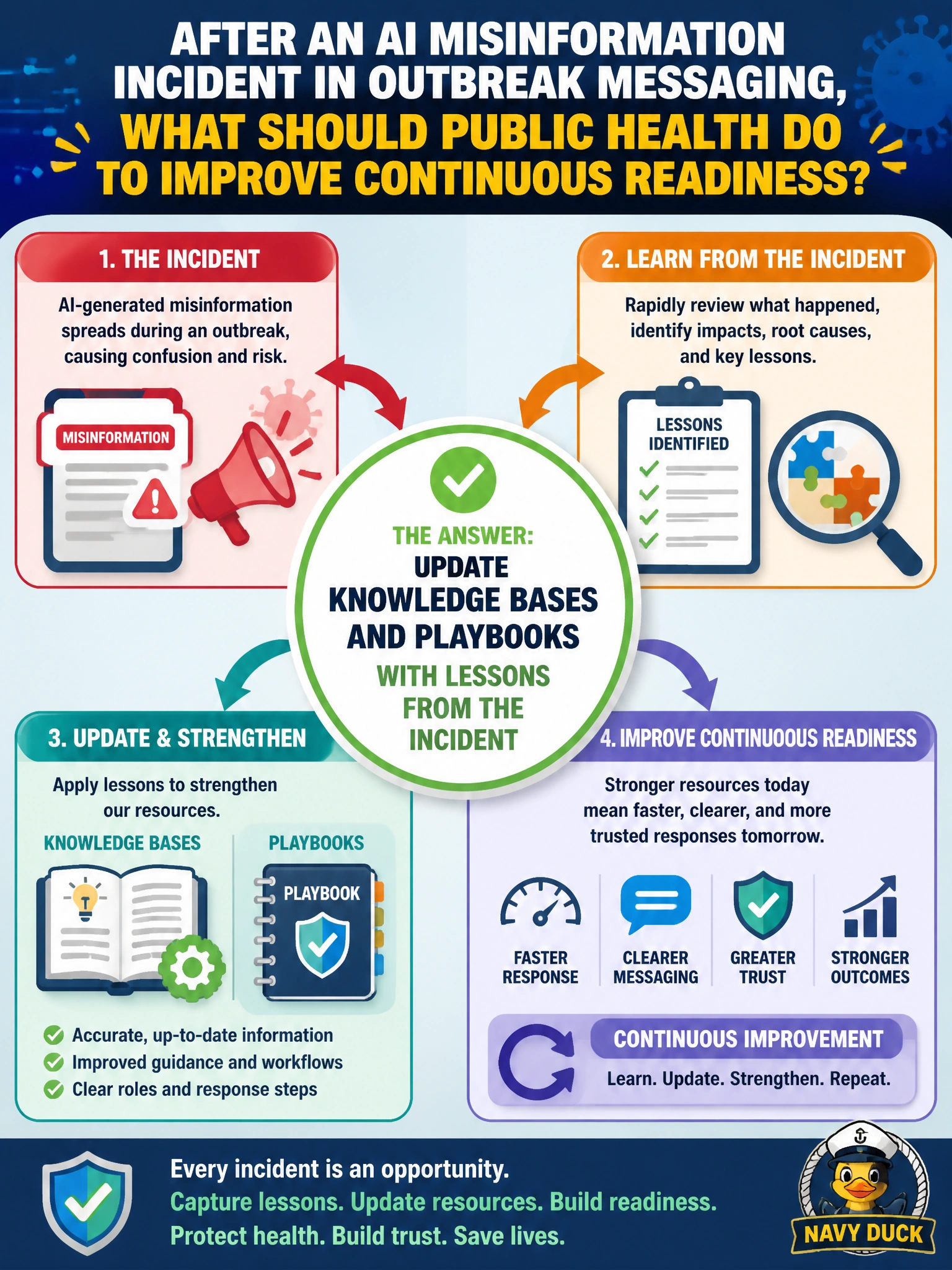
A bot that muddies outbreak messaging is a wake-up call, not a closed ticket. Feed the lessons into knowledge bases and playbooks so the next round is smarter.
Full Explanation
After an AI misinformation incident in outbreak messaging, public health continuous readiness improves only if lessons are captured into operating knowledge. The correct action is updating knowledge bases and playbooks with what failed, what controls would have caught it, and how responders should act next time. That converts a one-off crisis into durable institutional memory for civic AI incident response.
Archiving the incident privately and leaving all playbooks unchanged fails continuous improvement: the next shift cannot benefit from hard-won lessons. Punishing only the chatbot vendor without updating internal guidance externalizes blame while leaving municipal detection, approval, and escalation gaps untouched. Disabling all public messaging permanently to avoid future AI use is an overcorrection that harms outbreak communication capacity and confuses risk reduction with capability abandonment.
Exam caveat: continuous improvement after civic AI incidents is measured by updated guidance and practiced controls, not by private blame or permanent shutdowns. Operational check: within the post-incident window, confirm revised playbook steps, knowledge-base articles, and training notes are published to on-call staff, and schedule a short drill that exercises the new outbreak-messaging escalation path.