
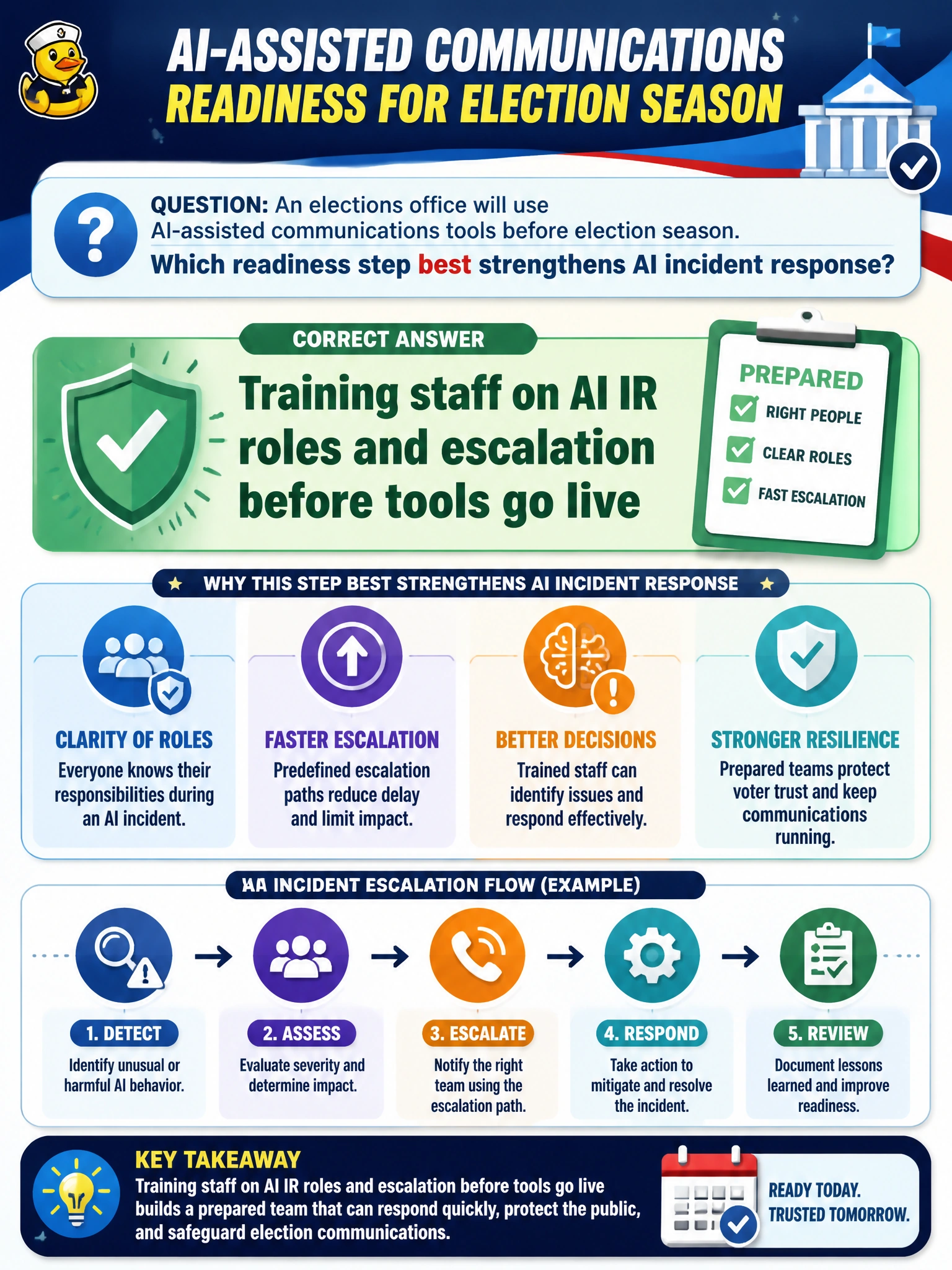
An elections office will use AI-assisted communications tools before election season. Which readiness step best strengthens AI incident response?
Select an answer to reveal the explanation.
Short Explanation
Don’t wait for election-week chaos to learn who calls whom. Train people on AI incident roles and escalation before the tools go live—like a fire drill before the first game day.
Full Explanation
Elections offices adopting AI-assisted communications tools before election season must harden incident response readiness before go-live. The strongest readiness step is training staff on AI-specific IR roles and escalation paths—who quarantines a bad draft, who approves public corrections, who notifies election leadership—while the tools are still in pre-prod. Role clarity and practice compress decision time when misinformation risk and media scrutiny peak.
Training staff only after the first live AI communications failure treats the public as the test environment and wastes the pre-election window when drills are cheapest. Skipping role drills because staff already know generic IT tickets fails conceptually: AI content incidents involve policy, public trust, and election integrity escalations that a standard help-desk queue does not encode. Assigning every AI outage solely to unpaid temporary poll workers dumps specialized response onto the least trained, least continuous workforce and breaks accountability.
Exam caveat: AI incident readiness is a people-and-process control that must precede production use of civic communications AI, especially in high-scrutiny election cycles. Operational check: before tools go live, run a tabletop where a drafted social post contains a wrong poll location—verify named roles, escalation timelines, and a corrected public statement path are exercised and recorded.