
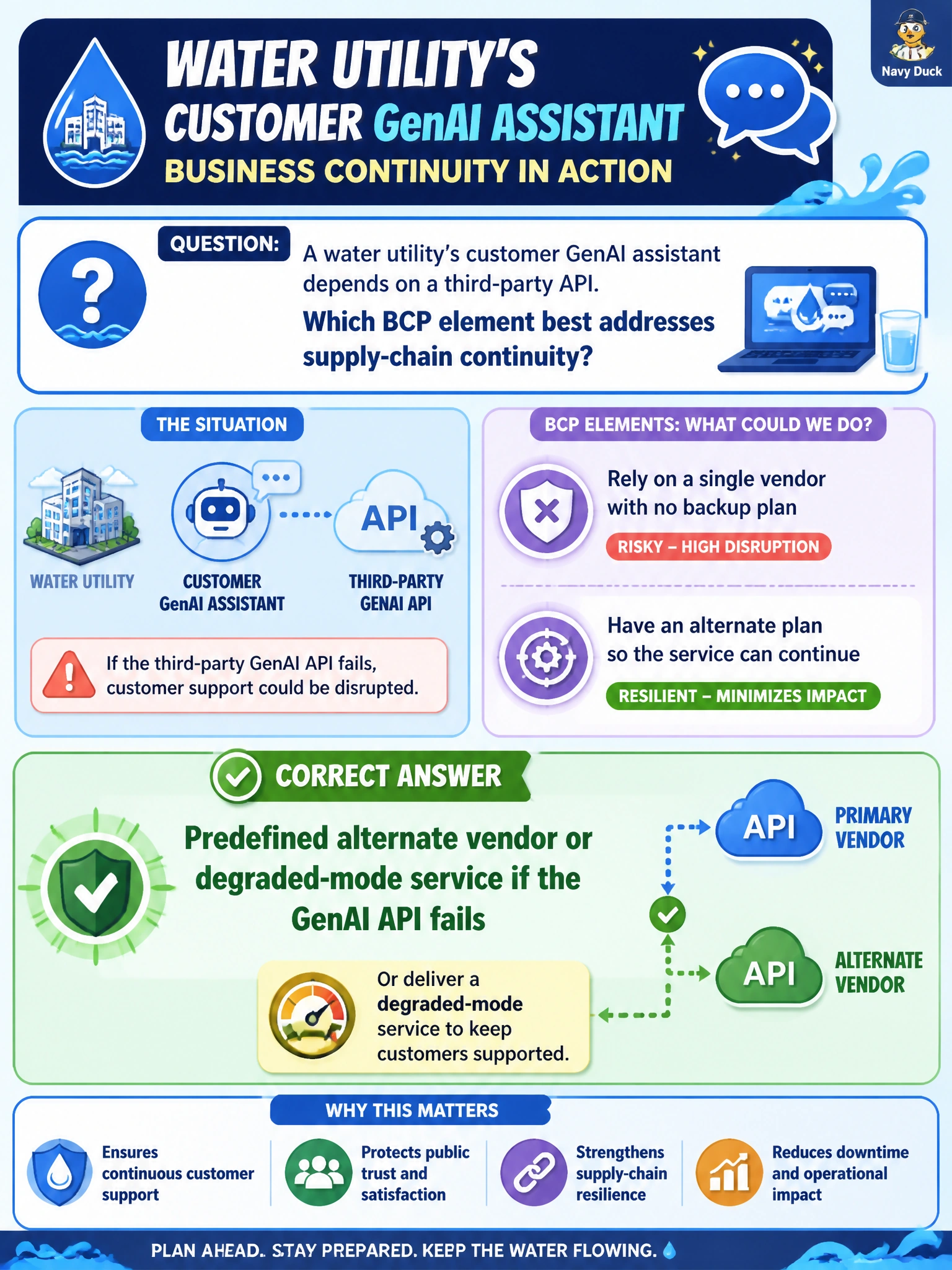
A water utility’s customer GenAI assistant depends on a third-party API. Which BCP element best addresses supply-chain continuity?
Select an answer to reveal the explanation.
Short Explanation
If the GenAI API goes dark, customers still need answers. Pre-plan an alternate vendor or a simpler degraded mode—same idea as a spare pump when the main one seizes.
Full Explanation
Water utilities that expose customer GenAI assistants through third-party APIs inherit supply-chain continuity risk. The best BCP element is a predefined alternate vendor path or a degraded-mode service—human call-center scripts, IVR FAQ trees, or a simpler rule-based bot—so billing and outage questions continue when the GenAI API fails. Documented triggers, ownership, and restoration criteria turn vendor dependency into a managed continuity control rather than an unspoken hope.
Assuming the vendor API can never fail during outages is a classic continuity fallacy: cloud and SaaS components fail, rate-limit, or change terms without municipal consent. Storing only marketing copy as the sole recovery objective fails because slogans do not restore customer service capability or meet utility RTO expectations. Blocking all human call-center staff from answering during API downtime weaponizes the outage and removes the most practical degraded mode civic agencies already fund.
Exam caveat: supply-chain continuity for AI is about service continuity for ratepayers, not perpetual vendor uptime guarantees. Operational check: run a scheduled API-kill drill—confirm the degraded mode activates within the published RTO, agents know the playbook, and customer-facing messaging explains temporary mode without promising GenAI features that are offline.