
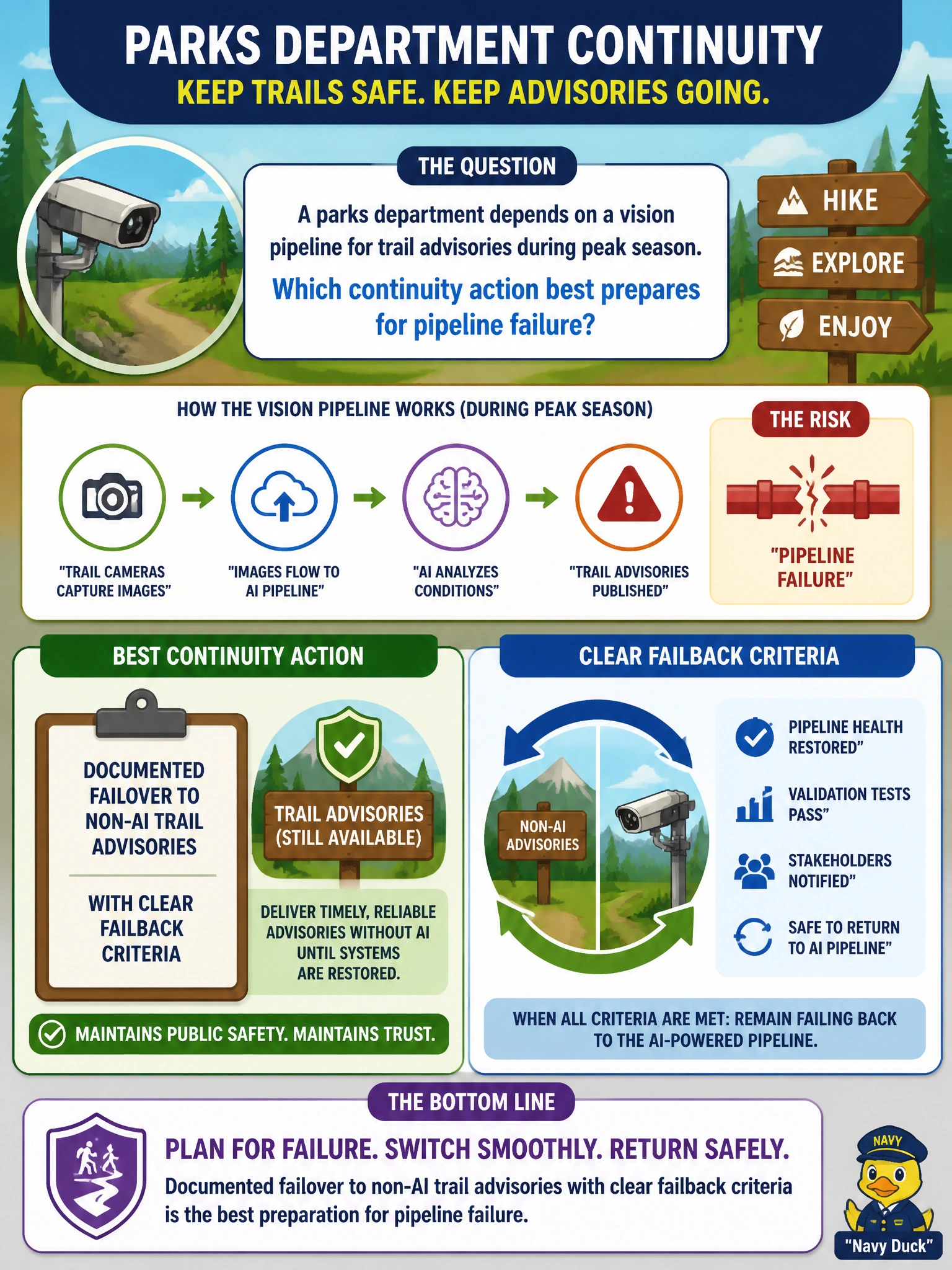
A parks department depends on a vision pipeline for trail advisories during peak season. Which continuity action best prepares for pipeline failure?
Select an answer to reveal the explanation.
Short Explanation
Peak-season trail advice can’t vanish when the camera model hiccups. Write down the non-AI advisory failover and when you flip back—like keeping paper trail maps behind the counter.
Full Explanation
Municipal parks departments that publish peak-season trail advisories through computer-vision pipelines must treat model or camera failure as a continuity event, not a surprise. The correct continuity action is a documented failover to non-AI advisories—static maps, ranger reports, weather-desk notices—with explicit failback criteria that define when the vision pipeline may resume advising the public. That preserves resident safety messaging when inference latency spikes, cameras go dark, or a model regresses, and it keeps operators from improvising under crowd pressure.
Leaving a broken vision feed live with no alternate advisory channel fails because residents continue to receive stale or empty guidance during the exact window when trail decisions matter most. Deleting the trail-map website whenever latency spikes confuses a dependency failure with a communication channel that still works and needlessly removes a manual fallback path. Waiting until peak season ends before defining any backup process postpones continuity planning until after the highest-risk period, which is the opposite of municipal readiness.
Exam caveat: continuity for AI-assisted civic services is judged by whether service outcomes continue for residents, not by whether the model itself stays online. Operational check: tabletop a camera outage during a holiday weekend—verify who publishes the non-AI advisory, where it is posted, who declares failback after health checks pass, and that the live site never silently serves blank vision output.