
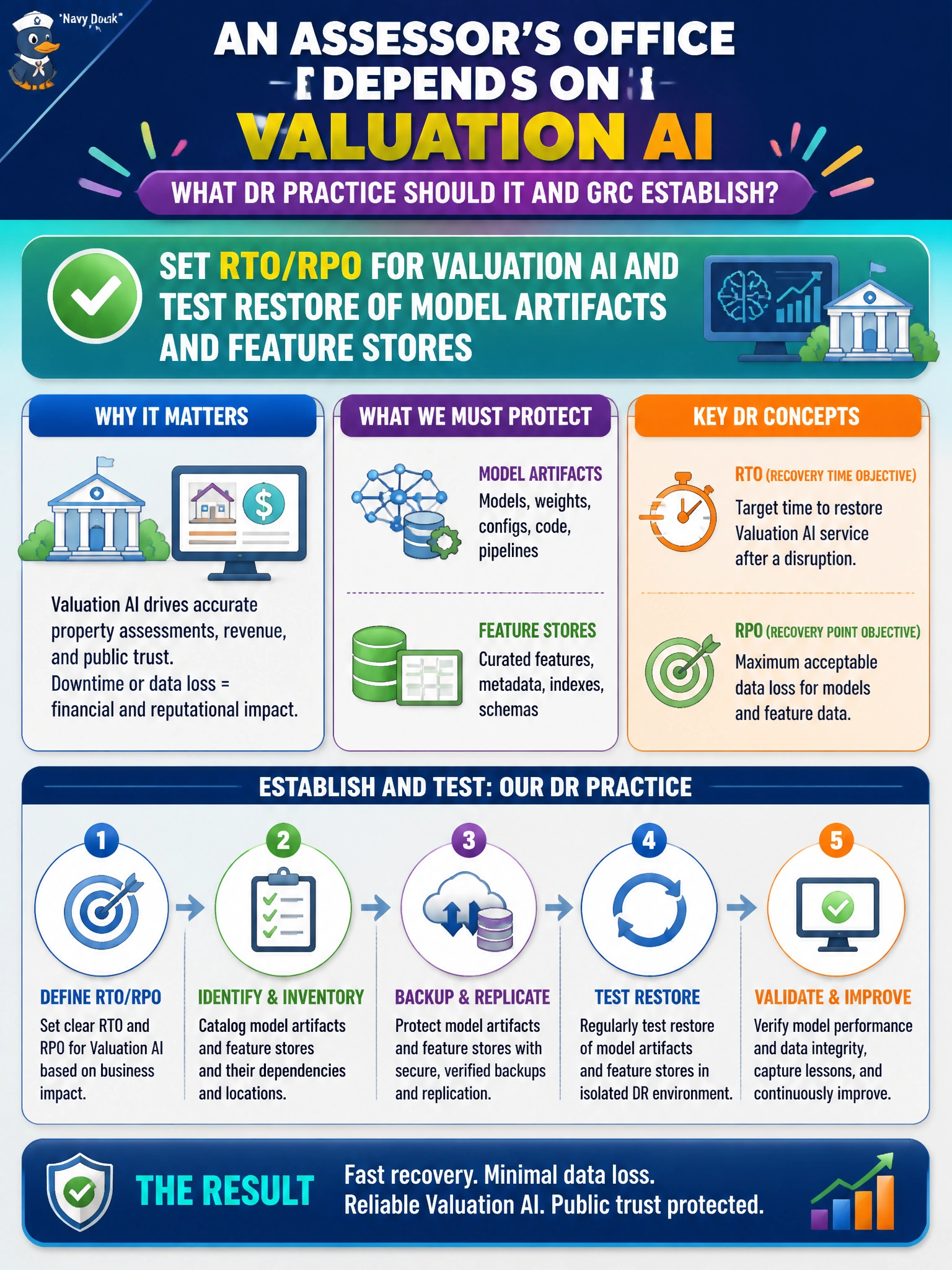
An assessor’s office depends on valuation AI. What DR practice should IT and GRC establish?
Select an answer to reveal the explanation.
Short Explanation
If valuation AI vanishes, clocks and backups matter. Set RTO/RPO and actually restore model artifacts and feature stores—screenshots won’t retrain the system.
Full Explanation
An assessor’s office that depends on valuation AI must set RTO/RPO for that AI capability and test restore of model artifacts and feature stores. Recovery objectives define how quickly valuation support must return and how much data/model loss is tolerable; tested restores of registry artifacts, features, and supporting configs prove those objectives are real rather than aspirational.
Skipping restore tests because cloud vendors never lose artifacts fails shared-responsibility and DR practice; vendor durability is not a tested municipal restore. Defining RTO only for office printers, not valuation models, fails criticality ranking: valuation AI may be more service-critical than peripherals. Backing up screenshots of dashboards instead of model artifacts fails recoverability—images cannot rehydrate models, features, or scoring pipelines.
Exam caveat: DR for AI systems must include models and feature stores in scope with explicit RTO/RPO, not only VMs or office equipment. Operational check: document RTO/RPO for valuation AI, back up model registry artifacts and feature stores, run restore tests on a schedule, and verify post-restore evaluation metrics before cutting traffic back to the recovered system.