
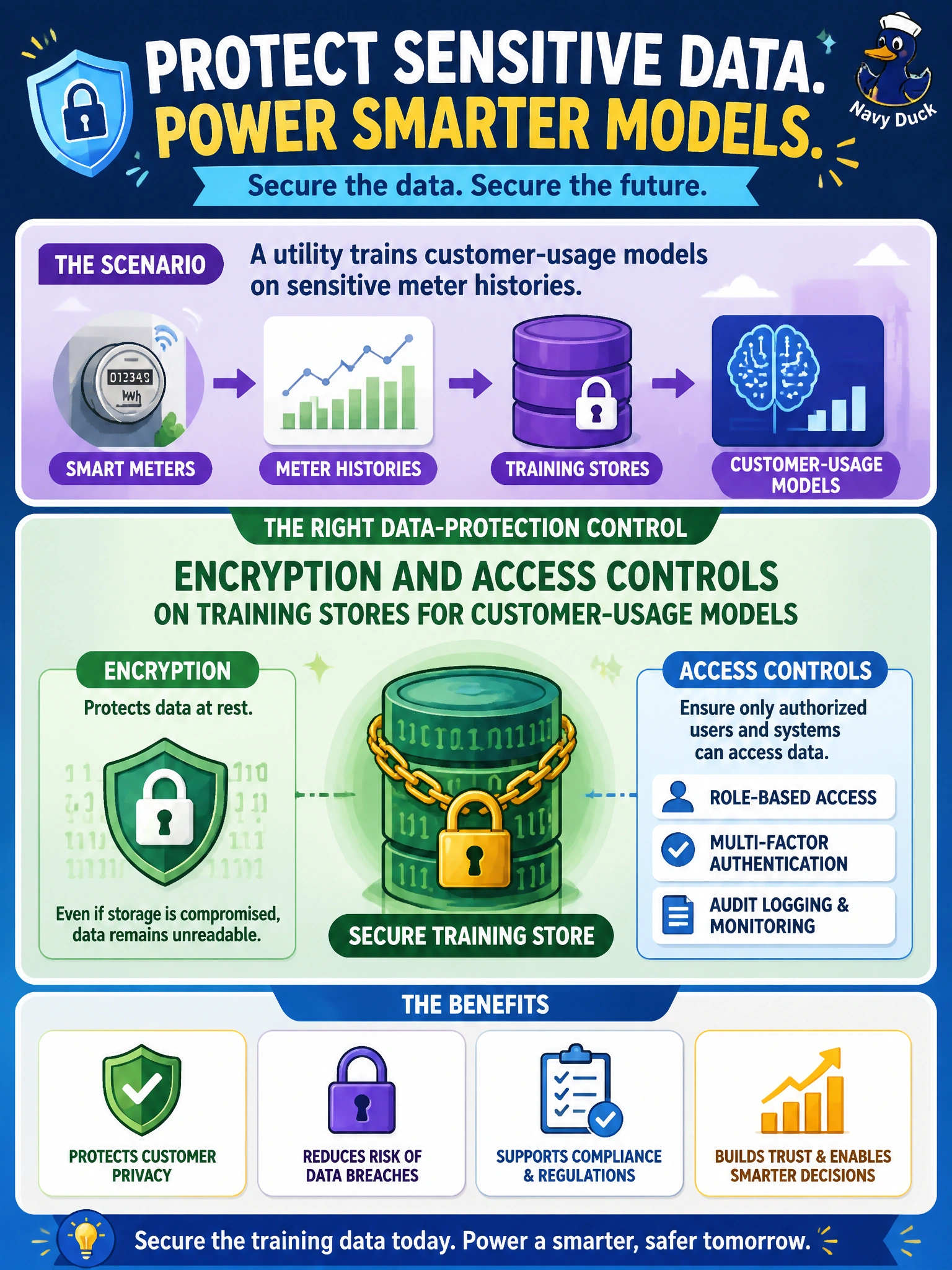
A utility trains customer-usage models on sensitive meter histories. What data-protection control should it adopt?
Select an answer to reveal the explanation.
Short Explanation
Meter histories are still personal patterns. Lock training stores with encryption and tight access—open laptop folders are not a privacy technology.
Full Explanation
Customer-usage models trained on sensitive meter histories expose detailed household or business patterns—occupancy proxies, medical equipment hints, commercial operations—that deserve strong data protection. The utility should adopt encryption and access controls on training stores so extracts at rest and in use are confidential, keyed to least-privilege roles, and auditable. Training convenience never justifies clear-text sprawl of meter-derived personal or customer data.
Storing training extracts in clear text on shared analyst laptops fails confidentiality and device-loss risk; laptops are not controlled training vaults. Granting whole-company read access to simplify experiments fails least privilege and multiplies insider and phishing blast radius. Disabling encryption because meter data is considered low value fails conceptually: usage time series are high-value for profiling and are often regulated or contractually sensitive even when not classic “passwords.”
Exam caveat: training-data protection is part of AI security and privacy, not an optional afterthought once the model works. Operational check: encrypt training stores (and preferably in-use protections where feasible), enforce role-based access with MFA, inventory who can export meter features, and test that deprovisioned analysts lose access immediately.