
After deploying a city permitting assistant, what ongoing trust practice should GRC enable?
Select an answer to reveal the explanation.
Short Explanation
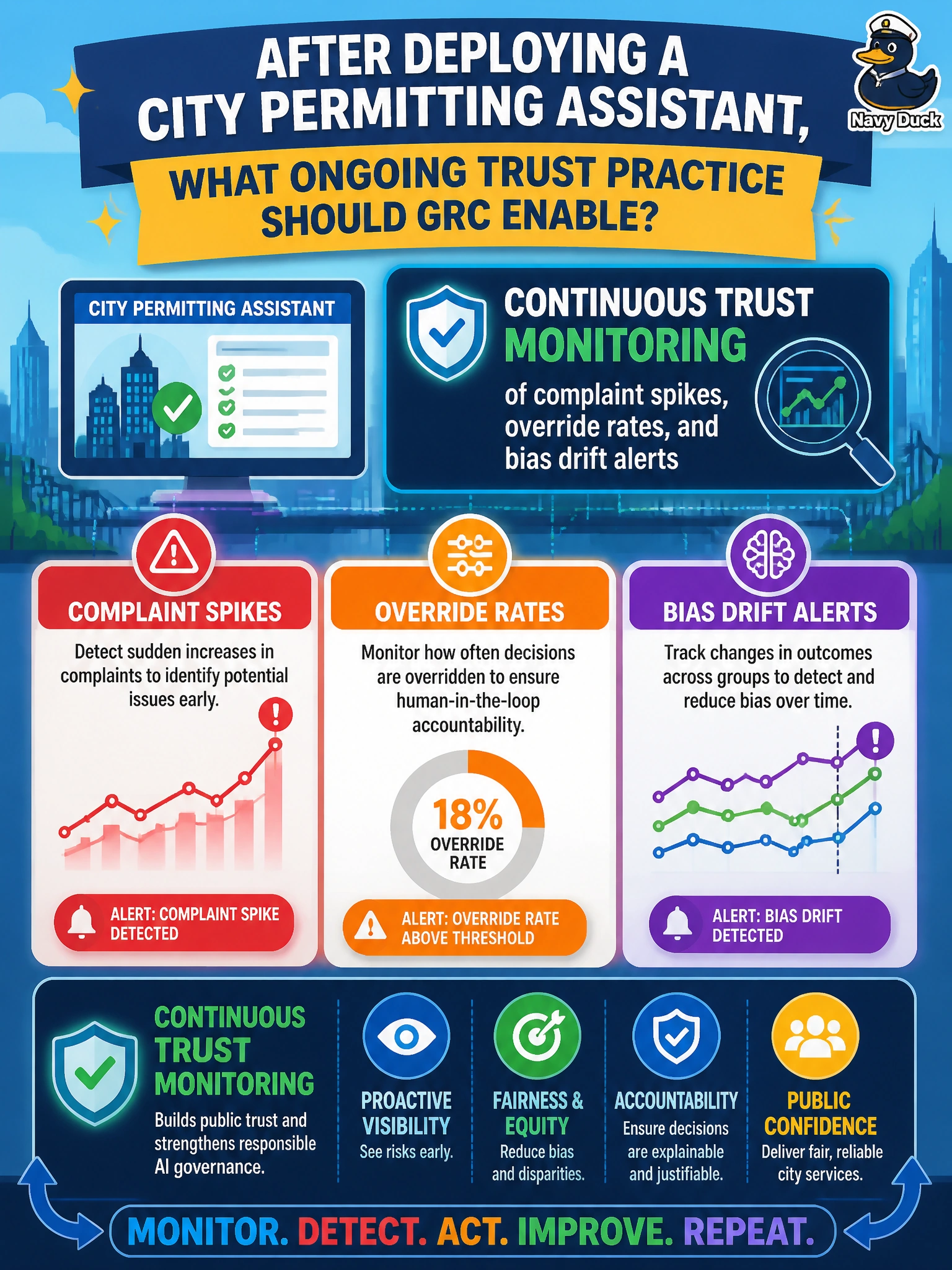
Go-live isn’t the finish line. Keep watching complaints, human overrides, and bias drift—trust decays quietly if nobody’s listening.
Full Explanation
After a city permitting assistant goes live, GRC should enable continuous trust monitoring—complaint spikes, human override rates, and bias drift alerts—because resident experience and model behavior change after deployment. Continuous monitoring keeps the assistant aligned with fairness, accuracy, and service-level expectations long after the go-live checklist is filed.
Archiving the go-live checklist and stopping metrics fails as an ongoing trust practice; launch compliance is not runtime assurance. Monitoring only uptime and ignoring resident complaint trends fails by measuring availability while missing quality, fairness, and UX failures that destroy trust. Assuming bias cannot drift after the first successful week fails conceptually: data drift, policy changes, and seasonal application mixes can reintroduce disparate outcomes without an outage.
Exam caveat: post-deployment GRC for civic GenAI centers behavioral and equity signals, not merely green uptime. Operational check: wire dashboards for complaint volume/themes, override frequency and reasons, and bias drift alerts by applicant segment or geography; define on-call GRC response when thresholds trip, including temporary human review gates.