
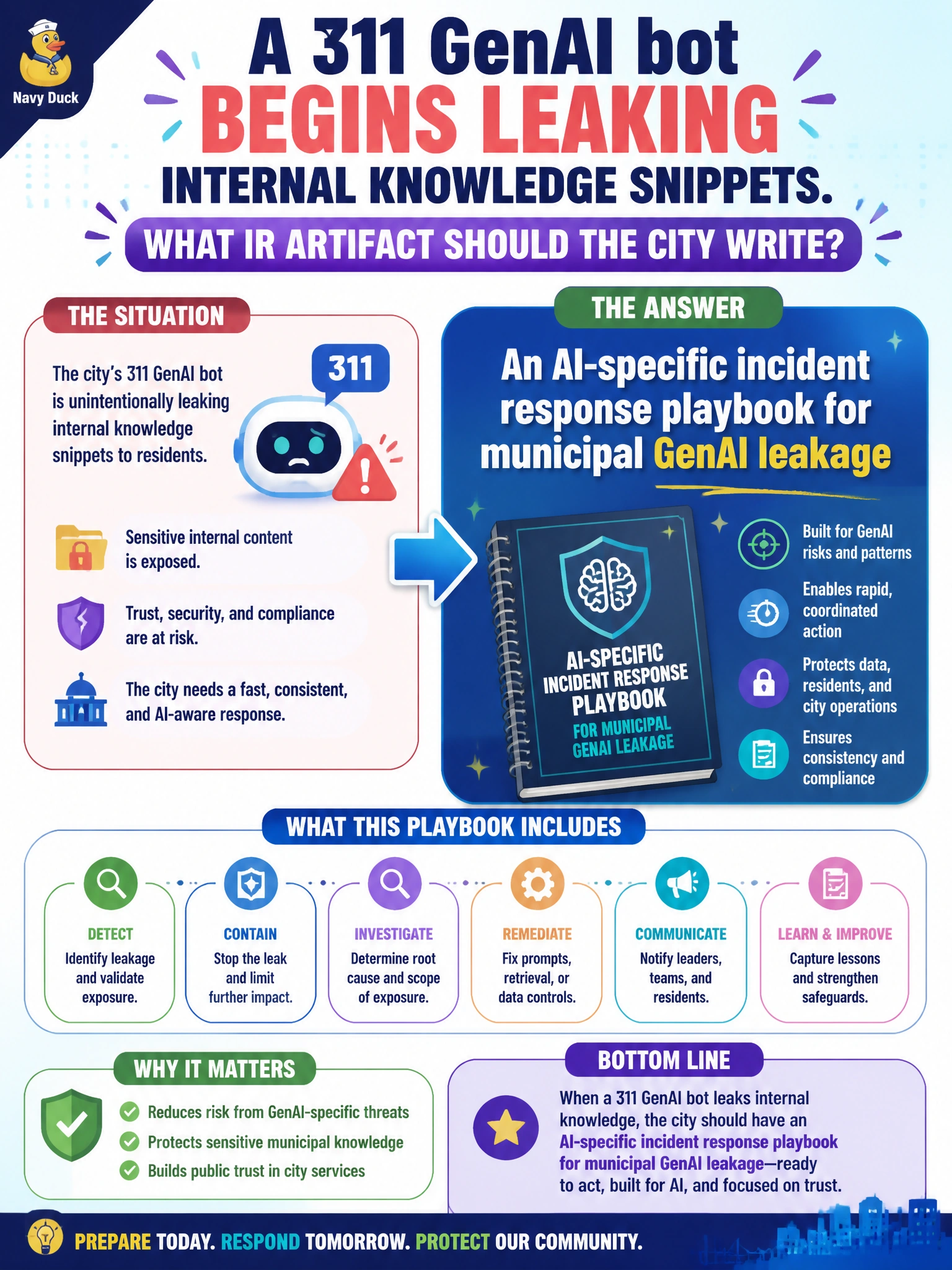
A 311 GenAI bot begins leaking internal knowledge snippets. What IR artifact should the city write?
Select an answer to reveal the explanation.
Short Explanation
When the bot spills internal notes, a printer jam runbook won’t cut it. Write an AI-specific IR playbook—leakage needs its own plays.
Full Explanation
When a 311 GenAI bot leaks internal knowledge snippets, the city needs an AI-specific incident response playbook covering detection of sensitive-content egress, prompt/response containment, knowledge-base access review, legal/privacy notification triggers, vendor coordination, and evidence preservation for model and retrieval logs. Generic IT runbooks that never mention GenAI retrieval, embeddings, or chat transcripts leave responders improvising during leakage.
Only a generic printer-jam runbook with no AI steps fails because the failure mode, artifacts, and containment actions differ completely from hardware support. A note saying GenAI leaks never qualify as incidents fails policy and risk reality: unauthorized disclosure of internal municipal knowledge is an incident regardless of the interface being a chatbot. A plan that deletes evidence before containment begins fails IR fundamentals—spoliation undermines investigation, regulation, and learning.
Exam caveat: AI leakage incidents need playbooks that name GenAI-specific systems of record (chat logs, vector stores, tool credentials). Operational check: publish and exercise an AI-specific IR playbook for municipal GenAI leakage, with decision trees for disabling retrieval connectors, rotating secrets, preserving prompts/outputs, and notifying privacy/legal when internal or personal data may have been exposed.