
A housing authority prepares case notes for vendor model evaluation. Which privacy step best fits?
Select an answer to reveal the explanation.
Short Explanation
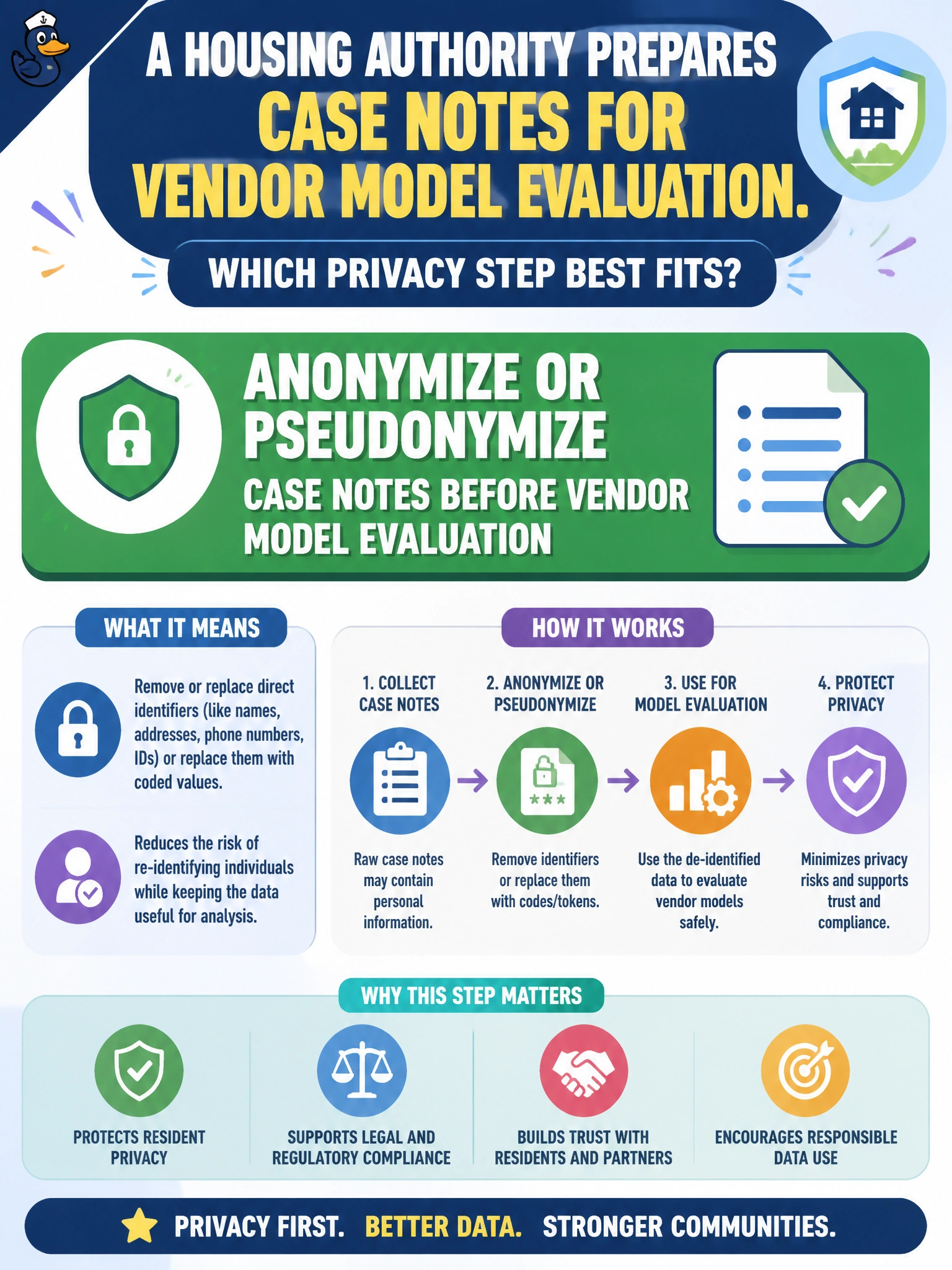
Vendors don’t need real names to kick the tires. Anonymize or pseudonymize housing case notes before any model evaluation leaves the building.
Full Explanation
A housing authority preparing case notes for vendor model evaluation should anonymize or pseudonymize before any data leaves for third-party testing. Vendors evaluating models need realistic structure and language patterns, not real resident names and direct identifiers. Anonymization/pseudonymization, paired with contractual use limits and deletion, reduces privacy exposure during bake-offs while still enabling technical comparison. This is standard privacy protection for municipal AI evaluations and a practical application of minimization to third-party workflows.
Sending full named case files to the vendor without transformation maximizes unnecessary disclosure. Emailing unredacted notes to any bidder who asks treats sensitive housing case content as marketing collateral. Requiring the vendor to store identifiers longer than the city does expands retention risk beyond the municipality’s own policy—opposite of privacy-preserving evaluation design.
Exam caveat: evaluation/sharing with vendors triggers anonymization or pseudonymization; do not confuse “need to evaluate models” with “need real names.”
Operational check: transform case notes with approved anonymization/pseudonymization procedures, validate residual identifiers are removed, bind vendors to purpose limitation and deletion SLAs, prohibit longer-than-city identifier retention, and spot-check sample exports before release to evaluators.