
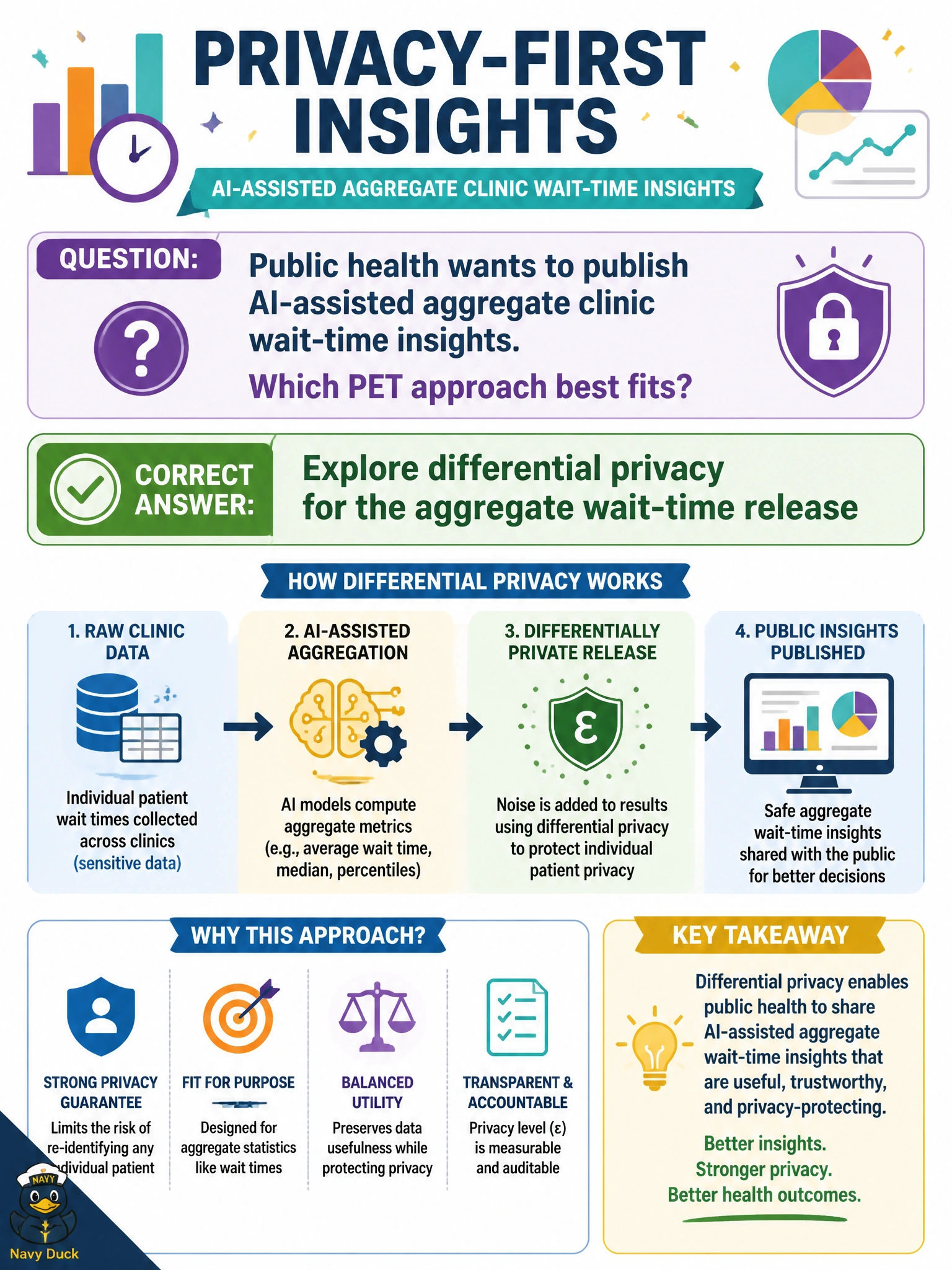
Public health wants to publish AI-assisted aggregate clinic wait-time insights. Which PET approach best fits?
Select an answer to reveal the explanation.
Short Explanation
Aggregates can still snitch if you’re careless. Differential privacy helps public health share wait-time insights without handing out patient-level breadcrumbs.
Full Explanation
Public health publishing AI-assisted aggregate clinic wait-time insights should explore differential privacy (or comparable PETs) so aggregates resist re-identification while still informing the public. Differential privacy adds calibrated noise or controlled query mechanisms that bound how much an individual’s presence can affect released statistics—important when slices by clinic, time, or demographic can become unique. PET-backed release supports transparency about wait times without handing out patient-level breadcrumbs.
Releasing row-level patient identifiers alongside aggregates negates aggregation’s privacy benefit. Posting named patient visit timelines on social media for “transparency” is identifying disclosure, not responsible open data. Ignoring re-identification risk because the dataset “feels small” is unsafe: small populations and fine-grained slices are often easier to re-identify, not harder.
Exam caveat: aggregates are not automatically safe; PETs like differential privacy address re-identification residual risk for civic analytic releases.
Operational check: choose a privacy budget and release mechanism with public-health privacy and analytics owners, test for unique cells and join risks, suppress or noise risky slices, and publish wait-time insights only after a documented PET/re-identification review.