
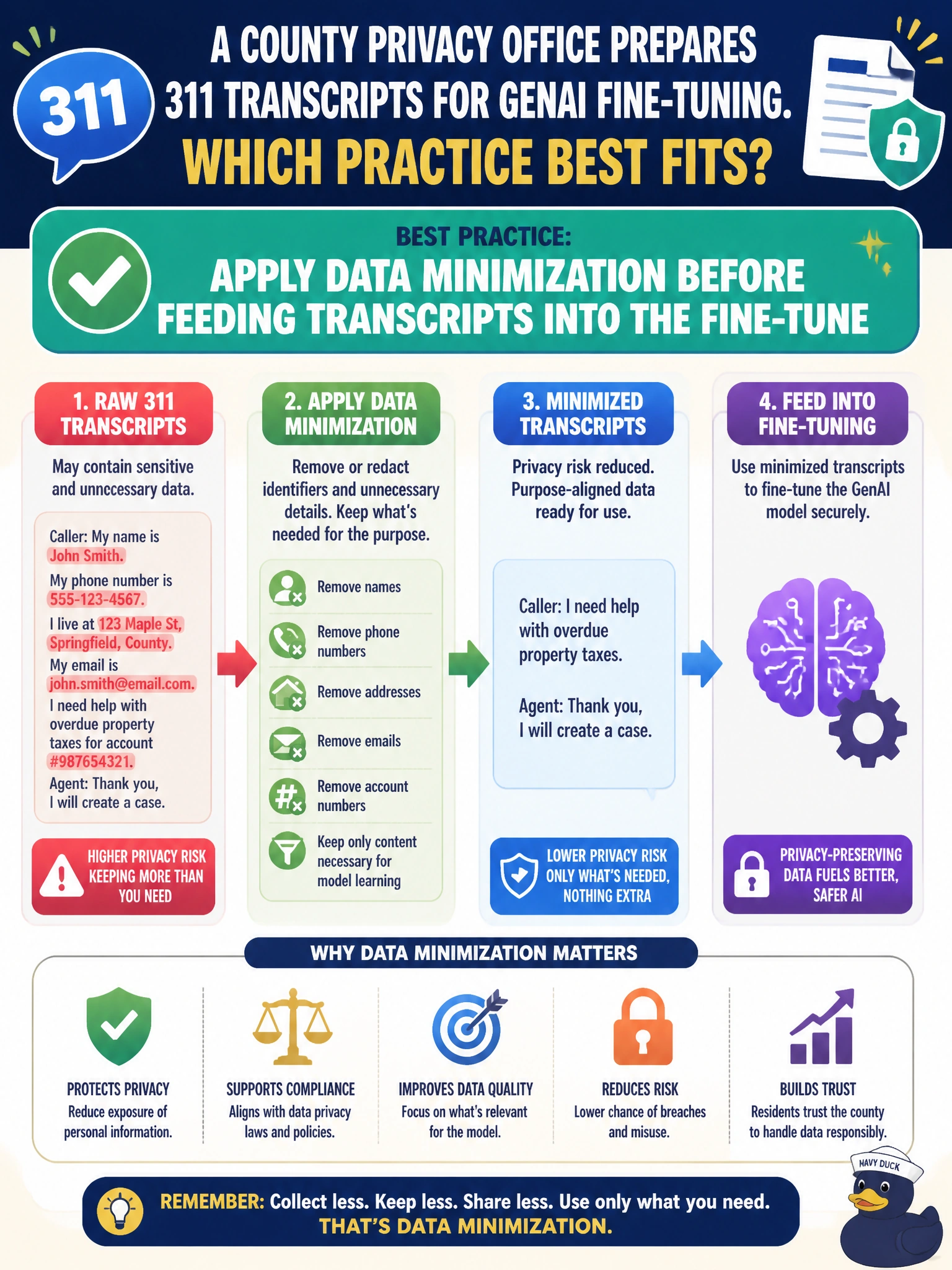
A county privacy office prepares 311 transcripts for GenAI fine-tuning. Which practice best fits?
Select an answer to reveal the explanation.
Short Explanation
Fine-tuning isn’t a yard sale for every field you own. Minimize the 311 transcript data first—only what’s needed, nothing extra.
Full Explanation
A county privacy office preparing 311 transcripts for GenAI fine-tuning should apply data minimization first: include only fields and spans necessary for the learning objective, and exclude optional attributes, gratuitous free-text dumps, and identity details not required for the task. Minimization shrinks privacy blast radius if training sets leak, reduces memorization surface for sensitive resident content, and aligns with civic privacy programs. Fine-tuning on sprawling transcripts without minimization treats convenience as a substitute for purpose limitation.
Including every optional field and free-text dump because “more is always better” increases sensitivity without proven model benefit and contradicts minimization. Skipping minimization and sending full identity details by default maximizes re-identification and harm potential. Retaining unused sensitive attributes solely to enlarge the training set invents a purpose that privacy law and policy typically reject.
Exam caveat: Domain 9-style privacy for municipal AI starts with minimization before exotic PETs; more data is not automatically better for fine-tuning civic transcripts.
Operational check: define a minimum necessary schema for the fine-tune, strip or hash identifiers, drop unused sensitive attributes, document legitimate purpose, and require privacy sign-off before any 311 transcript corpus enters a training pipeline.