
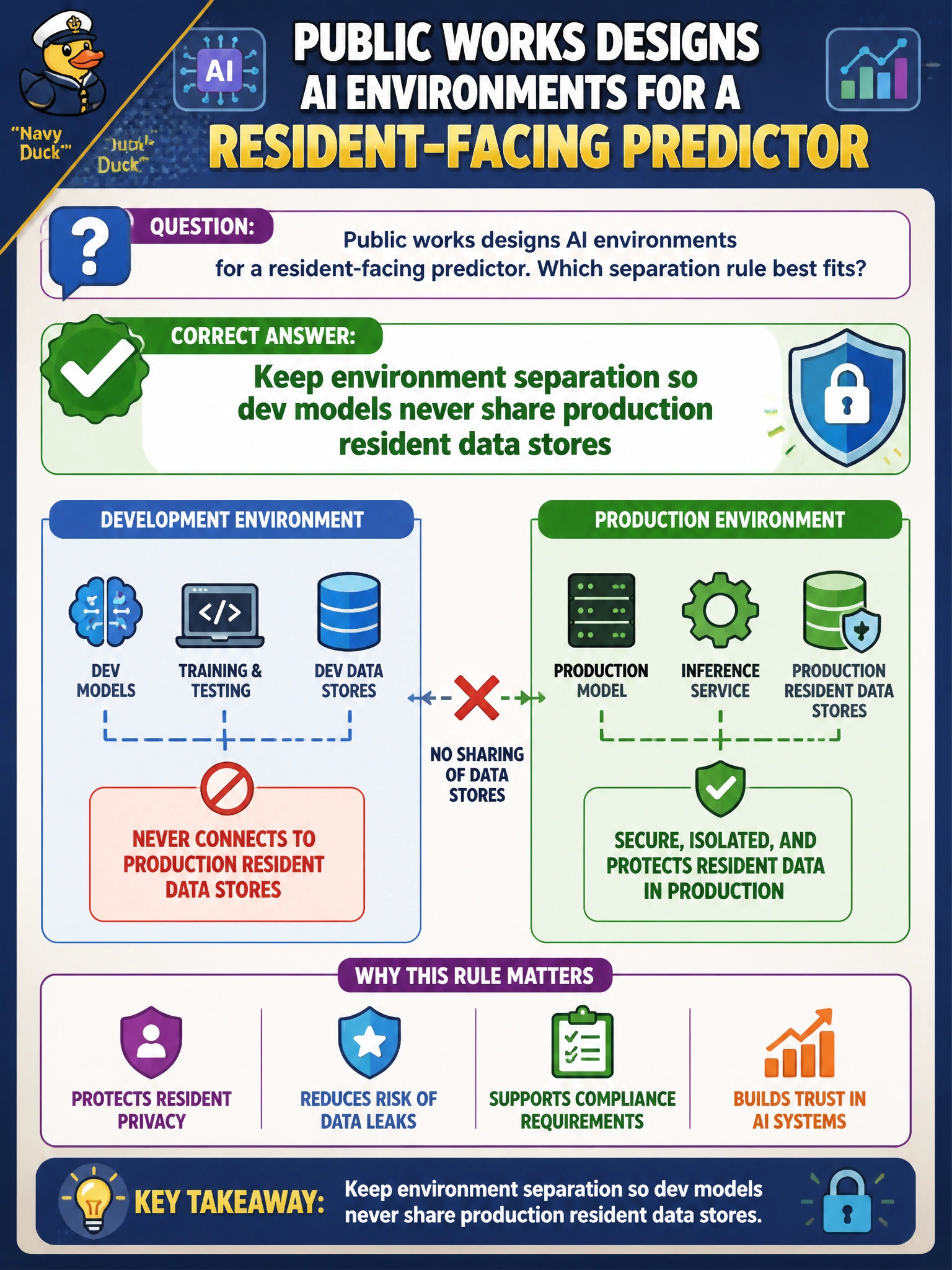
Public works designs AI environments for a resident-facing predictor. Which separation rule best fits?
Select an answer to reveal the explanation.
Short Explanation
You can protect residents by keeping environment separation in place: development models should never share production resident-data stores. That gives you room to experiment without exposing live resident information to unstable code.
Full Explanation
Public works should keep environment separation so development models never share production resident-data stores. Dev and test environments support safe experimentation; collapsing them into production data paths exposes live resident information to unstable code, broader developer access, and weaker change control. Separation includes distinct identities, datasets (synthetic or minimized where possible), networks, and promotion gates. For a resident-facing predictor, isolation is foundational AI security architecture that limits breach and misuse blast radius. Allowing developers to build and validate models using live resident-data stores maximizes personal-data exposure to non-production tooling. Sharing production credentials with every sandbox by default turns sandboxes into stealth production clients. Collapsing dev, test, and prod into one environment to save money optimizes cost while destroying containment—a false economy for civic systems. Exam caveat: environment separation protects production resident data from dev/test reachability; merely naming three folders on one shared database does not provide it. Practical check: provision isolated data stores and credentials per environment, deny dev identities access to production resident databases, use masked or synthetic data in lower tiers where feasible, and verify through access reviews that no sandbox holds production secrets before the predictor goes live.