
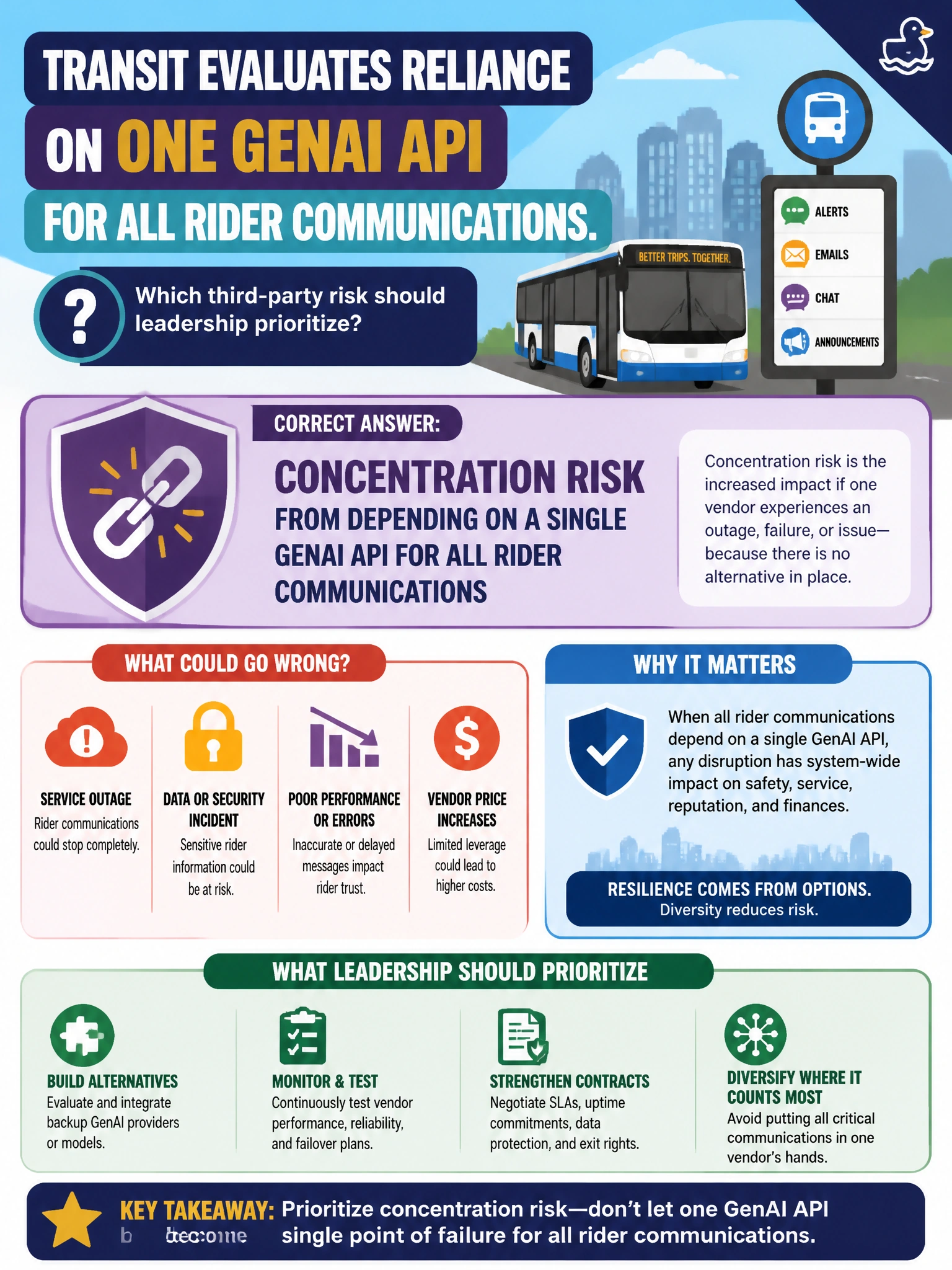
Transit evaluates reliance on one GenAI API for all rider communications. Which third-party risk should leadership prioritize?
Select an answer to reveal the explanation.
Short Explanation
One API for every rider message is a single point of failure wearing a friendly chat face. Call it concentration risk and plan for it.
Full Explanation
Transit evaluating reliance on one GenAI API for all rider communications should prioritize the third-party dependency that creates a single point of failure. Concentration risk from depending on a single GenAI API for all rider communications is correct because outage, price shock, policy change, or degradation at that one API can halt or distort every rider-facing message path. Municipal transit leadership should treat that concentration as a supply-chain and availability risk requiring fallbacks, diversification, or hardened contractual resilience.
Only the risk that bus ads use the wrong font weight fails by concept: advertising typography is unrelated to GenAI API concentration for rider communications. The belief that single-API dependence creates zero supply-chain exposure fails by concept: it denies concentration risk by assertion rather than assessing dependency. Only risks related to souvenir mug inventory fail by concept: retail inventory does not address rider-communications API concentration.
Exam caveat: concentration risk can be accepted temporarily with compensating controls, but acceptance must be explicit—denying exposure is not acceptance. Multi-channel rider communications (app, SMS, web, agency) may still share one GenAI backend; map the real dependency, not just the front-end brands.
Operational check: inventory rider communication flows that call the single GenAI API; score concentration risk; define a non-GenAI or alternate-provider degraded mode; test it during a simulated API outage; and present residual concentration risk to transit leadership before expanding the API to additional critical message types.