
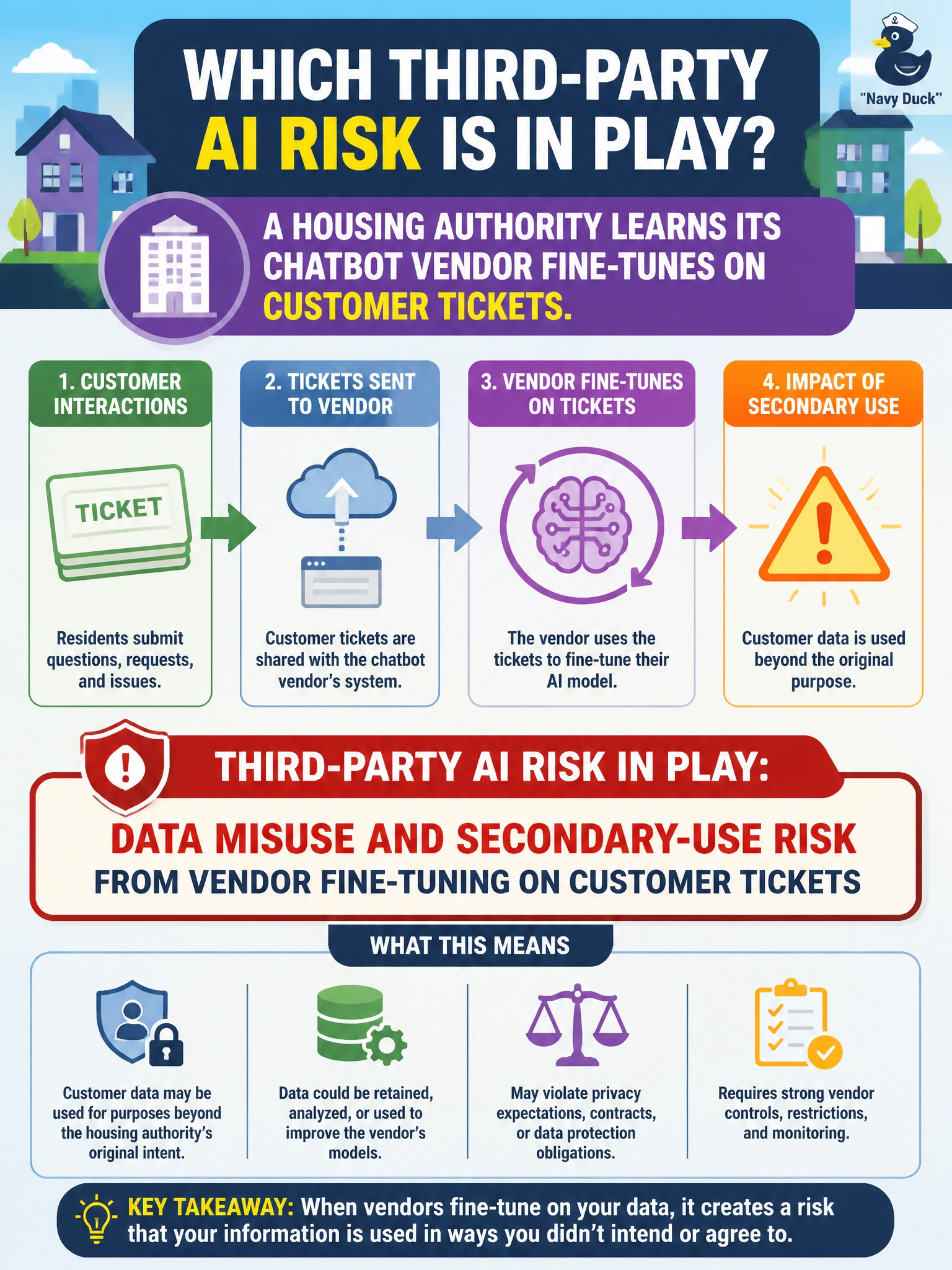
A housing authority learns its chatbot vendor fine-tunes on customer tickets. Which third-party AI risk category is in play?
Select an answer to reveal the explanation.
Short Explanation
Those tickets aren’t free training fuel. Fine-tuning on housing customer text is secondary-use risk—treat it like data misuse, not lobby furniture drama.
Full Explanation
A housing authority learning its chatbot vendor fine-tunes on customer tickets is facing a classic third-party AI data-use problem. Data misuse and secondary-use risk from vendor fine-tuning on customer tickets is correct because ticket text can contain resident PII, housing circumstances, and other sensitive civic information that was collected for service—not for the vendor’s model improvement. Secondary use without clear lawful basis, notice, and contractual limits is a core third-party AI risk category for housing authorities.
Only risks from lobby furniture warranties fail by concept: furniture warranties do not address training on customer ticket content. The belief that ticket text can never leave the chat window fails by concept: fine-tuning implies the vendor retains and reuses content beyond the live session. Only risks from parking garage lighting timers fail by concept: lighting timers are unrelated to secondary use of housing customer tickets.
Exam caveat: not every form of telemetry is fine-tuning, and some vendors offer no-train options—but once fine-tuning on tickets is confirmed, classify it as secondary-use/data-misuse risk and address it contractually and operationally. Redaction alone may be incomplete if tickets remain rich enough to re-identify residents.
Operational check: require the chatbot vendor to disclose training/fine-tuning uses of housing ticket data; disable secondary training where possible; amend the contract to prohibit unauthorized fine-tuning and mandate deletion; verify via questionnaire/audit evidence; and notify privacy/legal before any residual ticket data remains eligible for vendor model improvement.