
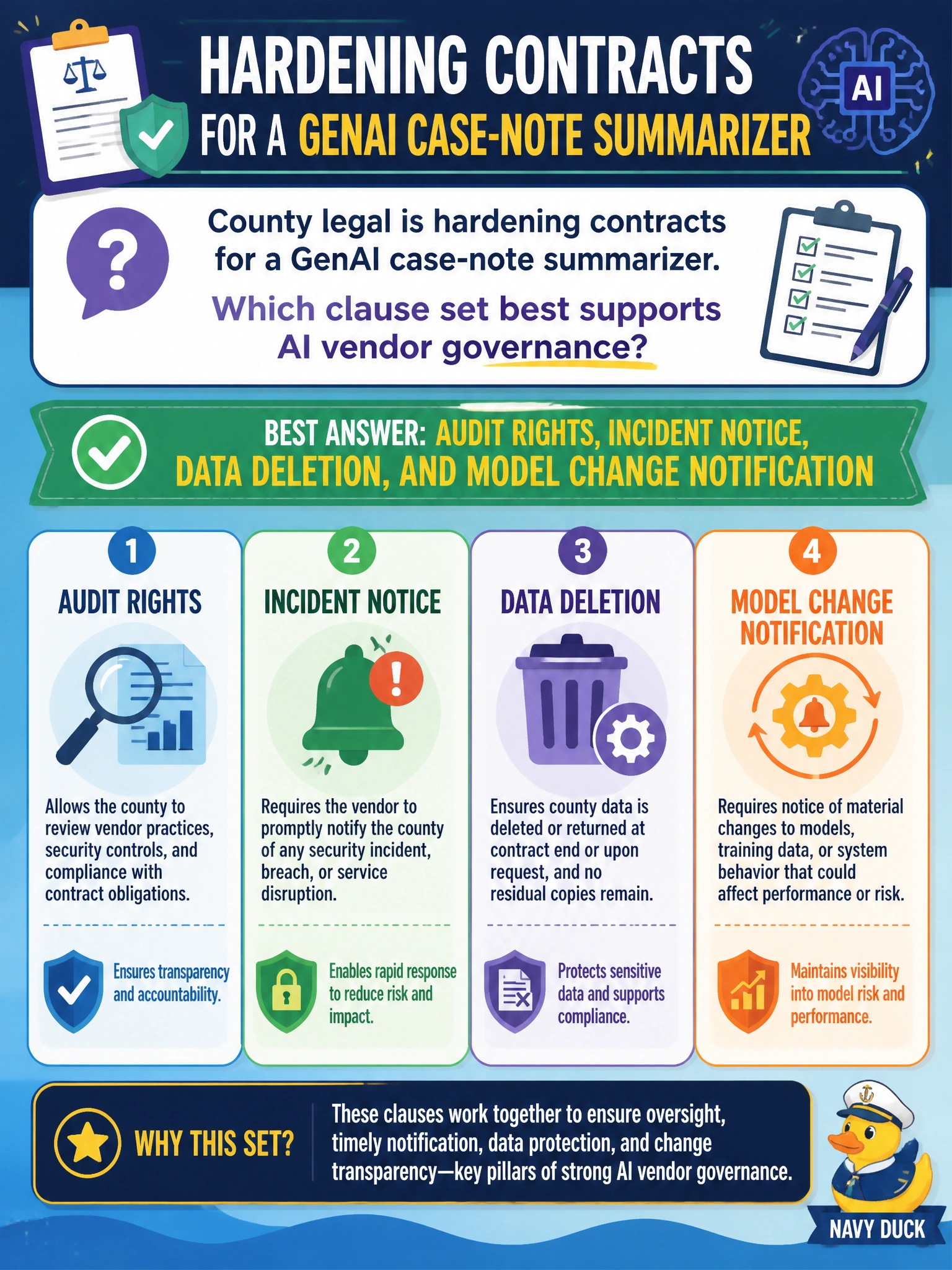
County legal is hardening contracts for a GenAI case-note summarizer. Which clause set best supports AI vendor governance?
Select an answer to reveal the explanation.
Short Explanation
Contracts are your seatbelt. Audit rights, incident notice, deletion, and model-change alerts keep the county from flying blind when the vendor shifts gears.
Full Explanation
County legal hardening contracts for a GenAI case-note summarizer needs enforceable oversight clauses, not silence and unbounded data use. Audit rights, incident notice, data deletion, and model change notification is the clause set that best supports AI vendor governance because it preserves the county’s ability to verify controls, learn of incidents promptly, require data return/destruction, and learn when model behavior may change. For civic legal/case-adjacent GenAI, those duties are foundational third-party AI controls.
Clauses that ban all audits and silence incident notices fail by concept: they block detection and oversight precisely when GenAI mishandles sensitive case notes. Clauses that allow indefinite secondary use of all county data fail by concept: unbounded secondary use creates data-misuse and privacy risk incompatible with public-sector data stewardship. Clauses that omit deletion and model-change duties fail by concept: without deletion and change notice, the county cannot offboard cleanly or revalidate after behavior shifts.
Exam caveat: naming the clause set is not the same as perfect operationalization—notice SLAs, audit scope, and deletion timelines still need specificity. The exam focuses on which control themes belong in the contract for AI vendor governance.
Operational check: before executing the GenAI summarizer agreement, confirm the contract includes audit rights, incident notification timelines, data deletion/return on exit, and model-change notification; reject redlines that ban audits, permit indefinite secondary use, or omit deletion/change duties; and calendar a post-signature control test of the notice and deletion pathways.