
An assessor’s office evaluates what happens if valuation AI systematically skews one district. Which impact dimensions should the risk assessment capture?
Select an answer to reveal the explanation.
Short Explanation
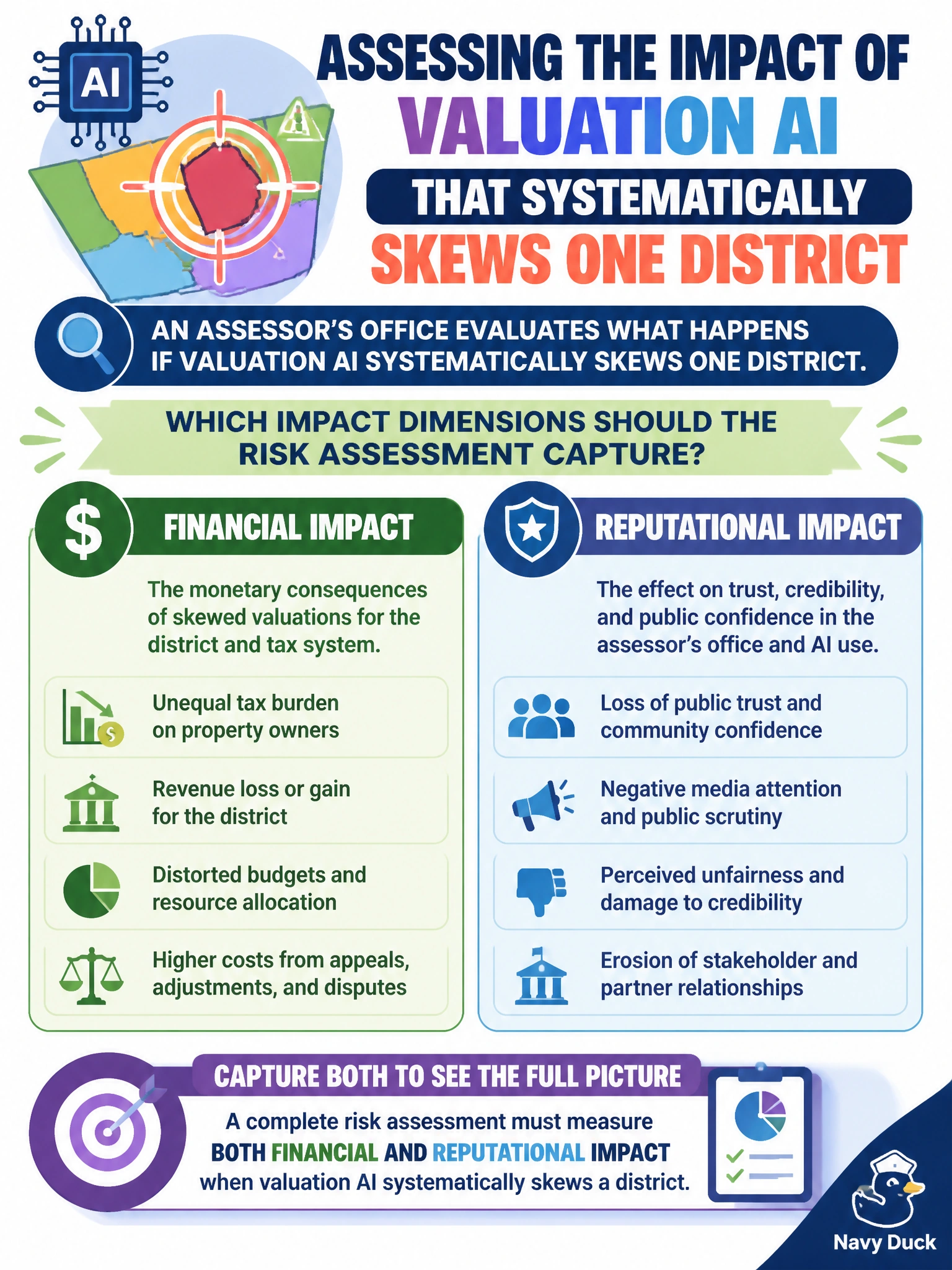
If valuation AI leans on one district, you’re not arguing about fonts—you’re talking money and reputation. Capture financial and reputational impact, not lobby décor.
Full Explanation
When an assessor’s office evaluates what happens if valuation AI systematically skews one district, the risk assessment must capture material impact dimensions, not cosmetic UI preferences. Financial and reputational impact if valuation AI systematically skews a district is correct because uneven valuations can shift tax burdens unfairly, trigger appeals and litigation costs, and erode public confidence in the assessor’s fairness. Civic valuation AI is a high-visibility municipal decision system; impact analysis that omits money and reputation understates enterprise exposure and under-prioritizes controls.
Only the color of the model dashboard theme fails by concept: theme aesthetics do not measure harm from skewed district outcomes. Only whether staff like the user interface fonts fails by concept: subjective UI taste is not an impact dimension for systematic valuation bias. Only the number of coffee machines in the assessor lobby fails by concept: facilities amenities are unrelated to AI outcome skew and do not inform residual risk or mitigation priority.
Exam caveat: capturing financial and reputational impact does not require proving intent to discriminate; systematic skew can arise from data drift, feature bias, or process errors. Impact scoring should still be documented even while root-cause analysis continues.
Operational check: for any valuation-assist AI, require the risk assessment to score financial impact (appeals, refunds, inequitable burden) and reputational impact (public trust, media, oversight) under a district-skew scenario; compare scores to control maturity; and escalate if residual impact remains above the assessor’s appetite before expanding production use.