
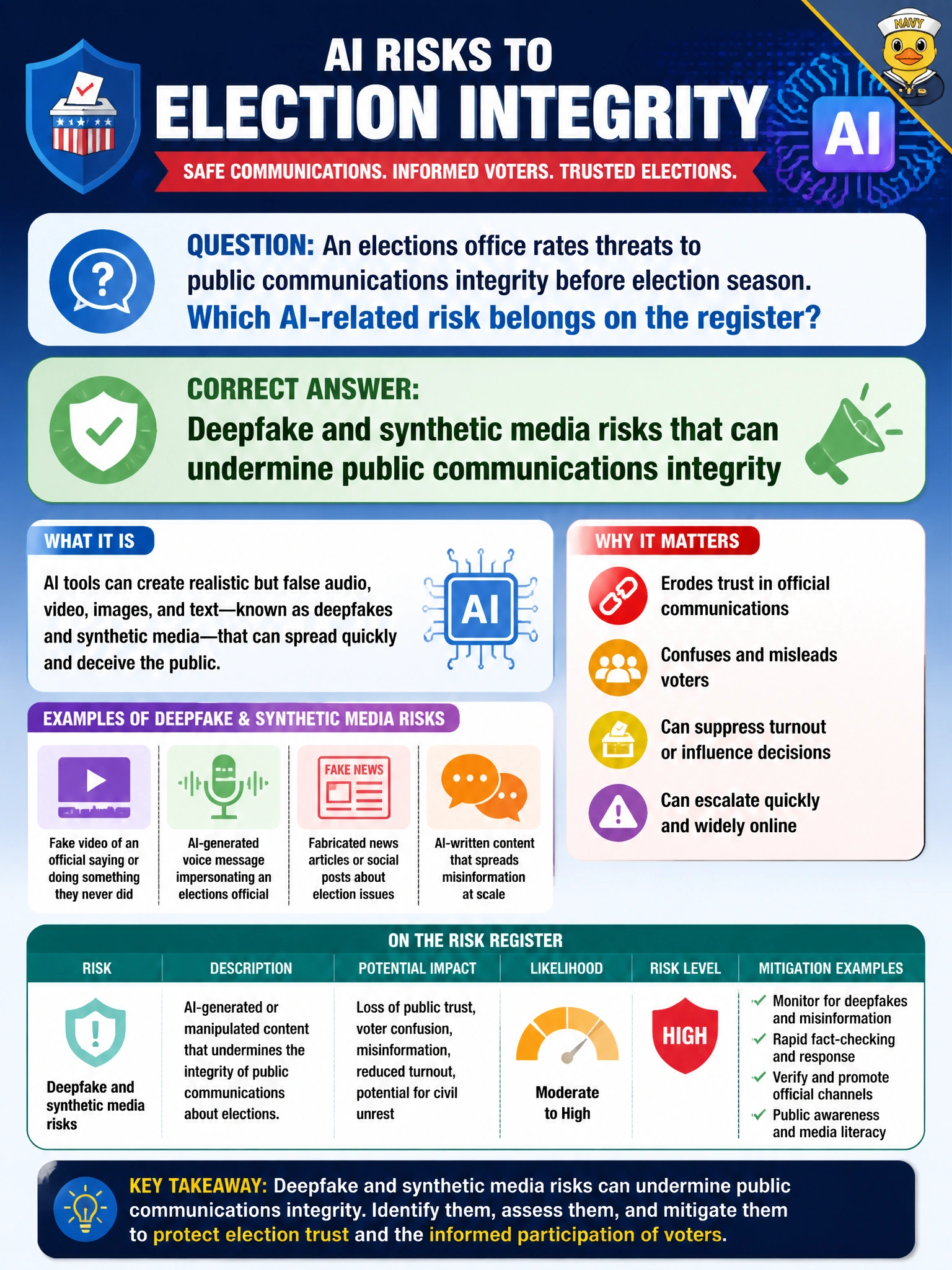
An elections office rates threats to public communications integrity before election season. Which AI-related risk belongs on the register?
Select an answer to reveal the explanation.
Short Explanation
Election season isn’t just about ballots—it’s about trust. Deepfakes and synthetic media can scramble public messaging, so that risk belongs on the register next to the boring printer stuff.
Full Explanation
An elections office must rate threats to public communications integrity before election season, and AI-related threats belong on that register alongside traditional ones. Deepfake and synthetic media risks that can undermine public communications integrity are correctly listed because fabricated audio, video, or imagery can impersonate officials, fabricate emergency notices, or distort candidate and polling-place messages. For municipal elections programs, that is an integrity and trust risk with direct civic impact, not a novelty side topic. Rating it before peak season lets the office plan monitoring, rapid-response messaging, verification channels, and resident guidance while there is still time to rehearse.
Only risks from paper ballot printers overheating fail by concept: printer hardware failures are operational but do not address AI-era synthetic media threats to public messaging. Only risks from cafeteria menu software fail by concept: cafeteria systems are unrelated to elections communications integrity and do not belong as the AI threat of record on this register. The belief that synthetic media never affects civic trust fails by concept: it denies a documented threat class instead of rating likelihood and impact for election-season communications.
Exam caveat: placing deepfake risk on the register is not the same as proving a specific deepfake already occurred; the exam item tests threat identification and inclusion, not incident confirmation. Also, ballot-system physical risks remain valid separately—synthetic media does not replace them.
Operational check: before election season, confirm the elections risk register explicitly includes deepfake/synthetic-media threats to official public communications; assign an owner; define detection and public-verification playbooks; and run a tabletop where a fabricated official message appears so staff can exercise confirmation channels and resident guidance without waiting for a live crisis.