
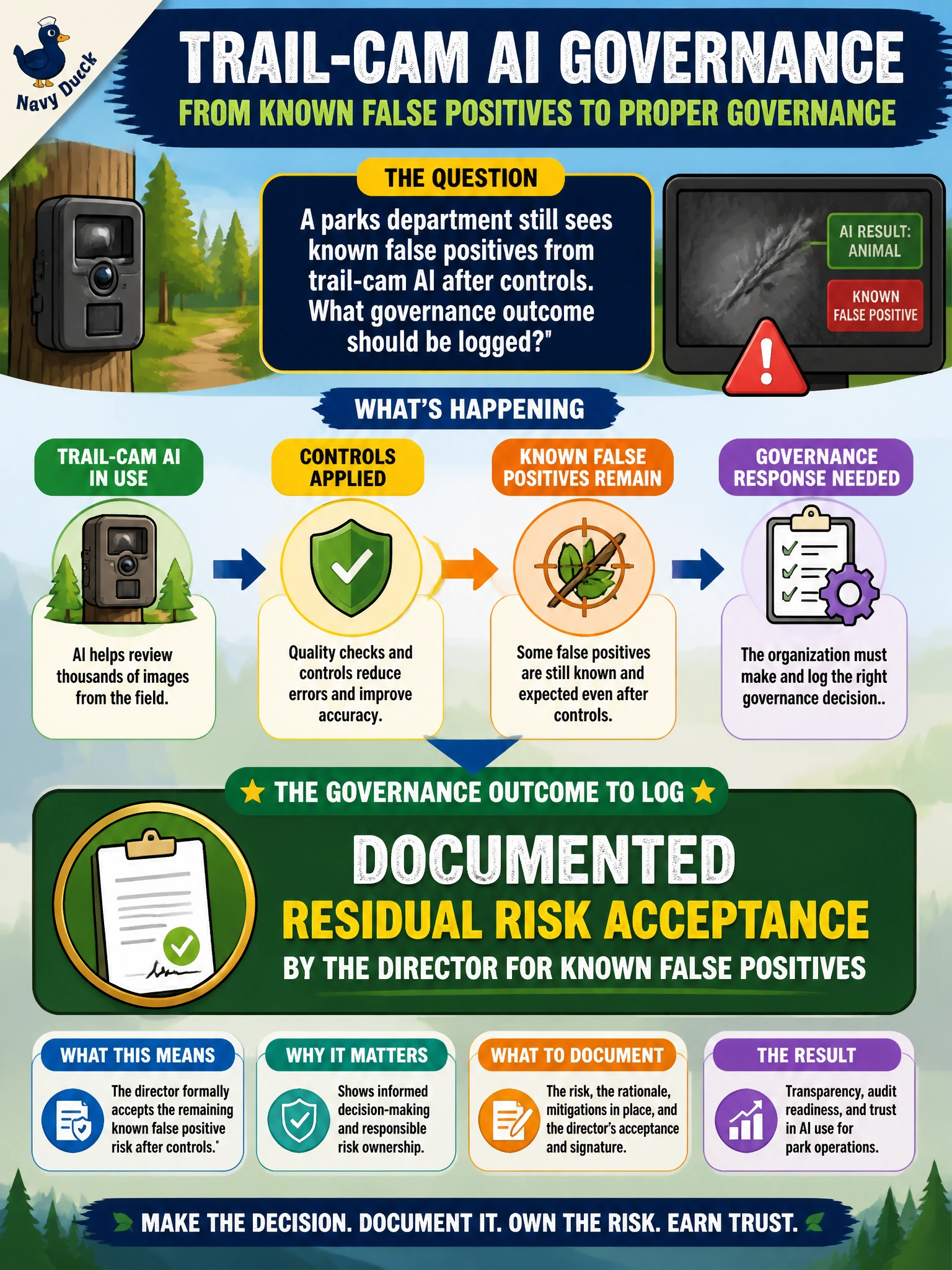
A parks department still sees known false positives from trail-cam AI after controls. What governance outcome should be logged?
Select an answer to reveal the explanation.
Short Explanation
False positives didn’t vanish—they just got owned. Log the director’s residual risk acceptance so everyone knows what was knowingly left on the table.
Full Explanation
A parks department that still sees known false positives from trail-cam AI after controls must record a governance outcome for what remains—not pretend the risk vanished. Documented residual risk acceptance by the director for known false positives is correct because residual risk that is knowingly retained needs an authorized owner’s acceptance on the register. In municipal parks programs, false positives can waste ranger time, affect visitor experience, or trigger unnecessary responses; accepting them formally creates accountability, monitoring triggers, and a review date instead of informal tolerance.
Delete the risk register so false positives disappear on paper fails by concept: destroying documentation does not reduce risk and violates risk-management integrity. Pretend residual risk is zero because the vendor emailed a logo fails by concept: marketing artifacts are not evidence that residual false positives are gone. Transfer ownership of residual risk to an unpaid intern with no authority fails by concept: residual acceptance requires an accountable official with authority—here framed as the director—not someone who cannot own municipal risk.
Exam caveat: residual risk acceptance is appropriate for known, bounded leftovers after reasonable controls; it is not a substitute for fixing intolerable safety or rights harms. Acceptance should be time-bounded and revisit when false-positive rates or mission impact change.
Operational check: after trail-cam AI controls are applied, log measured residual false-positive behavior, obtain the parks director’s documented acceptance (or rejection) with conditions and a review date, keep the entry visible on the AI risk register, and verify operators know the accepted residual so they do not treat every alert as high-confidence truth.