
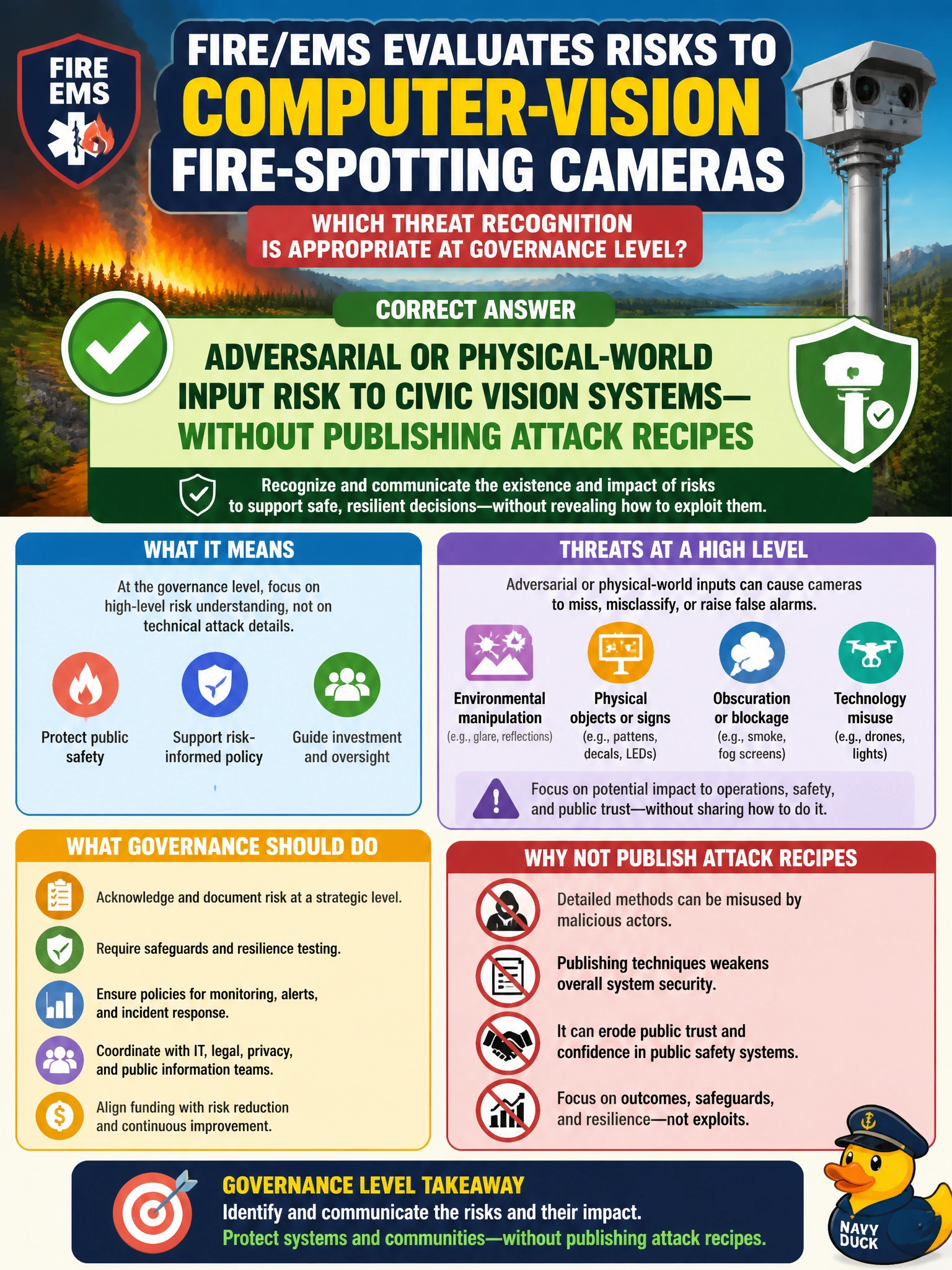
Fire/EMS evaluates risks to computer-vision fire-spotting cameras. Which threat recognition is appropriate at governance level?
Select an answer to reveal the explanation.
Short Explanation
Vision cameras can be fooled by the physical world—not only by network CVEs. Recognize adversarial input risk; don’t publish how-to attack recipes.
Full Explanation
Fire/EMS evaluating risks to computer-vision fire-spotting cameras should recognize adversarial or physical-world input risk to civic vision systems—without publishing attack recipes. Vision models can be degraded or fooled by manipulated scenes, adversarial patterns, or environmental conditions that differ from training. Governance needs this threat class on the register so detection integrity, redundancy, and human confirmation controls are funded for life-safety sensing.
Claiming physical-world inputs can never fool vision models fails by concept because camera AI is input-dependent and known to be sensitive to distribution shift and crafted scenes. Claiming only network CVEs matter for camera AI fails because integrity failures can occur at the sensing/model layer even when hosts are patched. Claiming fire-spotting cameras need no AI risk discussion fails because automated spotting influences emergency response prioritization.
Exam caveat: governance recognition means describing impact and controls at an oversight level; detailed exploit playbooks are unnecessary and harmful in municipal briefings. Operational check: add physical-world/adversarial input risk to the Fire/EMS AI register, require human confirmation pathways for critical alerts, and test performance under weather, occlusion, and sensor-fault scenarios before relying on automated spotting.