
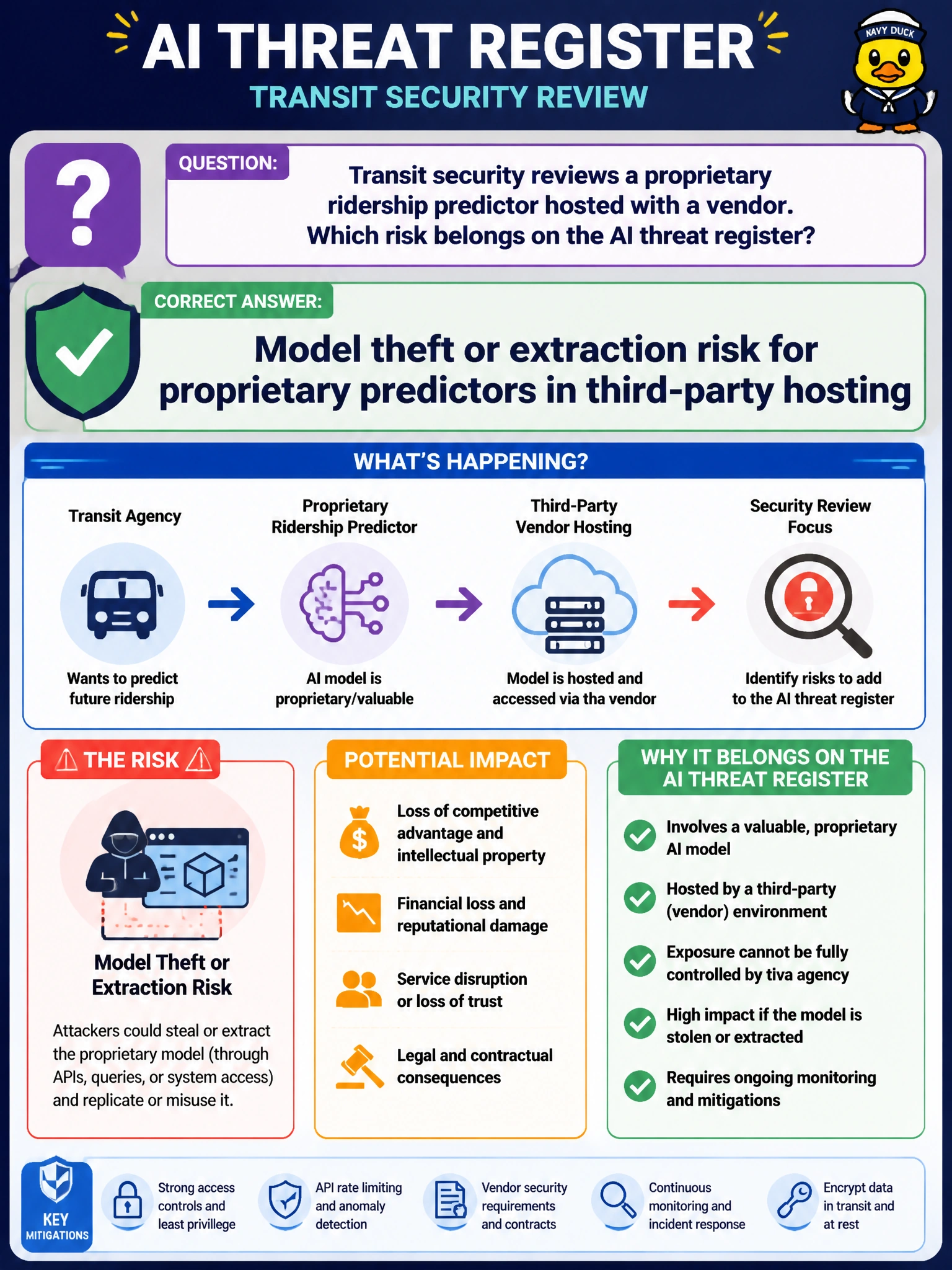
Transit security reviews a proprietary ridership predictor hosted with a vendor. Which risk belongs on the AI threat register?
Select an answer to reveal the explanation.
Short Explanation
A proprietary ridership predictor at a vendor isn’t just “their problem.” Model theft and extraction belong on the threat register—logo fonts don’t.
Full Explanation
For a proprietary transit ridership predictor hosted with a vendor, model theft or extraction risk belongs on the AI threat register. Third-party hosting expands the parties, interfaces, and incentives that could copy, query-extract, or misuse a model that encodes operational advantage and civic planning insight. Governance should treat proprietary predictors as protectable assets with confidentiality, access, contractual, and monitoring controls—not as ordinary low-sensitivity dashboards.
Listing only the risk that the logo font is slightly off fails by concept because branding polish is not an AI threat category for proprietary predictors. Claiming models never leave vendor environments under any condition fails because backups, subprocessors, support access, and API query patterns can still enable extraction or leakage. Claiming ridership models have no competitive or operational value to protect fails because transit predictors inform capacity and investment decisions that adversaries or competitors could exploit.
Exam caveat: “hosted with a vendor” does not eliminate theft/extraction risk; it relocates and reshapes it, often increasing dependency on contractual and API abuse controls. Operational check: require contractual IP/confidentiality and anti-extraction terms, minimize query interfaces, log anomalous bulk inference, and verify subprocessor boundaries before go-live and at renewal.