
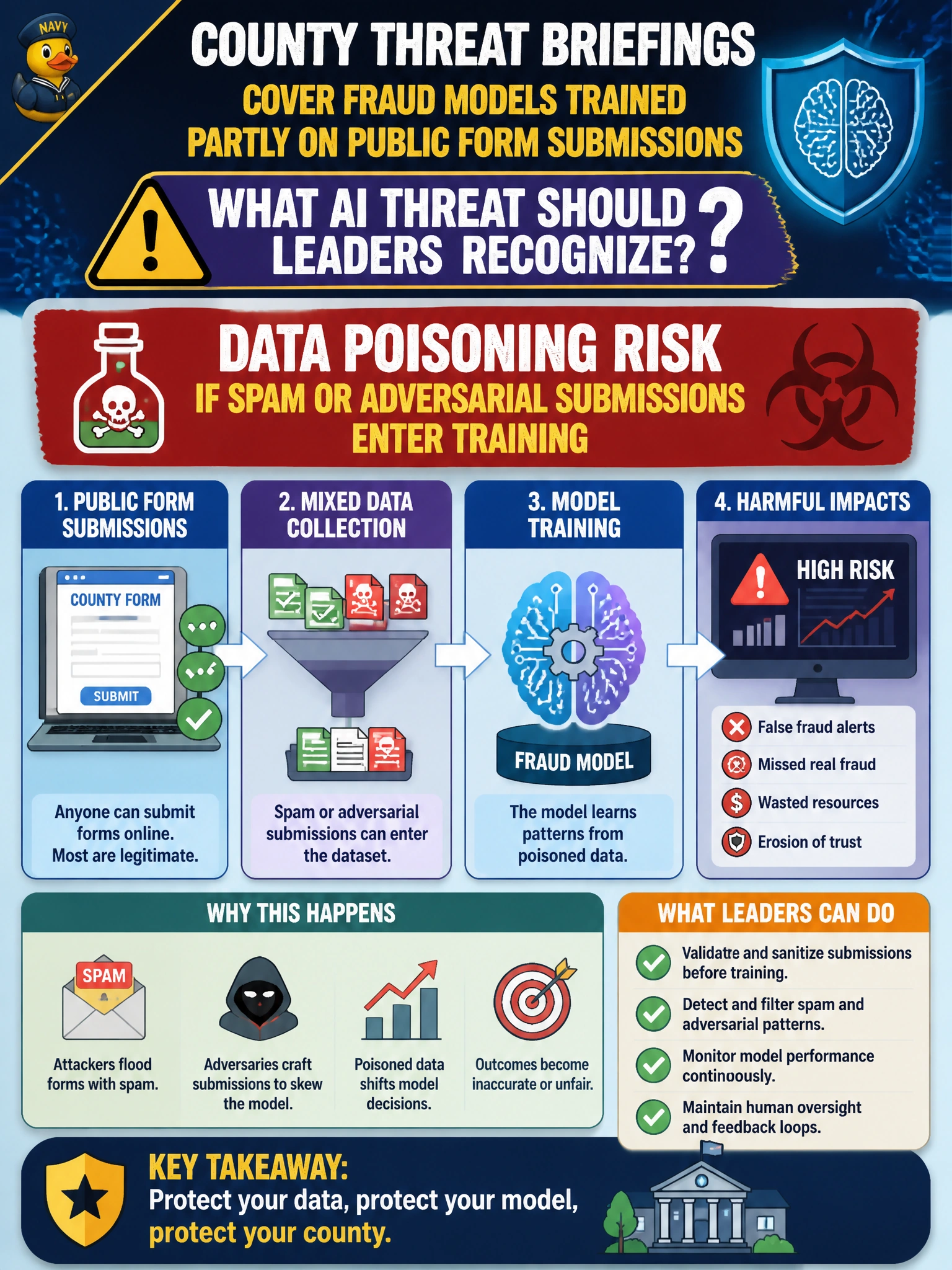
County threat briefings cover fraud models trained partly on public form submissions. What AI threat should leaders recognize?
Select an answer to reveal the explanation.
Short Explanation
If spammy public forms feed the fraud model, you’ve got a data-poisoning problem. Leaders should see that threat before junk becomes “ground truth.”
Full Explanation
County threat briefings covering fraud models trained partly on public form submissions should recognize data poisoning risk if spam or adversarial submissions enter training. Public intake channels are attacker-accessible: adversaries can plant misleading examples that skew detection thresholds, create blind spots, or encode abusive patterns. For municipal fraud models, training-data integrity is therefore a first-class AI threat, not a minor data-quality footnote.
Claiming public forms can never affect model quality fails by concept because training corpora derived from those forms directly shape learned behavior. Asserting that only stolen laptops matter for AI risk fails because endpoint theft is real but incomplete—integrity attacks on training pipelines are independent pathways. Claiming training data needs no integrity controls fails because unsupervised ingestion of hostile public inputs is exactly how poisoning succeeds.
Exam caveat: poisoning risk exists even when forms are “public records” workflows; openness of intake does not imply trustworthiness of content for model fitting. Operational check: gate training sets with filtering, anomaly review, and provenance tags for public-form sources; retrain only from approved snapshots; and monitor production drift metrics after each training cycle involving public submissions.