
County risk counsel reviews staff treating AI zoning recommendations as binding orders. What legal risk management step is most appropriate?
Select an answer to reveal the explanation.
Short Explanation
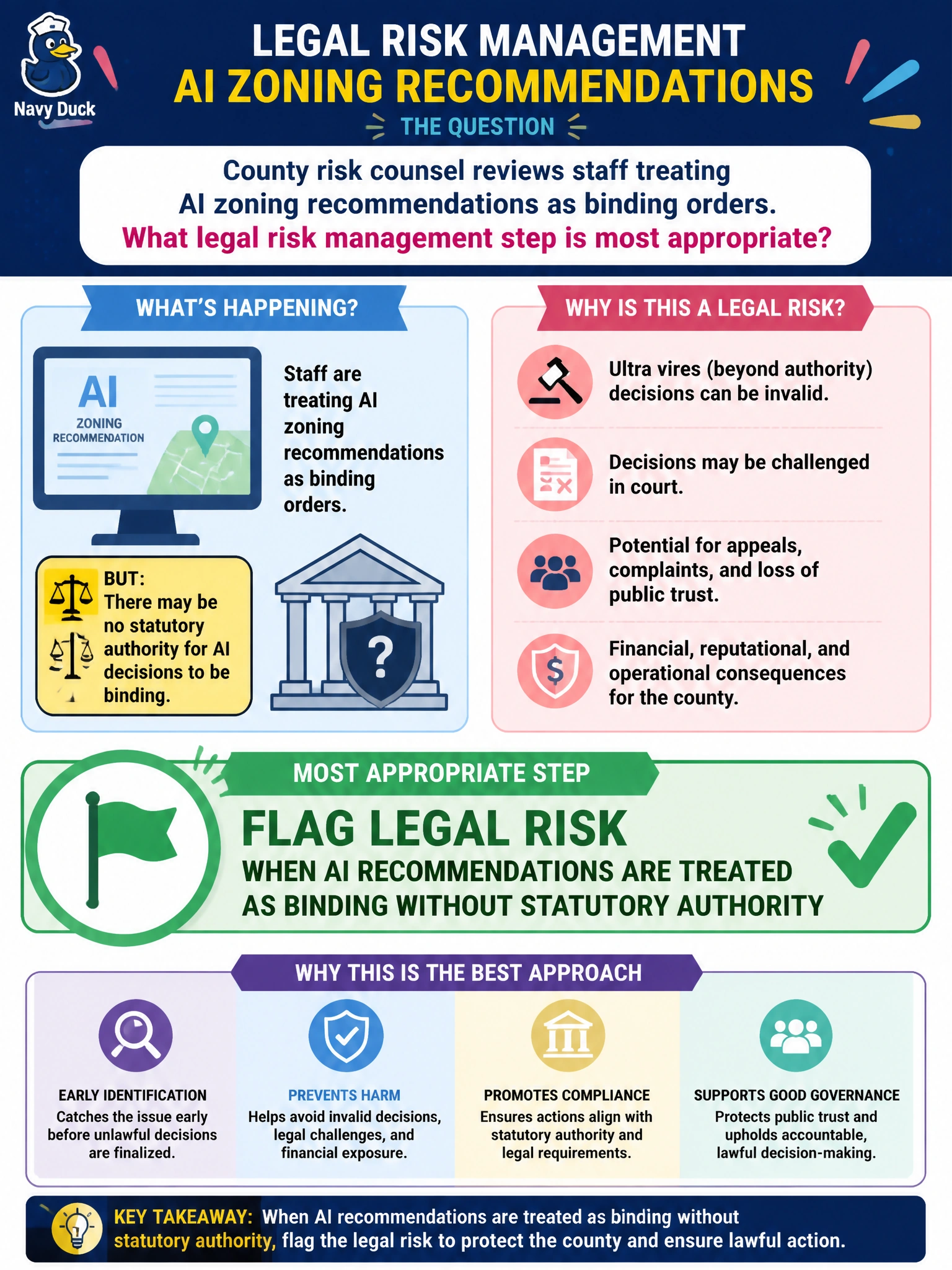
AI isn’t a judge with a gavel unless the statute says so. Treating recommendations as binding without legal authority is exactly the risk counsel should flag.
Full Explanation
County risk counsel correctly flags legal risk when staff treat AI zoning recommendations as binding orders without statutory authority. Legal risk management for civic AI starts from the principle that algorithms do not create law: recommendations remain advisory unless a statute, ordinance, or properly delegated authority makes a system’s output operative. Treating model suggestions as enforceable decisions invents unauthorized decision-making and exposes the county to ultra vires, due-process, and challengeability problems in land-use administration.
Codifying that every AI suggestion is automatically enforceable law fails by concept because a policy shortcut cannot invent statutory power the legislature did not grant. Deleting statutes so AI outputs become the only authority fails because discarding law to elevate a model inverts the legal hierarchy and is not risk management. Treating the vendor’s confidence score as a substitute for statutory authority fails because probabilistic confidence is not legal authorization and does not cure the binding-without-authority defect.
Exam caveat: high accuracy or high confidence never converts an advisory zoning tool into a lawful final order; authority and procedure remain independent of model quality. Operational check: issue written guidance that AI zoning outputs are non-binding recommendations, require human decision records citing legal authority, and audit sample files for language that improperly treats model text as an order.