
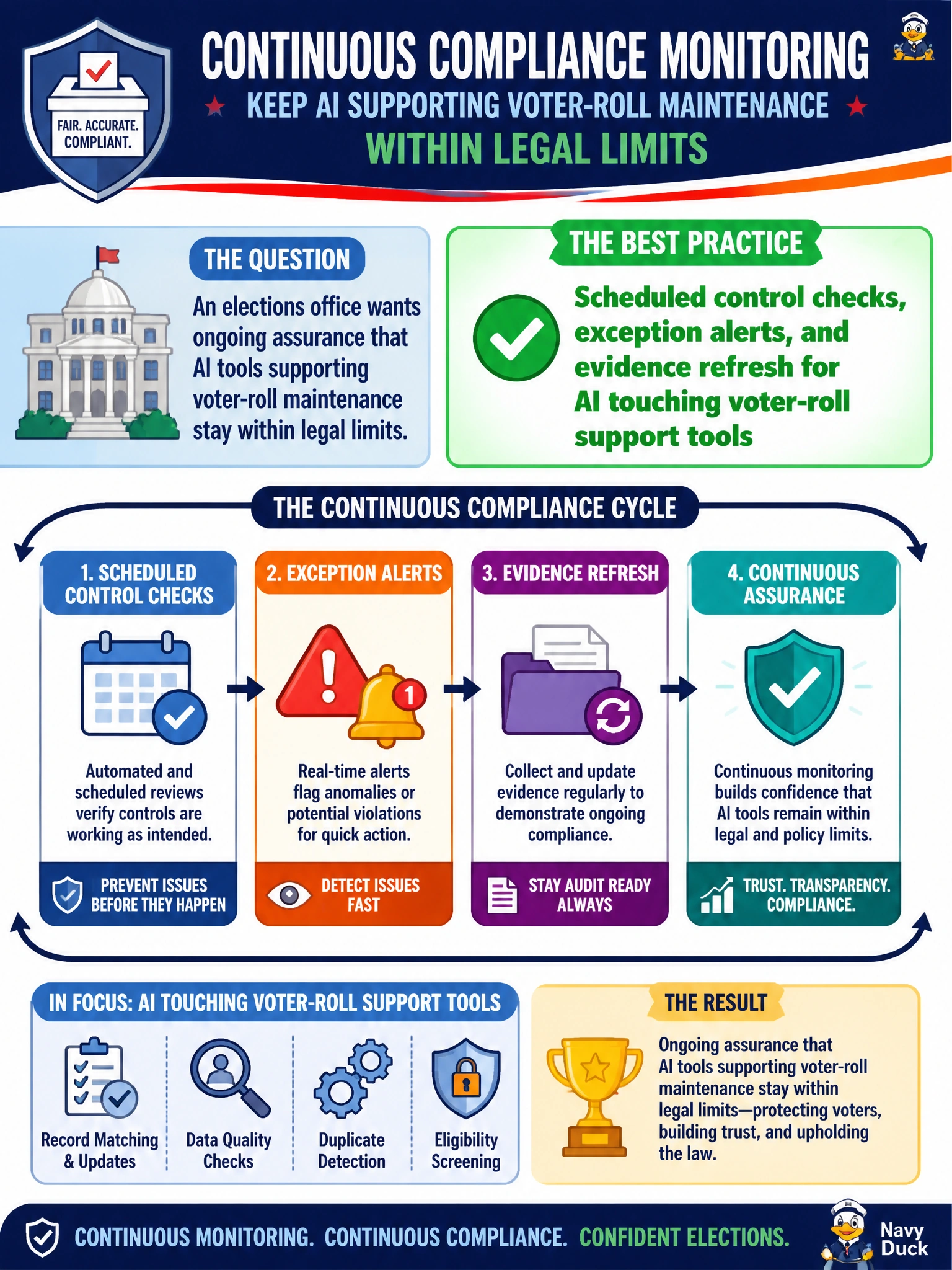
An elections office wants ongoing assurance that AI tools supporting voter-roll maintenance stay within legal limits. What practice best fits continuous compliance monitoring?
Select an answer to reveal the explanation.
Short Explanation
Elections AI isn’t a set-it-and-forget-it toaster. Continuous compliance means scheduled checks, alerts on exceptions, and fresh evidence—especially when tools touch voter-roll support.
Full Explanation
Continuous compliance monitoring for elections AI that supports voter-roll maintenance is an ongoing control program, not a purchase-day event. The correct practice combines scheduled control checks, exception alerts, and refreshed evidence so the office can show that tools remain inside legal limits as data, vendors, models, and statutes change. Recurring tests verify that access, purpose limitation, change control, and logging still match the approved use case; alerts surface drift or policy exceptions while they are still remediable; and evidence refresh keeps artifacts current for auditors, counsel, and election officials.
A one-time legal memo filed at purchase fails by concept because continuous compliance is temporal: legal fitness at procurement does not prove fitness months later after configuration or vendor changes. Relying only on vendor blog posts about future regulations fails because marketing commentary is not control evidence and does not bind the municipality’s actual deployment. Disabling all logs so nothing can be audited later fails because monitoring without durable records cannot demonstrate assurance and actively undermines accountability for high-trust civic systems.
Exam caveat: continuous monitoring complements—but does not replace—statutory authority, privacy constraints, and human oversight for election-adjacent decisions; monitoring proves control operation, not that the AI may legally decide outcomes. Operational check: maintain a dated control calendar for each voter-roll support AI, retain alert and evidence packages per retention policy, and require re-attestation after material model, data-source, or vendor changes before the next election cycle.