
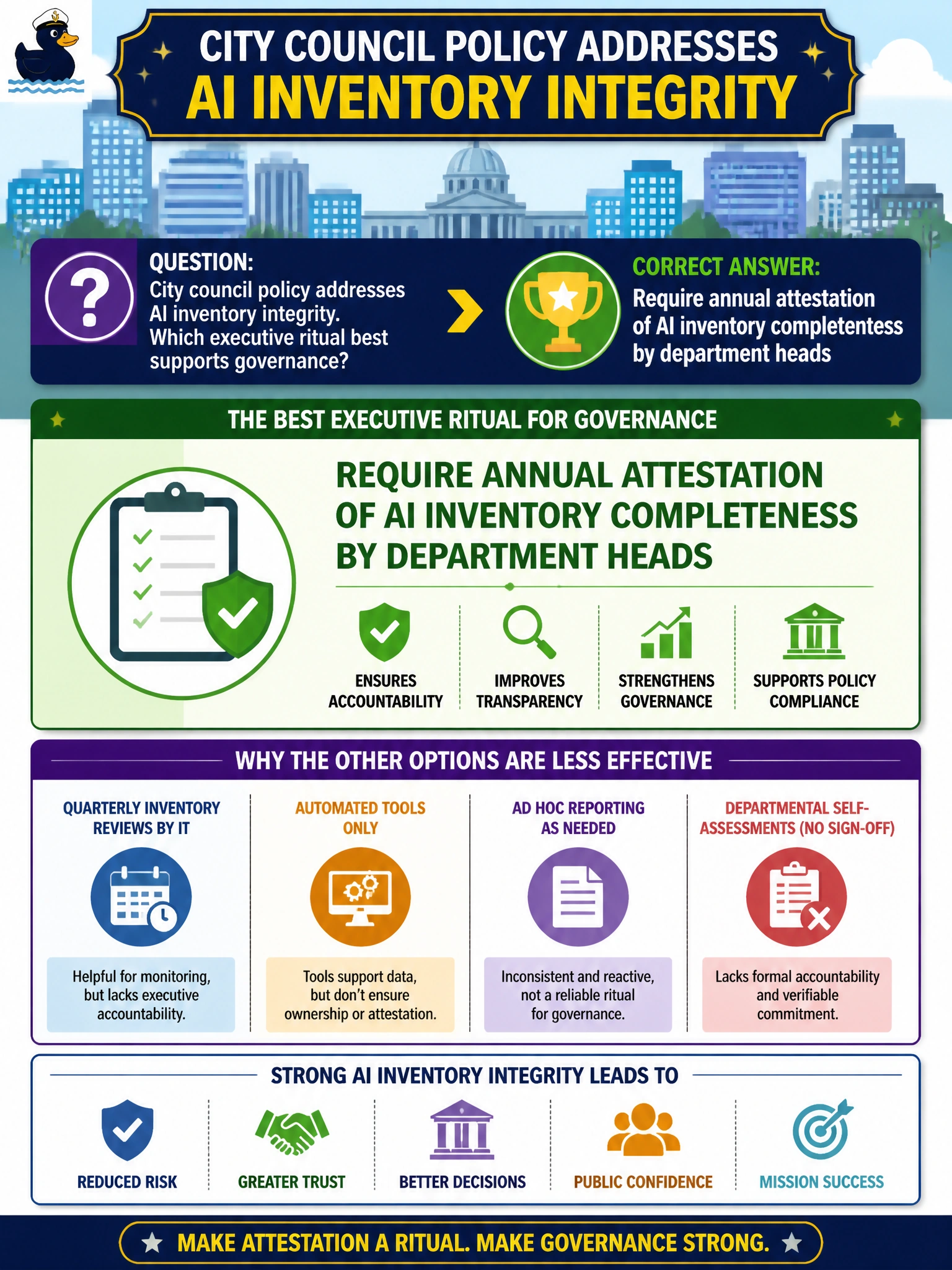
City council policy addresses AI inventory integrity. Which executive ritual best supports governance?
Select an answer to reveal the explanation.
Short Explanation
Once a year, department heads should put their name on “this is our complete AI inventory.” That ritual keeps shadow systems from living under the desk.
Full Explanation
Annual attestation of AI inventory completeness by department heads is an executive governance ritual that forces visibility. When directors must formally attest that listed systems are complete and that unknown AI has been declared or investigated, shadow tools surface, owners get named, and the board gains a control point comparable to other municipal asset attestations. The ritual pairs with the CAIO/inventory owner’s reconciliation process so completeness is both cultural and procedural.
Never asking departments what AI they run fails discovery and leaves the city blind to risk. Allowing only vendors to attest for city systems fails by concept: vendors lack authority and full visibility into departmental shadow use; municipal executives own the inventory duty. Publishing a fake inventory so auditors stop asking fails integrity and creates fraud/false-statement risk—worse than an incomplete but honest inventory with a remediation plan.
Exam caveat: attestation frequency may be annual or aligned to audit cycles; the principle is recurring executive accountability for completeness, not a one-time spreadsheet. Operational check: collect signed (or workflow-approved) attestations, reconcile against procurement and IT discovery, track exceptions for unattested systems, and report completeness metrics to the AI governance board.