
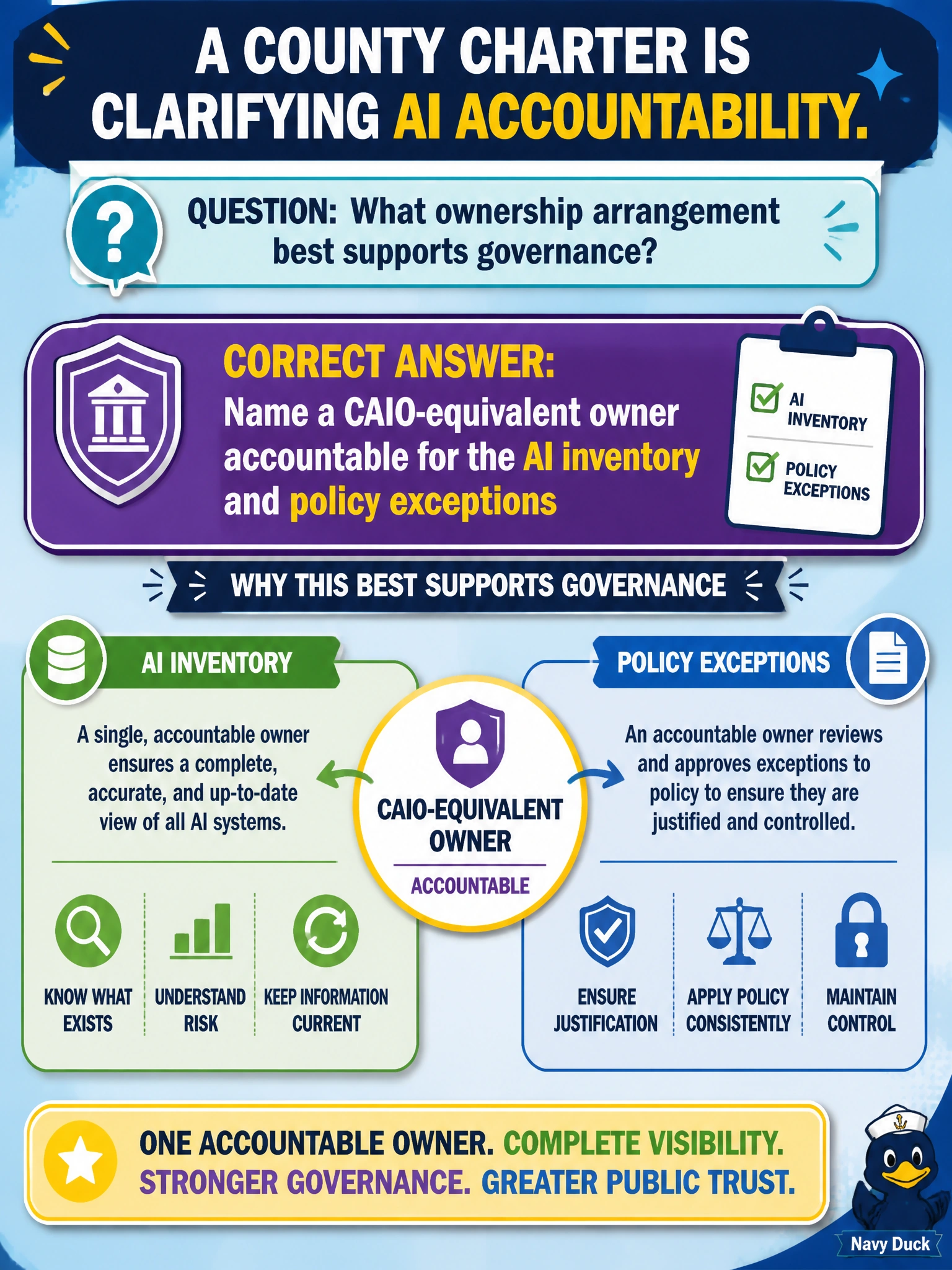
A county charter is clarifying AI accountability. What ownership arrangement best supports governance?
Select an answer to reveal the explanation.
Short Explanation
Somebody’s name has to be on the AI inventory and the exception pad. A CAIO-equivalent owner beats “everyone owns it,” which usually means nobody does.
Full Explanation
Accountability in a county AI charter starts with named ownership. Assigning a CAIO-equivalent owner who is accountable for the AI inventory and for policy exceptions creates a single point of responsibility for completeness of the portfolio, currency of risk tiers, and authorized deviations from baseline controls. That clarity enables the board and auditors to ask one accountable official how exceptions were granted, how inventory gaps are closed, and how departmental shadow systems are brought into view—core requirements for municipal governance of AI.
Leaving inventory ownership unnamed so any department can claim it fails because distributed claim without duty produces orphan systems and contested records during audits. Assigning policy exceptions only to anonymous shared inboxes fails by concept: inboxes do not hold decision authority, cannot be deposed as owners, and dilute trail of who approved risky deviations. Making every vendor exclusively accountable with no county owner fails residual risk reality—the county remains responsible to residents even when vendors operate components.
Exam caveat: a CAIO-equivalent may be a dedicated chief AI officer or an explicit dual-hat role (for example, CIO or CDO with written AI inventory and exception authority); the exam point is named municipal accountability, not a particular job title. Operational check: confirm the charter names the inventory and exception owner, the inventory lists systems with owners and review dates, and exception records show who approved what, when, and under which compensating controls.