
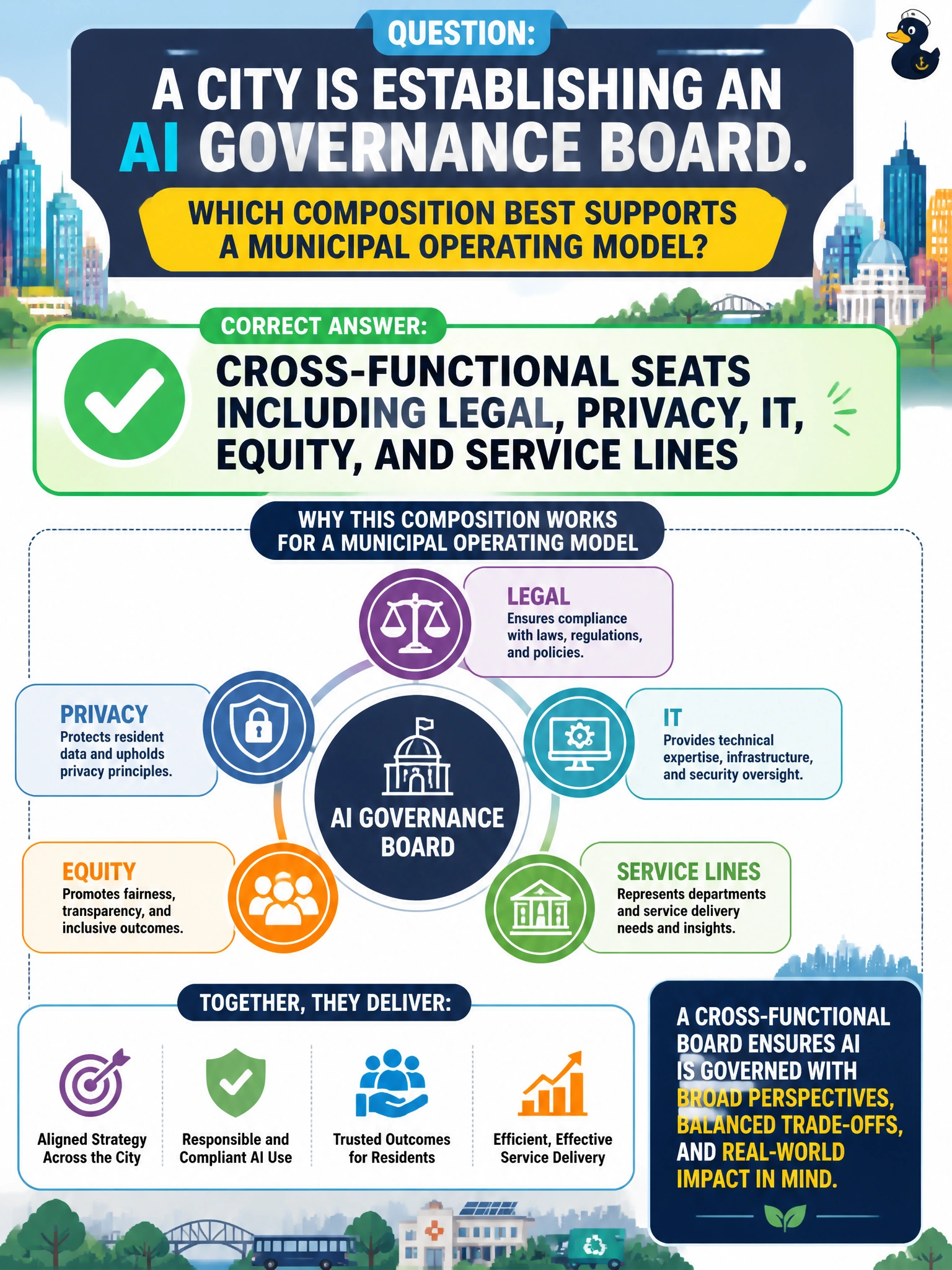
A city is establishing an AI governance board. Which composition best supports a municipal operating model?
Select an answer to reveal the explanation.
Short Explanation
AI governance isn’t a vendor fan club. Put legal, privacy, IT, equity, and the service lines at the table so the city—not a contractor—owns the decisions.
Full Explanation
A municipal AI governance board works when composition mirrors the decision rights the city must exercise: legal and privacy for statutory risk, IT for architecture and security, equity for disparate-impact oversight, and service lines for operational feasibility and resident impact. Cross-functional seats create shared ownership of policy, exceptions, and high-risk approvals so AI is governed as a civic operating concern rather than a side project of one team. This composition also supports escalation paths when models touch permitting, benefits, public safety, or other regulated services.
A board of only marketing staff with no legal or service-line seats fails because communications skill does not substitute for statutory interpretation, privacy compliance, or operational control design. A single IT contractor with no city officials present fails by concept: contractors advise; city officials retain policy authority and residual public accountability. Vendors voting on city AI policy without city members fails legitimacy and creates conflicts of interest—vendors optimize for commercial outcomes, not municipal fiduciary and equity duties.
Exam caveat: cross-functional membership does not mean every meeting requires unanimous technical deep-dives from every seat; it means each domain has standing voice and documented decision rights on relevant issues. Operational check: publish the board charter listing required seats (legal, privacy, IT, equity, service lines), voting vs. advisory roles, and quorum rules—then verify recent high-risk AI decisions show attendance and recorded positions from those seats.