
A county board reviews AI business cases. What should each case include to support value-driven prioritization?
Select an answer to reveal the explanation.
Short Explanation
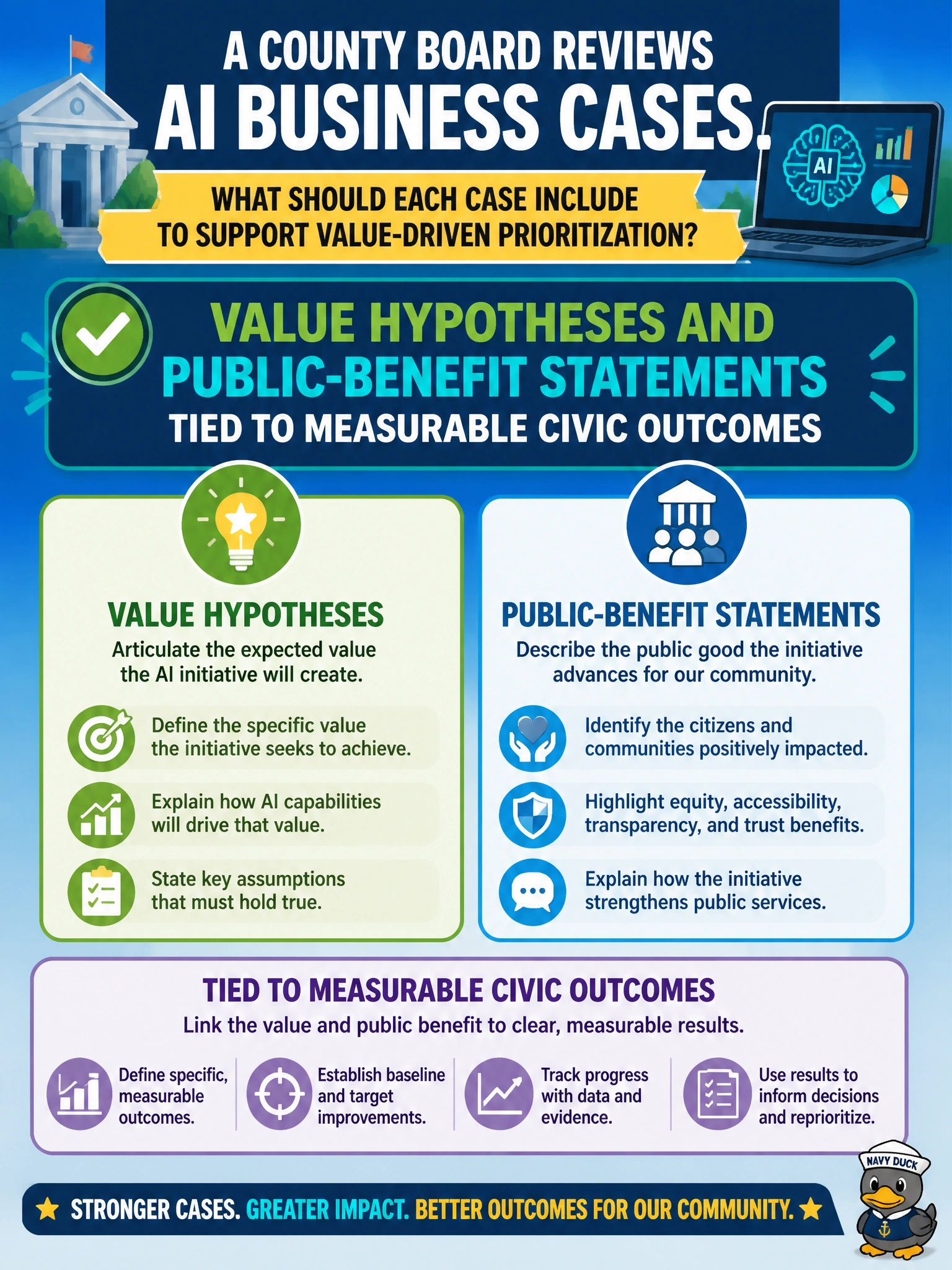
If the business case can’t say what public benefit you’re testing and how you’ll know it worked, it’s a shopping trip, not a strategy. County boards need value hypotheses and public-benefit statements.
Full Explanation
County boards prioritize scarce AI funding by comparing explicit value hypotheses and public-benefit statements tied to measurable civic outcomes—not vendor aesthetics. A sound business case states what public problem will improve (for example, permit cycle time, benefit processing accuracy, or 311 first-contact resolution), how the hypothesis will be tested, which equity and service metrics will move, and what success or stop criteria look like. That framing lets the board rank initiatives by civic return, risk, and feasibility rather than by demo polish, and it creates an evaluation trail for later audits and performance reporting.
A vendor logo collage with no service outcomes fails because branding is not evidence of public value; boards cannot compare investments without outcome measures. Promising to skip evaluation if the demo looks impressive fails by concept: impressive demos optimize for presentation, not for production data quality, integration cost, or disparate impact on residents. Requesting to hide costs from the public record by default fails transparency and often conflicts with open-government norms; cost concealment undermines value-driven prioritization and public trust.
Exam caveat: “public-benefit statements” are not marketing slogans; they must connect to measurable outcomes and evaluation methods the county can actually collect. Operational check: for each AI business case on the board agenda, require a one-page value hypothesis, named civic metrics with baselines, evaluation window, and total cost of ownership—and reject cases that substitute logos or demo charisma for those elements.