
County digital services wants lifecycle gates on the AI portfolio. Which stage sequence best reflects a civic AI adoption roadmap?
Select an answer to reveal the explanation.
Short Explanation
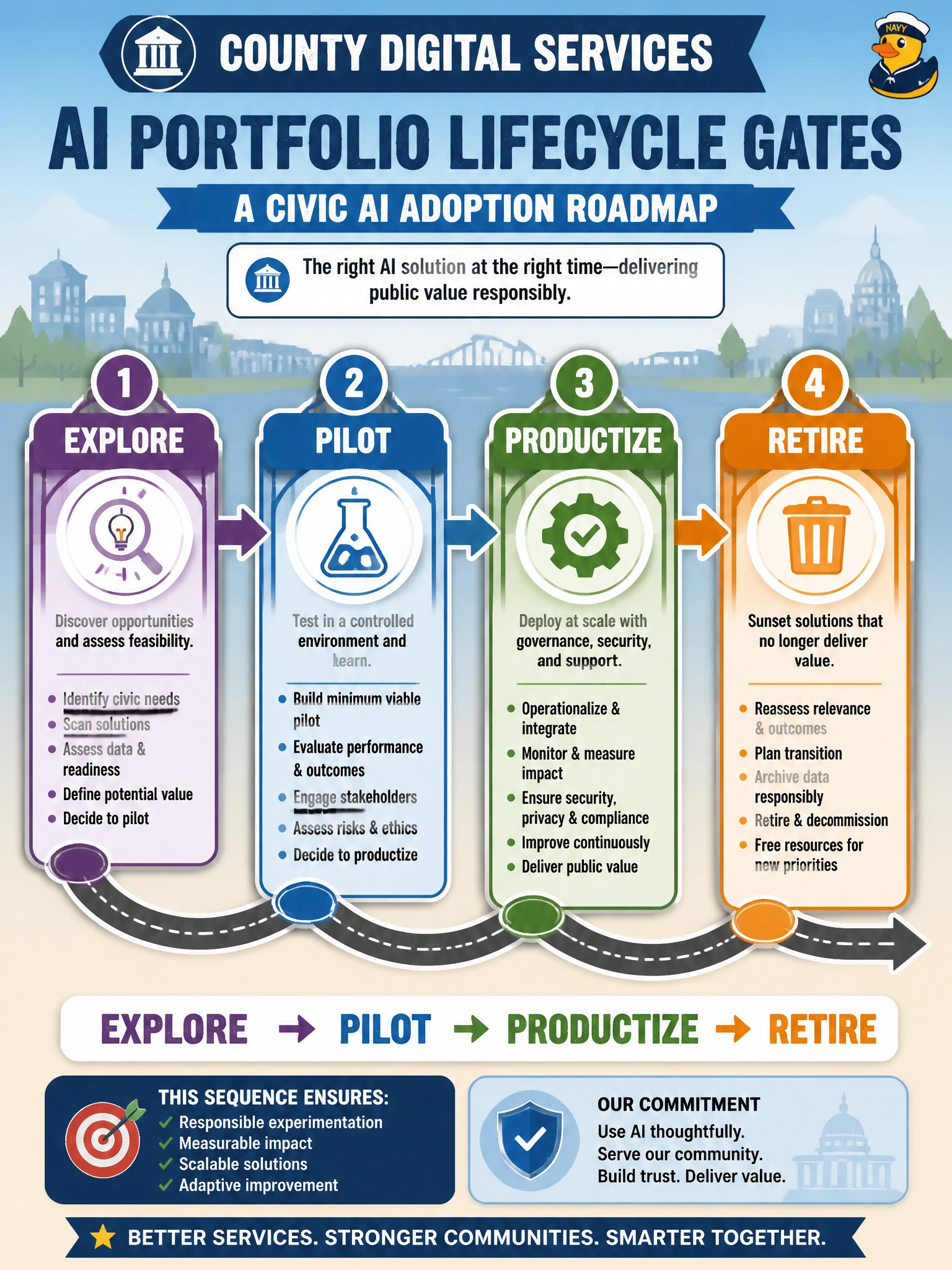
You can treat AI as a lifecycle: explore, pilot, productize, then retire when it no longer earns its keep. That keeps you moving toward useful, governed services instead of exploring forever or productizing before a pilot.
Full Explanation
The sound civic AI adoption sequence is Explore → pilot → productize → retire: discovery and feasibility come first, a bounded pilot tests value and risk controls, successful work becomes a supported product with owners and monitoring, and tools that no longer justify their cost or risk are retired. This gives county digital services lifecycle gates rather than treating experimentation as an endpoint. Retire → ignore → redeploy secretly fails conceptually because it is a nontransparent anti-lifecycle that obscures accountability. Productizing immediately with no explore or pilot stages skips discovery, stakeholder validation, and risk learning, so an unproven system may be deployed without adequate controls. Explore forever without ever deciding to pilot leaves the initiative in perpetual investigation, with no decision to test it or deliver governed resident value. Exam caveat: on CRAGE items, attend to stage order and watch for sequences that skip a pilot, omit retirement, or invert lifecycle stages. Practical check: label each AI initiative with its current stage, set written exit criteria for advancement, schedule retirement reviews for productized tools, and withhold further funding when an initiative remains in explore indefinitely without a pilot decision.