
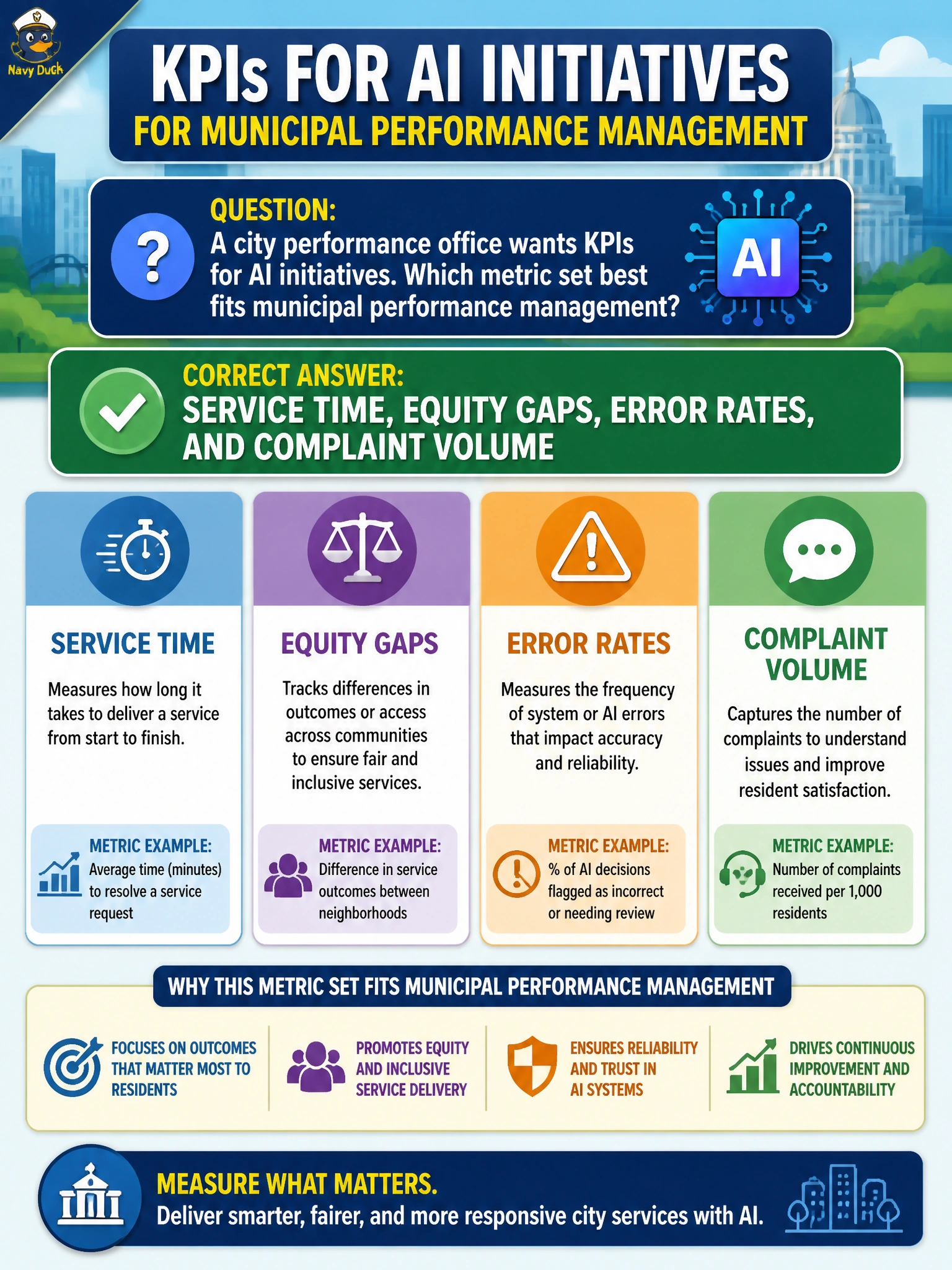
A city performance office wants KPIs for AI initiatives. Which metric set best fits municipal performance management?
Select an answer to reveal the explanation.
Short Explanation
If you can’t see service time, equity gaps, errors, and complaints, you don’t know if the AI helped residents—you only know it shipped. Those are the KPIs that matter.
Full Explanation
The correct answer is measuring AI initiatives with service time, equity gaps, error rates, and complaint volume. A city performance office needs KPIs that show whether AI improved municipal outcomes for residents—not whether the project was fashionable. Service time tracks operational benefit. Equity gaps reveal whether gains are uneven across neighborhoods or demographic groups. Error rates catch quality and safety regressions. Complaint volume surfaces lived friction that dashboards may miss. Together they fit municipal performance management and support budget accountability.
Only social-media follower counts for the AI project account fail by concept because attention metrics are not service outcomes. Only the number of models deployed regardless of outcomes fails because portfolio size is activity, not public value. Only how often executives mention AI in speeches fails because rhetoric is not performance evidence and cannot guide remediation.
Exam caveat: municipal KPI sets on CRAGE emphasize resident-facing outcomes and equity, not vanity or activity counts. Operational check: add these four KPI families to the AI program scorecard, stratify service time and errors by equity dimensions, review complaint themes monthly with service owners, and tie continued funding to measured improvement rather than deployment count.