
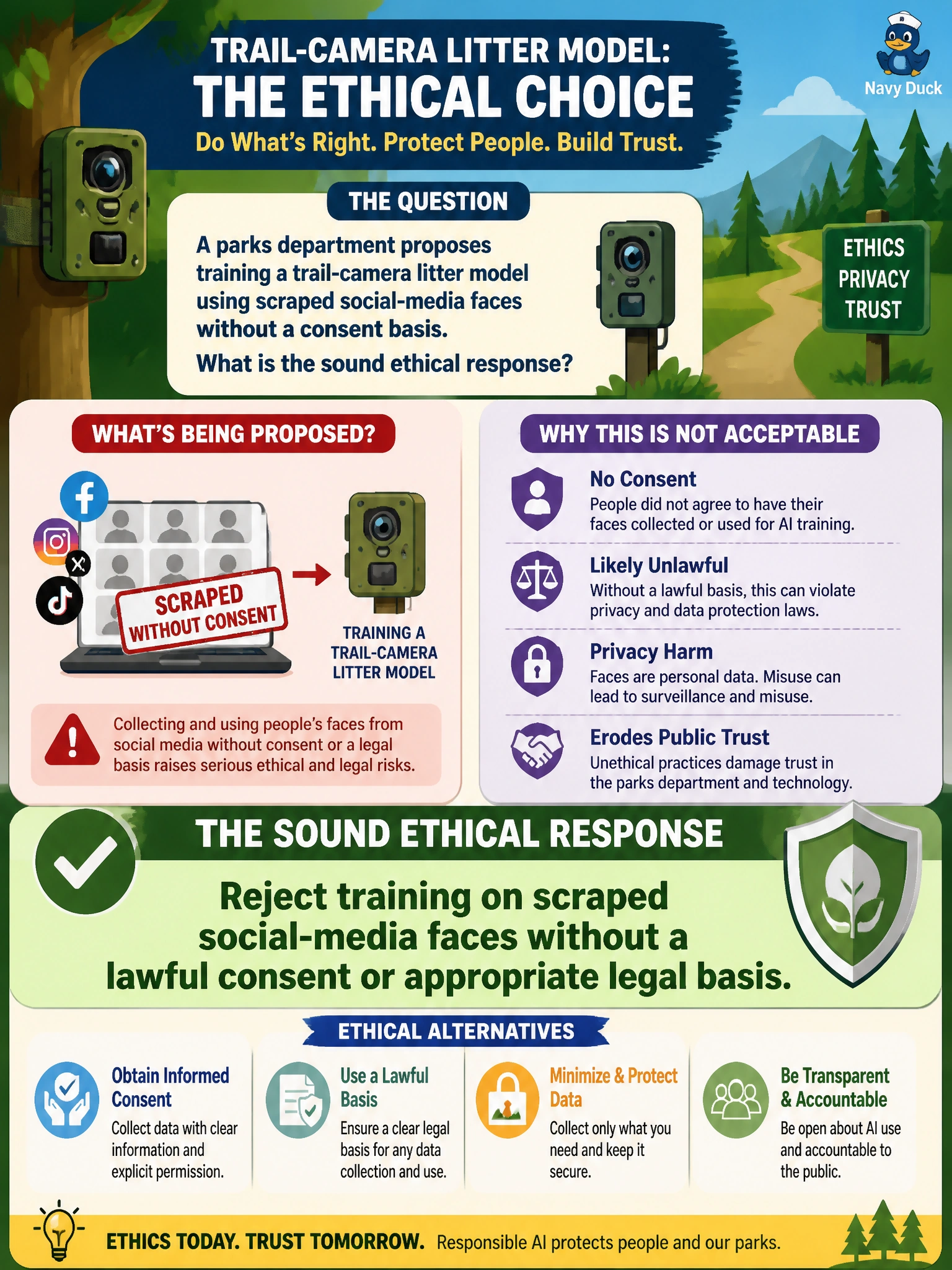
A parks department proposes training a trail-camera litter model using scraped social-media faces without a consent basis. What is the sound ethical response?
Select an answer to reveal the explanation.
Short Explanation
Scraping strangers’ faces off social media for a trail camera is not “open data”—it’s an ethics landmine. Without a consent or lawful basis, the right call is reject that training plan.
Full Explanation
The correct answer is rejecting training on scraped social-media faces without a lawful consent or appropriate legal basis. A parks department proposing to train a trail-camera litter model on scraped social-media faces raises biometric privacy and dignity concerns far beyond litter detection needs. Ethical and lawful AI practice requires a valid consent or other appropriate legal basis, purpose necessity, and minimization. Scraped faces of unrelated people are not a free training commons for municipal computer vision, especially when less intrusive litter-detection approaches exist.
Approving scraping because public websites “feel free to use” fails by concept: public accessibility is not the same as a lawful training basis for biometric-related processing. Increasing scrape volume overnight to improve accuracy faster fails because scaling an unethical data practice increases harm rather than legitimizing it. Storing face embeddings indefinitely with no retention policy fails as a data-governance anti-pattern that compounds privacy risk even if collection were somehow authorized.
Exam caveat: CRAGE expects rejection of unjustified biometric scraping even when accuracy arguments sound attractive. Operational check: stop the scrape plan, prefer litter labels from consented or synthetic/non-biometric sources, document legal basis reviews with counsel, and set retention limits if any personal data remains necessary.