
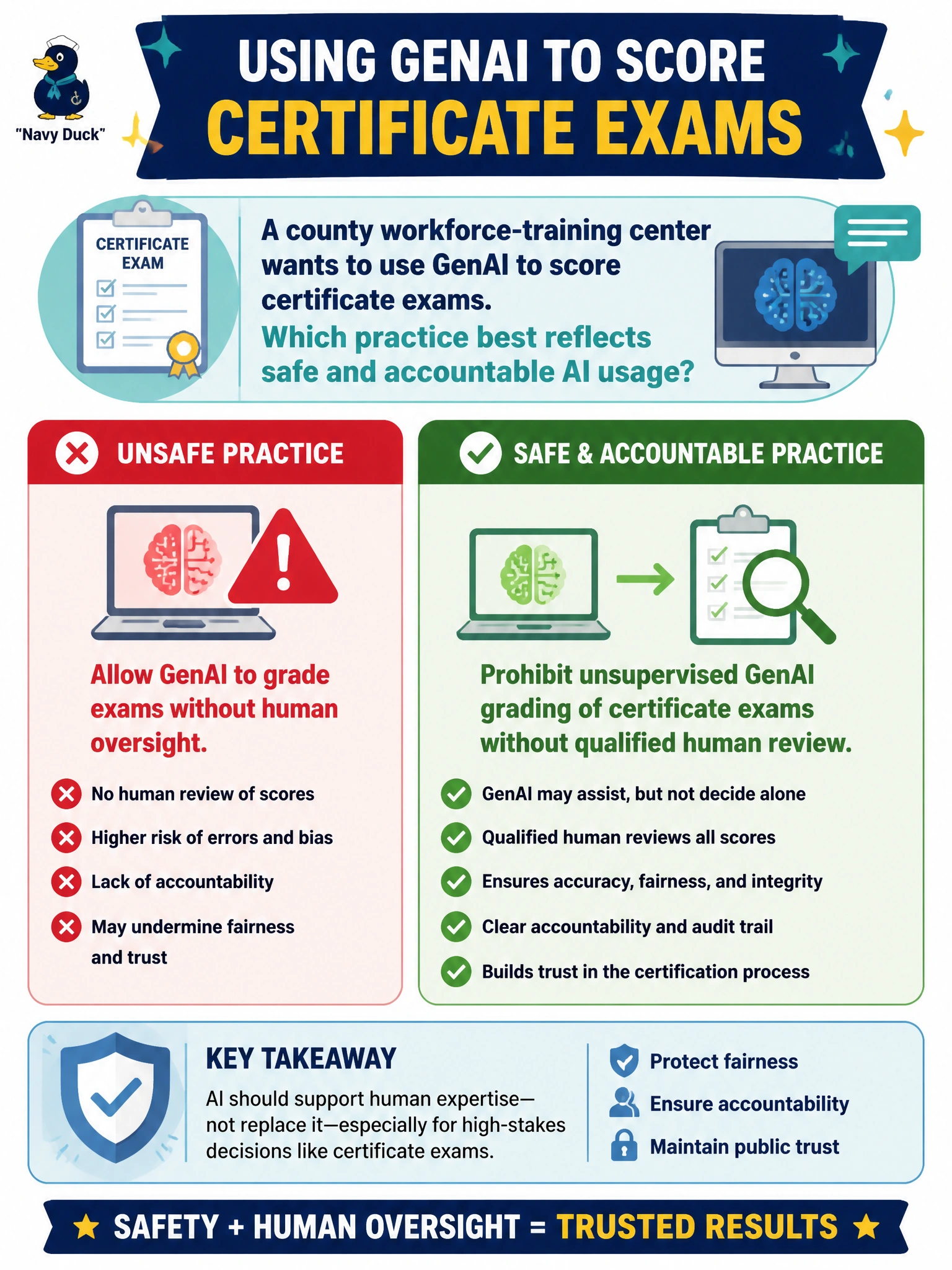
A county workforce-training center wants to use GenAI to score certificate exams. Which practice best reflects safe and accountable AI usage?
Select an answer to reveal the explanation.
Short Explanation
Scoring certificates is not a casual chatbot chat—credentials matter. Banning unsupervised GenAI grading without a human review is the safe, accountable move for a public training program.
Full Explanation
The correct answer is prohibiting unsupervised GenAI grading of certificate exams without qualified human review. A county workforce-training center that uses GenAI to score certificate exams is touching credential integrity. Safe and accountable usage treats grading as a high-stakes assessment process: GenAI may draft score suggestions or flag anomalies, but final credential decisions require qualified human review against rubrics and appeal pathways. Without that control, hallucinated scoring, prompt sensitivity, and unexamined bias can issue or withhold certificates unfairly.
Allowing unsupervised GenAI final scores with no human review fails by concept because it treats generative models as authoritative examiners despite known variability and limited accountability. Replacing all instructors with an unmonitored grading bot immediately fails as a workforce and quality anti-pattern—it removes pedagogical judgment and supervisory duty of care. Training the model only on jokes so scores stay entertaining fails because it abandons validity and fairness; assessment integrity is not a humor exercise.
Exam caveat: CRAGE distinguishes assistive GenAI from unsupervised decision-making in credentialing and similar civic determinations. Operational check: ban unsupervised final grading in policy, require dual control or instructor sign-off on certificate scores, sample-audit GenAI-assisted grades, and document appeal rights for trainees.