
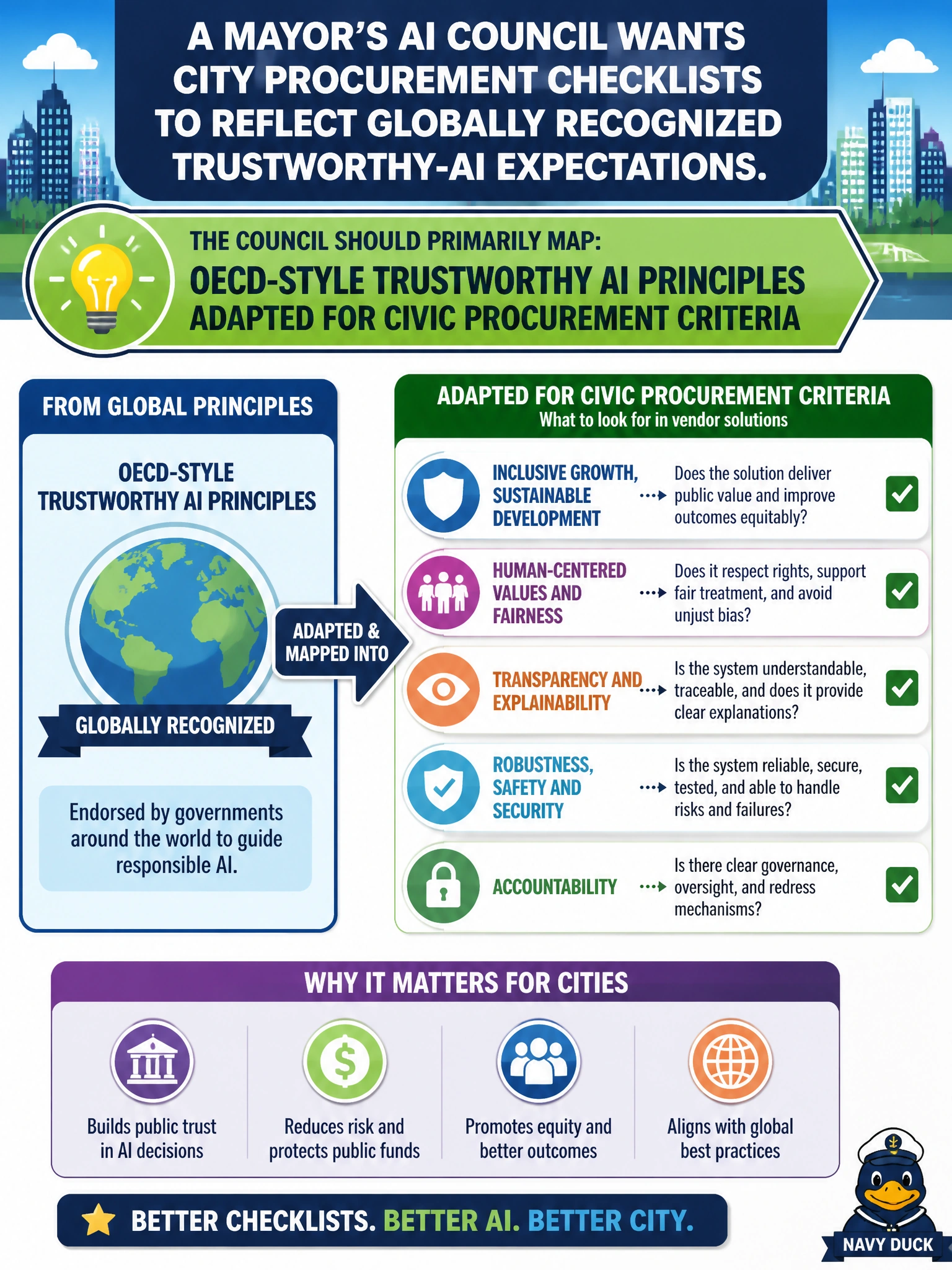
A mayor’s AI council wants city procurement checklists to reflect globally recognized trustworthy-AI expectations. What should the council primarily map into those checklists?
Select an answer to reveal the explanation.
Short Explanation
Procurement checklists are where good intentions either stick or evaporate. Mapping OECD-style trustworthy-AI principles into those checklists turns ethics into something vendors must actually answer.
Full Explanation
The correct answer is mapping OECD-style trustworthy AI principles into civic procurement criteria. A mayor’s AI council that wants checklists to reflect globally recognized expectations must translate high-level principles—such as transparency, robustness, accountability, and human-centered values—into concrete vendor questions, contract clauses, and evaluation scoring. Procurement is where ethics either becomes enforceable or remains aspirational. Adapting OECD-style language for municipal RFPs, scoring sheets, and acceptance tests gives purchasing officers a shared standard that vendors must answer before award.
Only GPU price sheets from the lowest bidder fail by concept because hardware cost alone says nothing about trustworthy behavior, data provenance, bias testing, or audit rights. Marketing slogans from a vendor homepage carousel fail because promotional language is not evidence and cannot substitute for contractual commitments or technical attestations. Internal jokes from the help-desk Slack channel fail because informal culture artifacts are not governance controls and cannot be scored, audited, or enforced in a public procurement file.
Exam caveat: CRAGE often tests whether you know ethics belong in buying criteria, not only in post-award policy decks. Operational check: add a trustworthy-AI annex to every AI RFP, score responses against principle-mapped criteria, and refuse award when vendors cannot document how their product meets those civic expectations.