
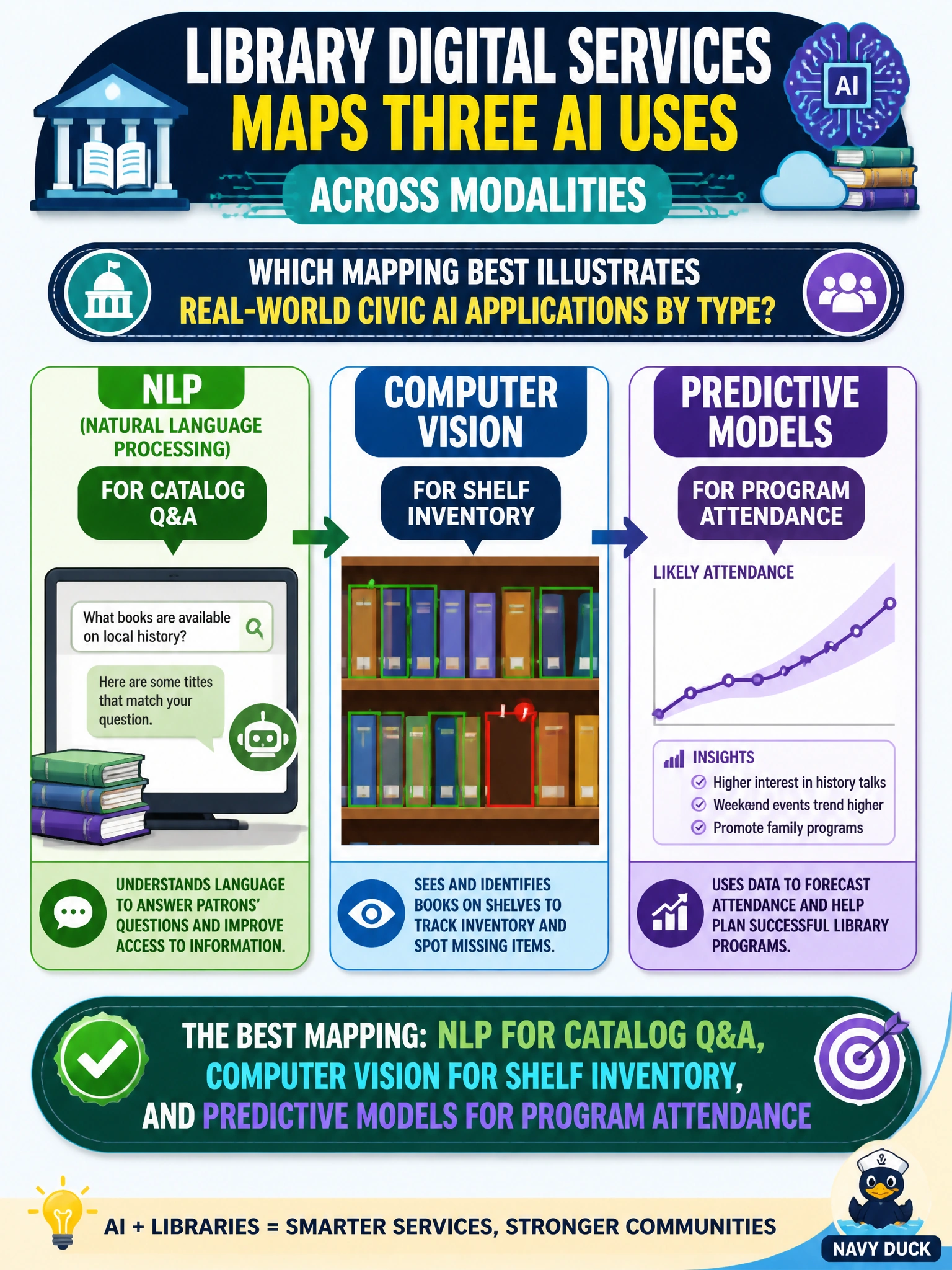
Library digital services maps three AI uses across modalities. Which mapping best illustrates real-world civic AI applications by type?
Select an answer to reveal the explanation.
Short Explanation
Libraries can use language AI to answer catalog questions, vision AI to check what’s on the shelves, and predictive models to guess which storytime will pack the room. Matching the modality to the job is half of governing the toolkit.
Full Explanation
Library digital services mapping three AI uses across modalities should align NLP with catalog Q&A, computer vision with shelf inventory imagery, and predictive models with program attendance forecasting. That mapping matches how each civic task’s data type drives the appropriate AI technique and keeps modality literacy concrete for library governance.
Why the other options fail by concept: Pairing NLP with shelf photos, computer vision with catalog Q&A, and predictive models only with barcode printing misassigns language, vision, and prediction to the wrong jobs. Swapping vision onto Q&A, NLP onto attendance forecasts, and prediction onto shelf photos similarly breaks modality-task fit. Using predictive models for catalog Q&A, NLP for shelf photos, and computer vision for attendance forecasts again mismatches input types to methods.
Exam caveat: Real systems can combine modalities (e.g., multimodal catalog help), but the exam item tests whether you can correctly assign primary modality types to classic civic library use cases. Wrong mappings produce wrong vendor questions, wrong privacy reviews, and wrong monitoring metrics.
Operational check: Update the library AI inventory with three entries: NLP catalog assistant (text corpora, grounding in catalog records), vision shelf inventory (camera placement, retention), and attendance prediction (historical program data, fairness across branches). Review each against its modality-specific risks before expansion.