
A municipal open-data team shows that a permitting chatbot, a traffic-signal optimizer, and a benefits fraud-flag model share a common pattern. What pattern should governance recognize?
Select an answer to reveal the explanation.
Short Explanation
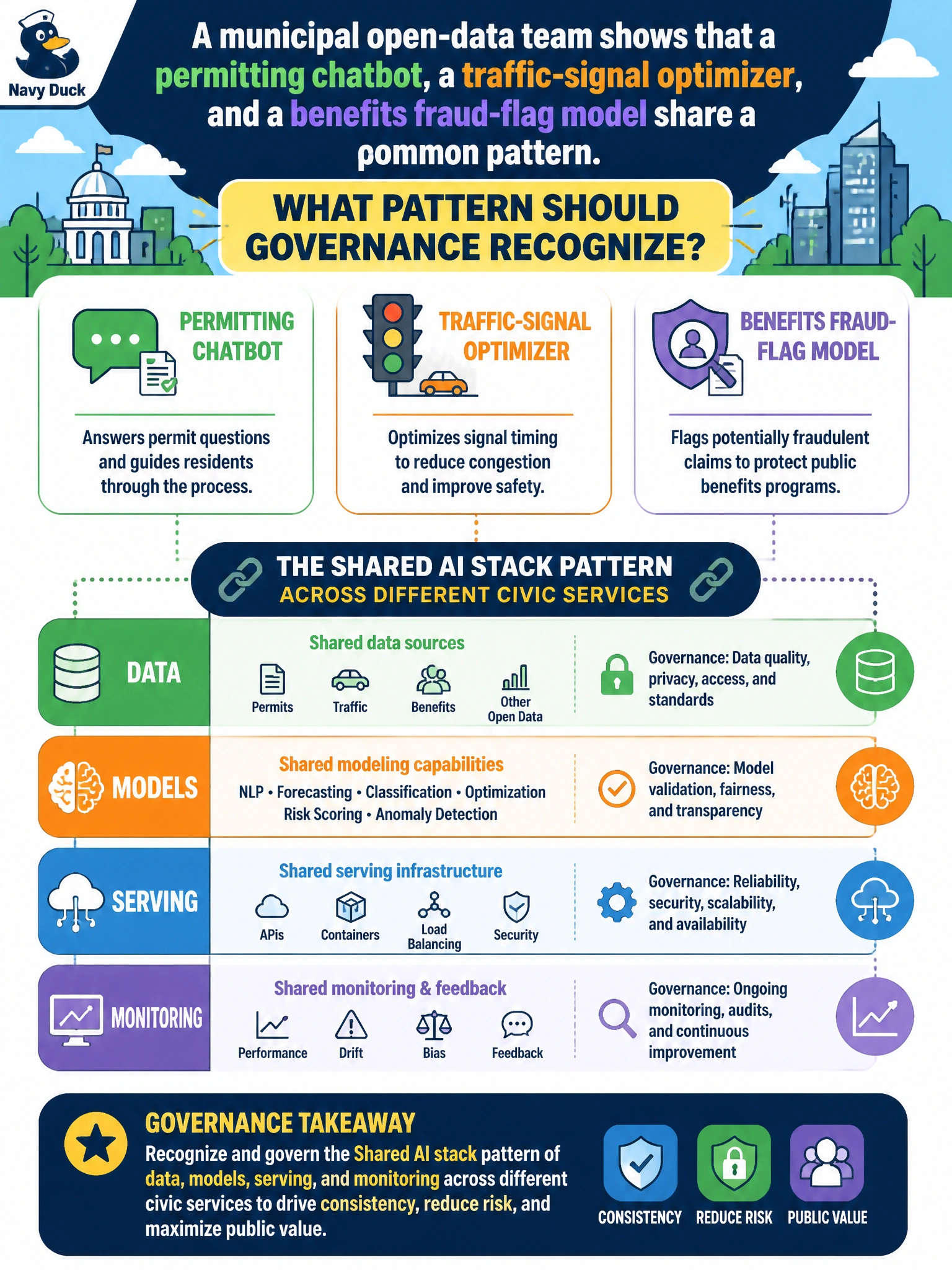
Different city services still rhyme under the hood: data in, model in the middle, serving out front, monitoring on the side. Whether it is permits, signals, or fraud flags, that shared stack pattern is what governance can inventory once and reuse.
Full Explanation
A municipal open-data team showing that a permitting chatbot, a traffic-signal optimizer, and a benefits fraud-flag model share a common pattern should lead governance to recognize a shared AI stack pattern of data, models, serving, and monitoring across different civic services. Domain outcomes differ, but the layered architecture—and thus many controls—rhymes.
Why the other options fail by concept: Treating the pattern as proof that one chat interface can replace all three systems without any models confuses UX with the stack and erases model-specific risk. Requiring every civic AI system to optimize traffic signals first is nonsensical domain chauvinism, not architecture. Claiming fraud-flag models cannot share infrastructure patterns with chatbots denies reusable platforms (feature stores, registries, monitoring) that cities rightly consolidate.
Exam caveat: Shared stack patterns enable shared standards (logging, access control, model registry) without implying identical risk tiers. A fraud model and a permit FAQ bot may share serving infrastructure yet need different human review, fairness testing, and legal hold rules.
Operational check: Publish a city reference AI stack diagram (data → training/registry → serving → monitoring) and map each of the three services onto it. Require every new civic AI intake to declare which layers it uses and which shared controls it inherits, rather than reinventing per-department silos or assuming one chatbot covers everything.