
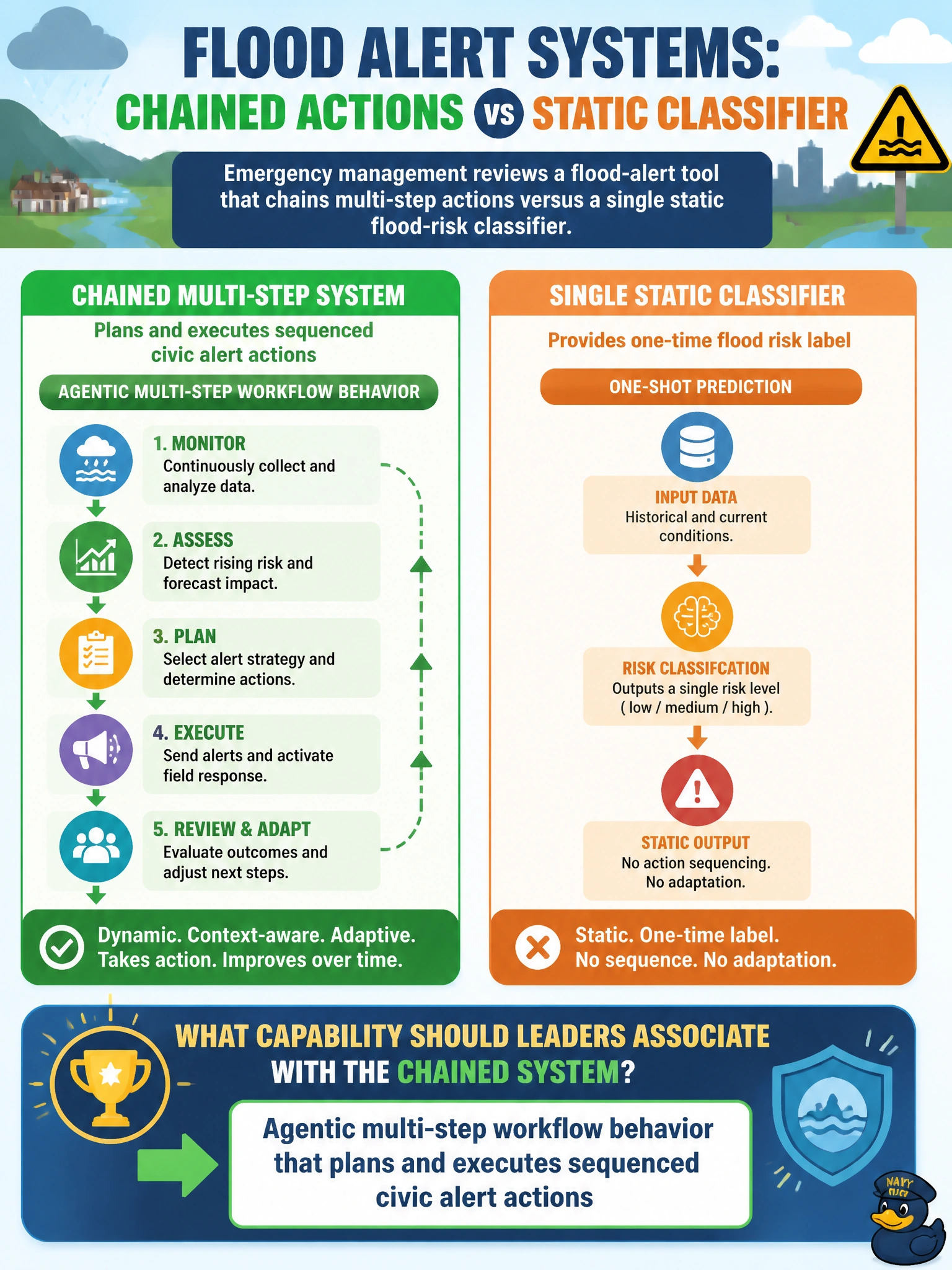
Emergency management reviews a flood-alert tool that chains multi-step actions versus a single static flood-risk classifier. What capability should leaders associate with the chained system?
Select an answer to reveal the explanation.
Short Explanation
A static classifier is a weather stick that says “high risk.” An agentic workflow is more like a junior ops runner who checks gauges, drafts the alert, and queues the next step. Emergency managers should govern that extra autonomy as its own kind of AI system.
Full Explanation
Emergency management reviewing a flood-alert tool that chains multi-step actions versus a single static flood-risk classifier should associate the chained system with agentic multi-step workflow behavior that plans and executes sequenced civic alert actions. Unlike a one-shot risk score, an agentic design retrieves context, decides subsequent steps, and triggers workflows—raising distinct control, audit, and stop-button requirements.
Why the other options fail by concept: Guaranteeing that no human coordinator is ever needed during floods confuses automation capability with acceptable emergency doctrine; agentic tools augment, not erase, human incident command. Claiming static classifiers are illegal for public emergency use is false—many jurisdictions still rely on simpler risk scores. Equating the chained system with a single static classifier that only outputs one risk score denies the multi-step planning difference the stem highlights.
Exam caveat: “Agentic” does not mean unsupervised or unbound. Civic deployments need scoped tools, approval gates for public alerts, logging of intermediate steps, and clear human authority to halt or override. A static classifier may remain appropriate for some screening steps inside a larger workflow.
Operational check: Diagram the flood tool’s steps (inputs, tools/APIs called, decision points, alert channels), mark which steps are autonomous versus human-gated, and place kill-switches and audit logs on sequenced actions. Inventory it as agentic workflow AI, separate from any static risk classifier still in use.