
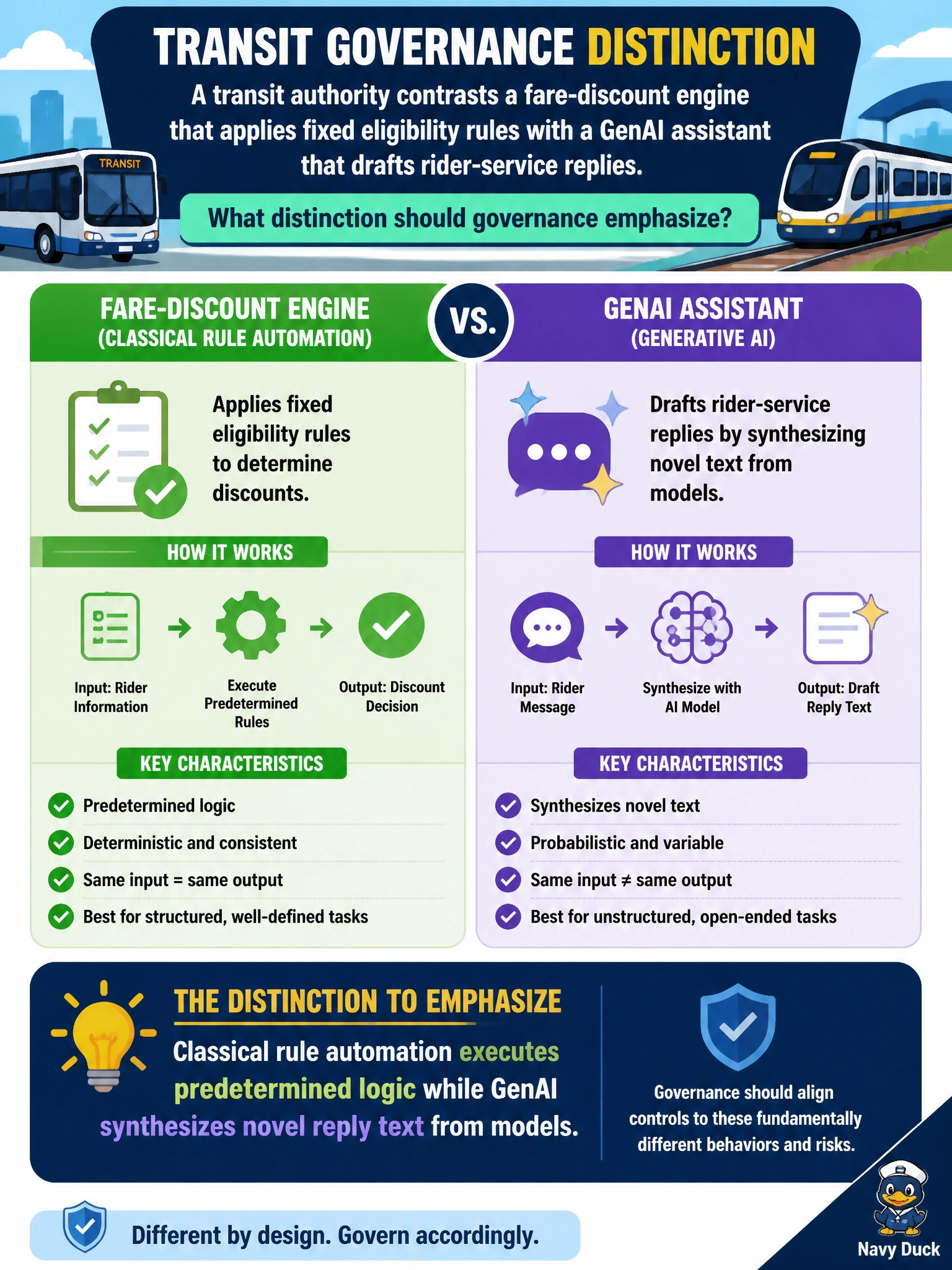
A transit authority contrasts a fare-discount engine that applies fixed eligibility rules with a GenAI assistant that drafts rider-service replies. What distinction should governance emphasize?
Select an answer to reveal the explanation.
Short Explanation
A fare rule engine is like a vending machine—drop in the right tokens, get the programmed discount. A GenAI rider assistant is more like a junior writer drafting a fresh email from patterns it learned. Same transit desk, very different guts, and governance needs to know which is which.
Full Explanation
A transit authority contrasting a fare-discount engine that applies fixed eligibility rules with a GenAI assistant that drafts rider-service replies should emphasize a clear technical distinction for governance. Classical rule automation executes predetermined logic, while GenAI synthesizes novel reply text from models. The fare engine applies explicit criteria; the assistant generates new language conditioned on prompts and model weights. Those are different risk, testing, and disclosure profiles.
Why the other options fail by concept: Calling both systems GenAI because any automated municipal reply counts as generative AI collapses automation with generation and over-expands the GenAI inventory. Treating rule automation and GenAI as identical because both remove humans from every fare decision is false on two counts: neither necessarily removes humans from all decisions, and removal of humans is not what defines GenAI. Claiming only the rule engine is AI while drafting natural-language replies can never involve AI models ignores how generative models actually work.
Exam caveat: Rule engines can be part of a larger AI system, and GenAI outputs may be constrained by rules (allow-lists, policy filters). Governance still needs the primary distinction: predetermined logic versus model-synthesized content. Accountability for incorrect discounts versus incorrect or fabricated rider replies also differs.
Operational check: Inventory the fare engine as rule automation with versioned eligibility tables and change control; inventory the rider assistant as GenAI with model/provider, prompt templates, grounding sources, human review thresholds, and hallucination/misinformation controls. Do not file both under one undifferentiated “AI chatbot” entry.