
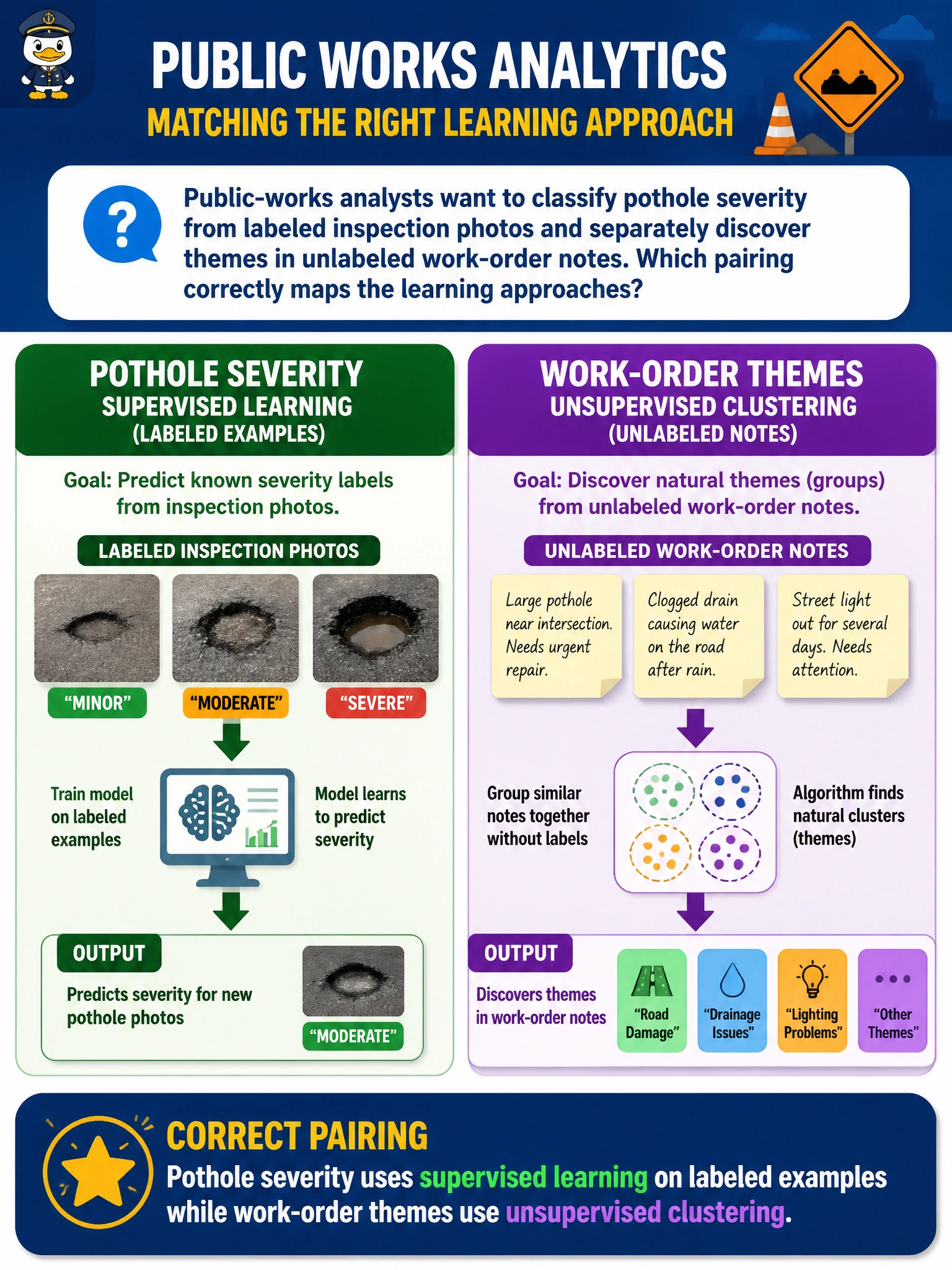
Public-works analysts want to classify pothole severity from labeled inspection photos and separately discover themes in unlabeled work-order notes. Which pairing correctly maps the learning approaches?
Select an answer to reveal the explanation.
Short Explanation
Labeled pothole photos are like flash cards with the right answers written on the back—that’s supervised learning. Theme hunting in a pile of unlabeled notes is more like sorting socks by color with no tags—unsupervised clustering. Keep those two toolkits straight when governing municipal analytics.
Full Explanation
Public-works analysts classifying pothole severity from labeled inspection photos and separately discovering themes in unlabeled work-order notes must map each task to the correct learning approach. Pothole severity uses supervised learning on labeled examples, while work-order themes use unsupervised clustering. Supervised learning needs ground-truth labels so the model can map photo features to severity classes; unsupervised methods find structure when no theme labels exist in the notes.
Why the other options fail by concept: Claiming both tasks require only unsupervised clustering ignores that severity classification has inspector labels and is a classic supervised problem. Swapping the approaches—unsupervised for labeled pothole photos and supervised labels for unlabeled notes—reverses the data conditions and would fail both analytically and in audit. Mandating reinforcement learning because field crews give daily rewards misapplies RL; occasional operational feedback is not the same as an RL reward loop designed for sequential policy learning.
Exam caveat: Hybrid pipelines are common—clustering themes first, then having humans label clusters for a later supervised classifier—but the stem asks for the correct pairing of the two stated tasks as described. Do not invent labels where none exist, and do not discard labels where they do. Civic analytics literacy is about matching method to data availability.
Operational check: Confirm the photo dataset has severity labels with an agreed taxonomy and hold-out evaluation before training the severity model. For notes, run clustering or topic modeling without fabricating theme labels, review cluster interpretability with supervisors, and only then decide whether to promote themes into a labeled supervised workflow. Document both paths in the public-works AI inventory.