
A city CIO tells council that a 311 triage tool qualifies as AI. What criterion should the CIO emphasize?
Select an answer to reveal the explanation.
Short Explanation
Think of AI like a clerk who actually gets better at sorting mail after reading thousands of old envelopes—not just a pretty window labeled “smart.” The 311 triage tool earns the AI badge because it learns patterns from past ticket text. A chat UI alone does not make something AI.
Full Explanation
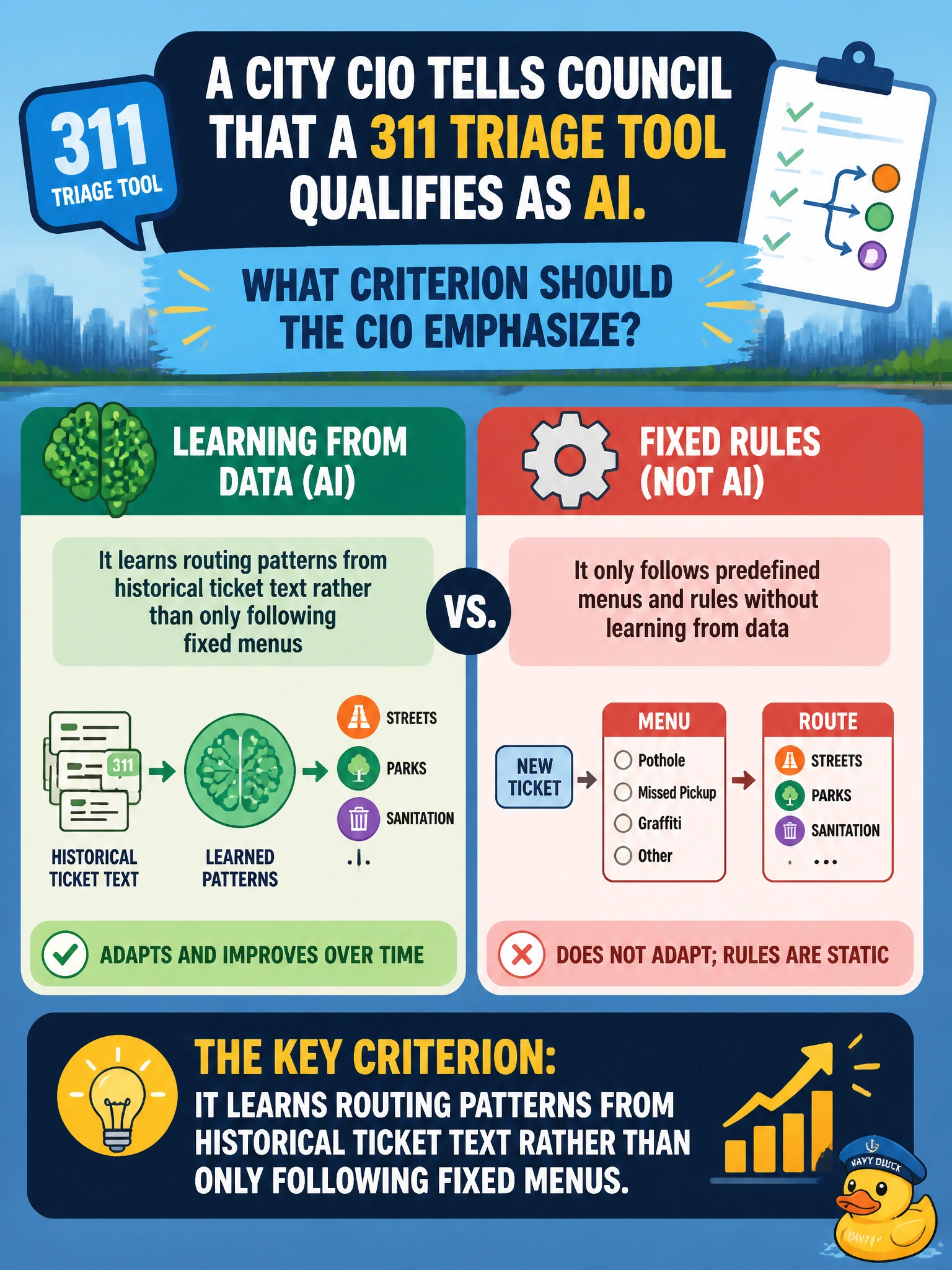
A city CIO briefing council on whether a 311 triage tool qualifies as AI should emphasize learning behavior, not branding. The sound criterion is that the tool learns routing patterns from historical ticket text rather than only following fixed menus. That pattern-from-data behavior is what separates machine learning–based triage from static decision trees or scripted portals, and it is the definition civic leaders need when inventorying AI under municipal policy.
Why the other options fail by concept: A chat-style interface labeled “smart” on the resident portal is presentation and marketing UX, not evidence of learning or model-driven decisions. Purchase from a vendor that markets every product as artificial intelligence confuses sales language with technical capability—governance cannot accept vendor slogans as the classification test. Running on the same servers that host the city’s static FAQ pages is an infrastructure coincidence; co-location with non-AI content does not make a system AI.
Exam caveat: Some rule-based systems are sophisticated and useful, yet still are not “AI” under definitions that require learning or statistical generalization from data. Conversely, not every model-backed tool exposes a chat UI. Councils should ask how decisions improve or adapt from data, what training corpus exists, and whether performance is measured over time—not whether the homepage says “smart.”
Operational check: For the 311 triage candidate, document whether routing decisions are produced by a model trained or updated on historical tickets (features, labels, evaluation metrics, retraining cadence). Record that evidence in the AI inventory; if the system only executes fixed menus with no learned component, classify it as automation—not AI—and govern it accordingly.