
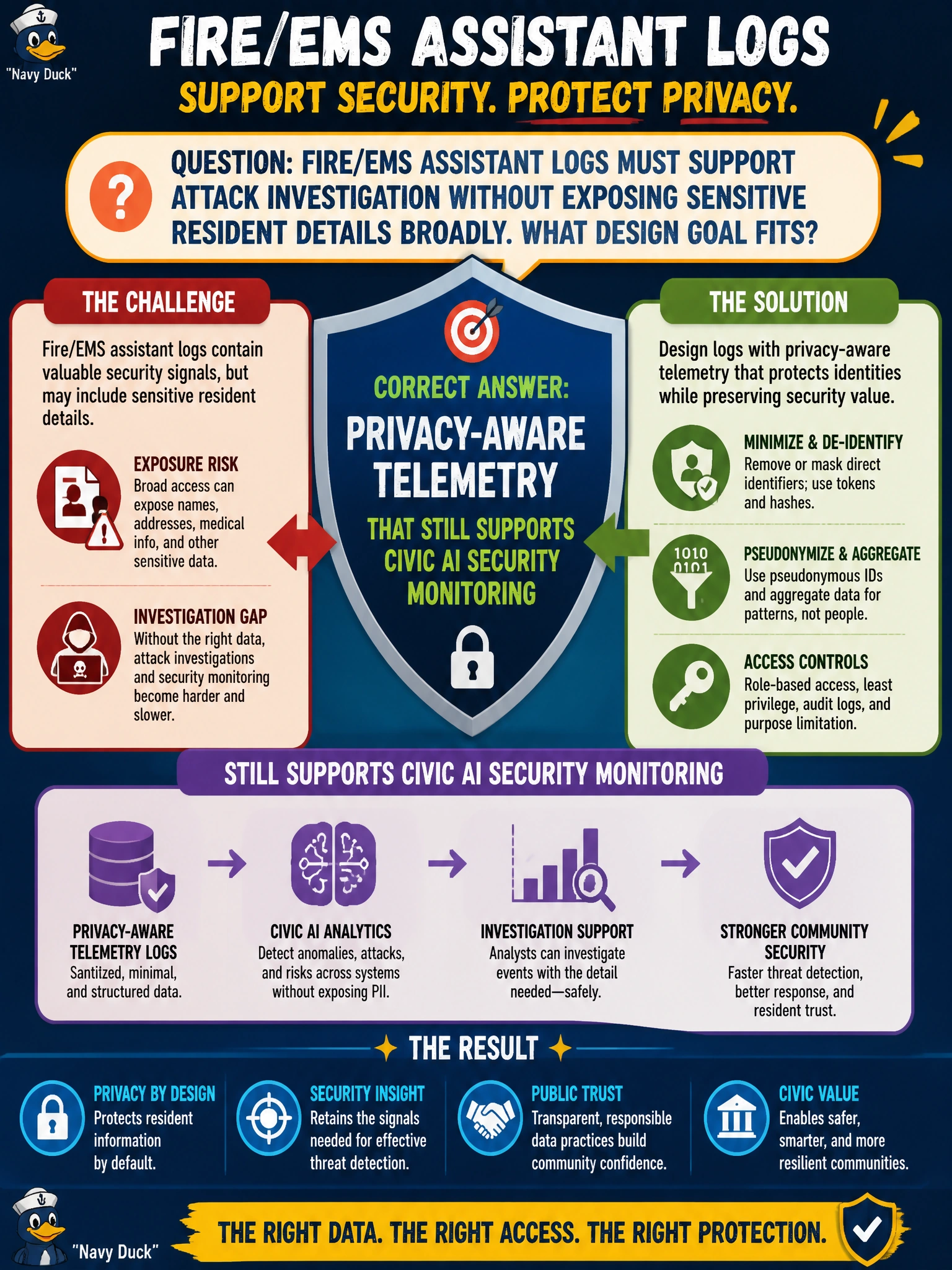
Fire/EMS assistant logs must support attack investigation without exposing sensitive resident details broadly. What design goal fits?
Select an answer to reveal the explanation.
Short Explanation
You need logs that catch attacks without spraying medical or address details all over the SOC—redact smart, keep the security signal. String lights aren’t privacy-aware telemetry.
Full Explanation
Fire/EMS assistant logs must support attack investigation without broadly exposing sensitive resident details, so the fitting design goal is privacy-aware telemetry that still supports civic AI security monitoring. Effective designs minimize or redact addresses, medical details, and other sensitive fields in default SOC views while retaining security-relevant metadata—prompt-injection indicators, tool-call sequences, auth context, timestamps, model versions, and hashed or tokenized correlators—that investigators need. All-or-nothing logging either blinds defenders (no AI telemetry) or overexposes protected information across analysts who do not need full clinical or address content. Privacy-aware telemetry reconciles EMS confidentiality duties with the need to detect and investigate abuse of the assistant during emergencies. String lights in apparatus bays, custom slogans on dispatch mugs, and neon station-locker numbers fail conceptually: station décor neither redacts sensitive fields nor preserves security signal. Amenities are not privacy-aware monitoring design. Exam caveat: 'log everything forever' and 'log nothing for privacy' are both traps; the stem asks for a design goal that supports investigation without broad sensitive exposure. Operational check: implement field-level redaction on Fire/EMS AI logs with role-based break-glass for full content, verify SOC detections still fire on injection/tool anomalies using redacted streams, and audit who accessed unredacted artifacts.