
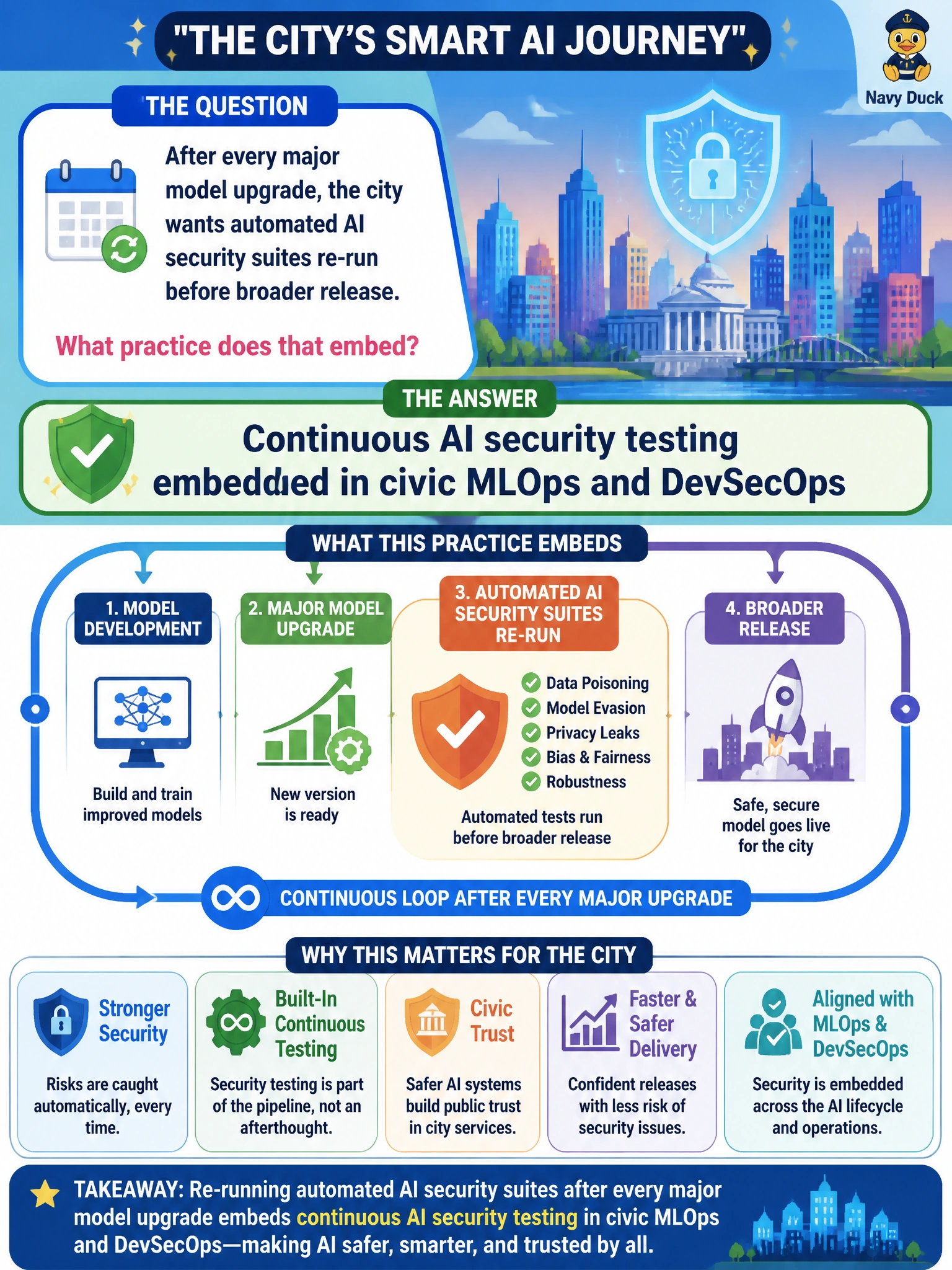
After every major model upgrade, the city wants automated AI security suites re-run before broader release. What practice does that embed?
Select an answer to reveal the explanation.
Short Explanation
New model, same gauntlet—re-run the AI security suites so upgrades don’t silently reopen holes. Party balloons aren’t continuous testing.
Full Explanation
Wanting automated AI security suites re-run after every major model upgrade before broader release embeds continuous AI security testing in civic MLOps and DevSecOps. Model upgrades can silently regress jailbreak resistance, tool-authz behavior, retrieval filtering, or bias properties even when functional tests pass. Embedding regression suites—prompt-injection packs, poison/retrieval checks, tool-abuse cases, policy-filter tests—into the promotion pipeline catches those regressions before citywide release, treating AI security as a lifecycle control rather than a one-time pre-launch event. For municipalities, continuous testing after upgrades is how assurance keeps pace with vendor model churn and internal prompt changes affecting resident-facing services. City-logo release-party balloons, animated changelog GIFs, and disco lights in standup rooms fail by concept: release aesthetics do not execute security regression suites or gate promotions. Celebrations are not continuous AI security testing. Exam caveat: a single pre-launch pen test does not satisfy 'after every major model upgrade'; look for continuous/automated suites in MLOps/DevSecOps. Operational check: wire AI security suites into the model-promotion pipeline as required checks, fail the release on critical regressions, retain evidence artifacts per upgrade, and verify a dry-run where a known failing injection case blocks promotion.