
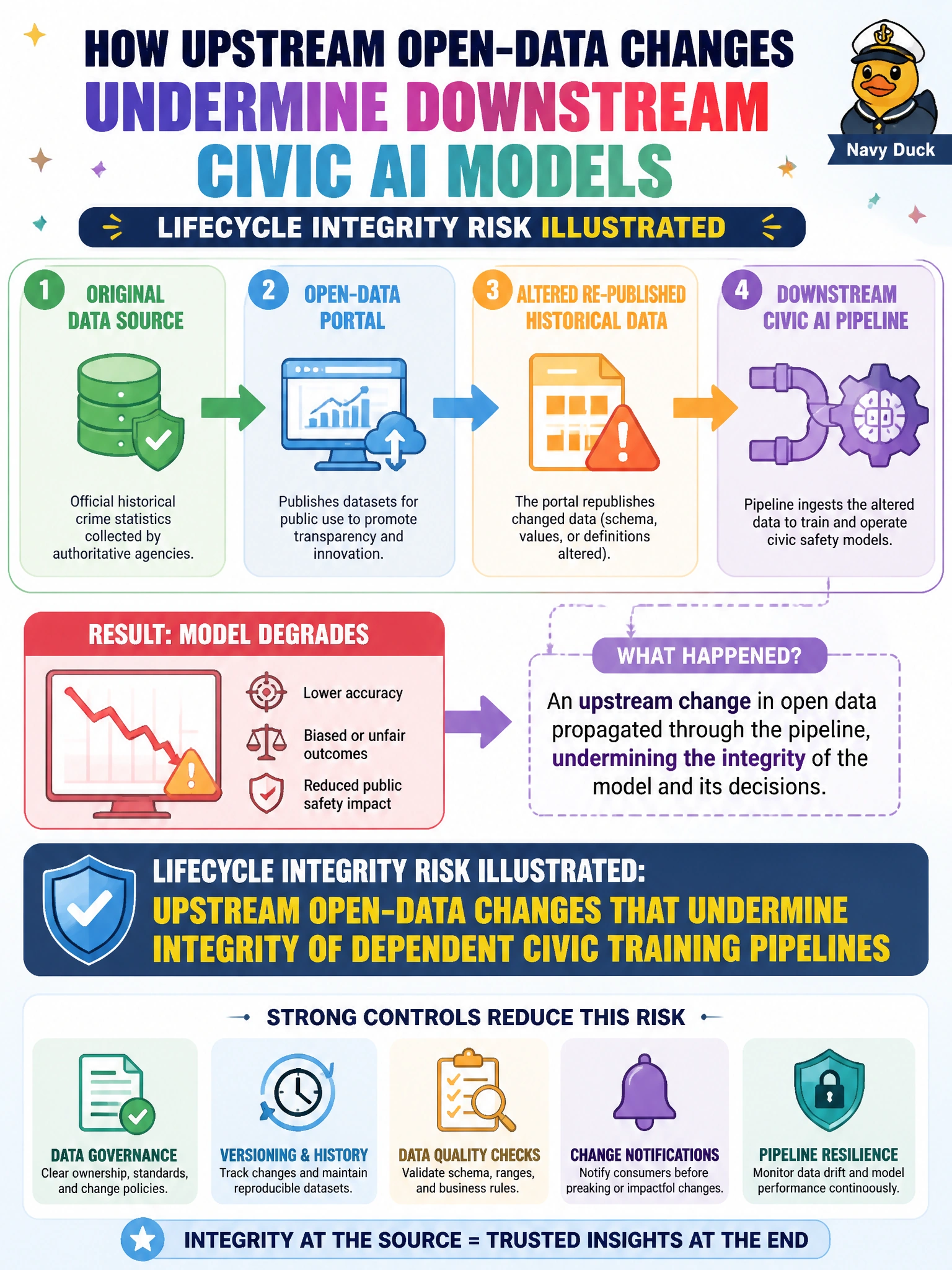
A downstream civic safety model degrades after an open-data portal republishes altered historical crime statistics. What lifecycle integrity risk does this illustrate?
Select an answer to reveal the explanation.
Short Explanation
When the open-data faucet changes history, every model drinking from it can get sick—trace upstream.
Full Explanation
When a downstream civic safety model degrades after an open-data portal republishes altered historical crime statistics, the lifecycle integrity risk is upstream open-data changes that undermine integrity of dependent civic training pipelines. Models that drink from public portals inherit silent revisions, schema changes, and historical rewrites unless consumers pin versions, verify checksums, and alert on upstream change. Municipal teams often treat open data as static truth; this incident pattern shows training-time integrity risk can originate outside the city boundary yet still break safety models.
Stale cache entries delaying refreshed crime maps in the portal interface are a display-layer caching issue, not a corruption of the historical training data consumed by the model. Incomplete metadata descriptions reducing discoverability of published civic safety datasets affect findability, not the integrity of the data already being used in training pipelines. Gradual shifts in reporting practices altering live incident distributions for deployed scoring services describe inference-time drift in live scoring, not upstream changes to historical training data that degrade model training integrity. Distractors fail by focusing on interface caching, metadata discoverability, and live scoring drift instead of upstream-change risk to civic ML training pipelines.
Exam caveat: open-data publishers may revise history for legitimate corrections; the consumer still needs controlled uptake. Distinguish malicious portal compromise from announced corrections—both require change management before retraining safety models. License and ethical use of crime data remain separate from integrity pinning.
Operational check: pin dataset versions and hashes for each training run; subscribe to portal change feeds; block automatic retrain when hashes change until an owner accepts the delta. Diff altered historical series and assess impact on safety-model metrics before promotion. If a portal rewrite can silently retrain production, the upstream integrity control is missing.