
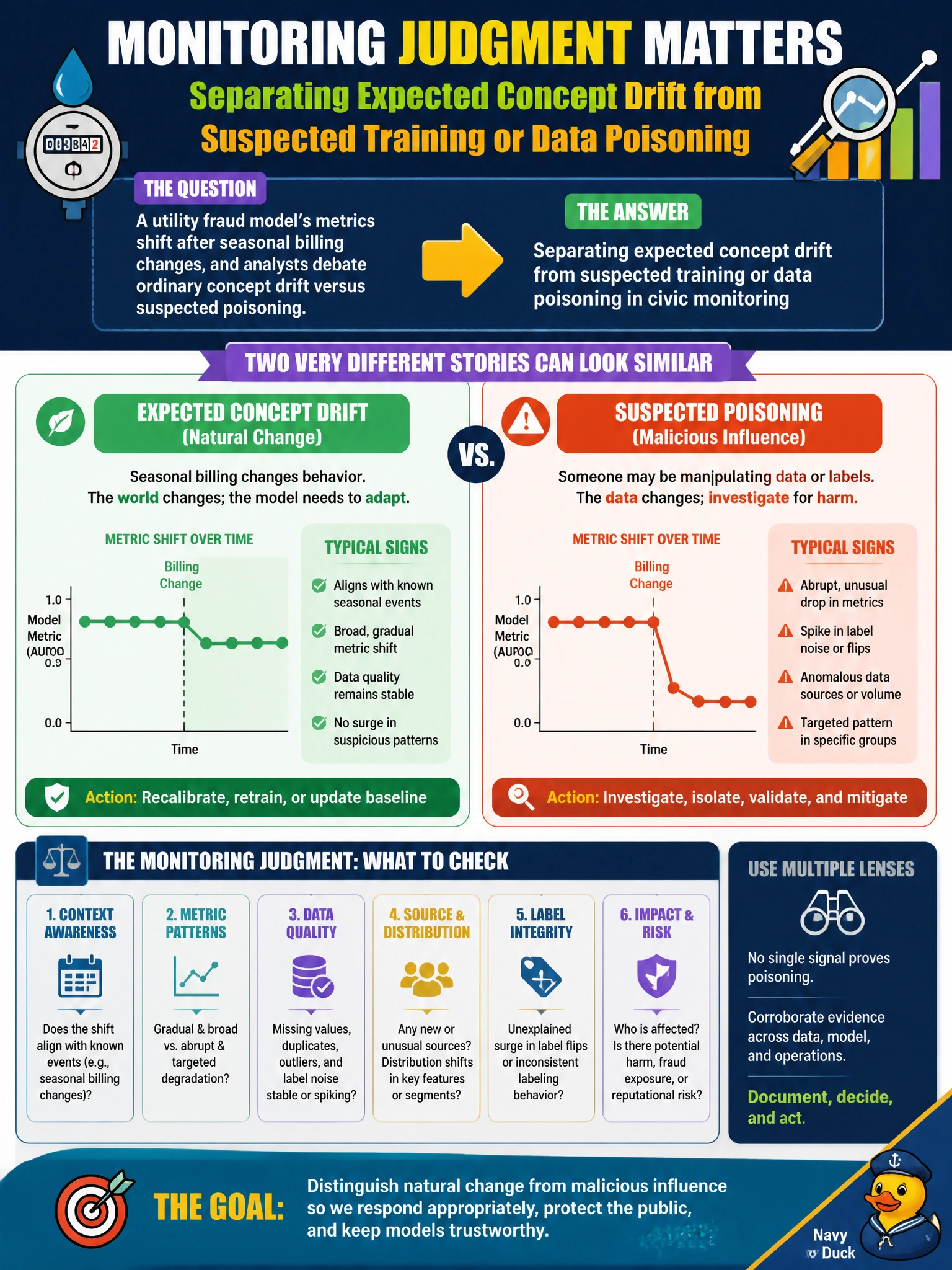
A utility fraud model’s metrics shift after seasonal billing changes, and analysts debate ordinary concept drift versus suspected poisoning. What monitoring judgment is required?
Select an answer to reveal the explanation.
Short Explanation
Seasonal swings can be drift; sudden weird skew can be poison—sort the weather from the tampering.
Full Explanation
When a utility fraud model's metrics shift after seasonal billing changes and analysts debate ordinary concept drift versus suspected poisoning, the required monitoring judgment is separating expected concept drift from suspected training or data poisoning in civic monitoring. Seasonal rate structures, weather-driven usage, and legitimate tariff changes can move distributions without malice. Poisoning or tampering produces anomalies that do not match known business calendars, concentrate on attacker-useful segments, or coincide with integrity failures. Playbooks must define different investigation depth and containment for each so municipal responders neither cry wolf nor miss tampering.
Retraining the fraud model on recent seasonal billing data to absorb shifted usage patterns is exactly the failure the question warns against—it presumes the shift is ordinary drift and can bake a possible poisoning into the model instead of testing the poisoning hypothesis. Leaning on confidence scores and prediction distributions alone is unreliable because a poisoning attack can be tuned to preserve plausible-looking confidence and distribution shapes while still corrupting outcomes. Correlating metric shifts with seasonal billing volumes to update fraud score thresholds gives an attacker a ready disguise, since it adjusts thresholds to expected seasonality without first testing for tampering, and a competent poisoning campaign can be timed to coincide with expected seasonal billing changes. The required judgment is to actively separate the two causes with evidence, not to default to the more comfortable explanation.
Exam caveat: drift and poison can co-occur; seasonal change does not rule out tampering. Use business-context calendars, integrity signals, and segment-level residual analysis together. Avoid automatic retrain on unexplained shifts for fraud models that affect customers.
Operational check: maintain a documented calendar of billing/tariff changes; when metrics move, first reconcile to that calendar and data-pipeline digests; escalate to poison investigation if shifts are unexplained, integrity checks fail, or fraud scores skew toward privileged accounts. Record the decision path in the monitoring ticket. If the SOC lacks criteria to separate drift from poison, the civic monitoring program is incomplete.